Review
. 2018 Jun 8;10(6):189.
doi: 10.3390/cancers10060189.

The Roles of p53 in Mitochondrial Dynamics and Cancer Metabolism: The Pendulum between Survival and Death in Breast Cancer?

Affiliations
Review

The Roles of p53 in Mitochondrial Dynamics and Cancer Metabolism: The Pendulum between Survival and Death in Breast Cancer?

David E Moulder et al. Cancers (Basel). .

Abstract

Cancer research has been heavily geared towards genomic events in the development and progression of cancer. In contrast, metabolic regulation, such as aberrant metabolism in cancer, is poorly understood. Alteration in cellular metabolism was once regarded simply as a consequence of cancer rather than as playing a primary role in cancer promotion and maintenance. Resurgence of cancer metabolism research has identified critical metabolic reprogramming events within biosynthetic and bioenergetic pathways needed to fulfill the requirements of cancer cell growth and maintenance. The tumor suppressor protein p53 is emerging as a key regulator of metabolic processes and metabolic reprogramming in cancer cells—balancing the pendulum between cell death and survival. This review provides an overview of the classical and emerging non-classical tumor suppressor roles of p53 in regulating mitochondrial dynamics: mitochondrial engagement in cell death processes in the prevention of cancer. On the other hand, we discuss p53 as a key metabolic switch in cellular function and survival. The focus is then on the conceivable roles of p53 in breast cancer metabolism. Understanding the metabolic functions of p53 within breast cancer metabolism will, in due course, reveal critical metabolic hotspots that cancers advantageously re-engineer for sustenance. Illustration of these events will pave the way for finding novel therapeutics that target cancer metabolism and serve to overcome the breast cancer burden.

Keywords: breast cancer; metabolism; mitochondria; p14ARF; p53; tumor suppressor protein.


Conflict of interest statement

The authors declare no conflict of interest.

Figures
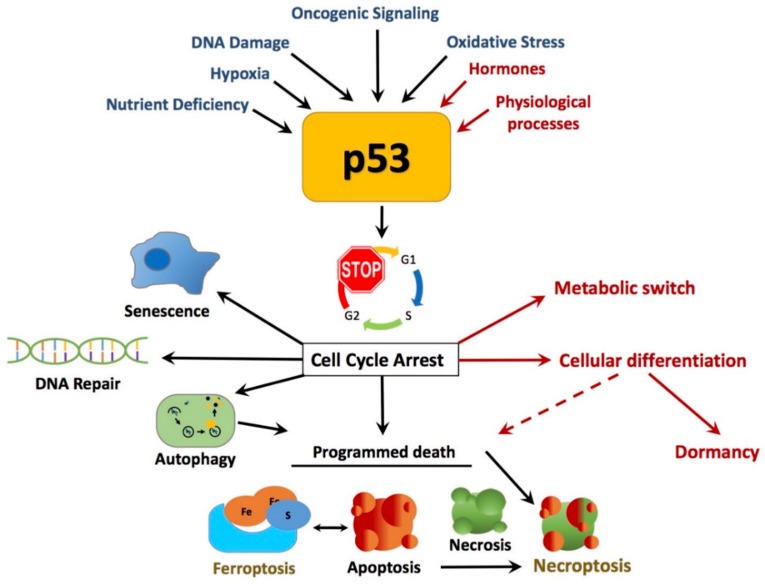
Figure 1
Figure 1
p53 canonical and non-canonical tumor suppressor roles of p53. p53 is activated by a range of cellular stress signals. These activators of p53 include nutrient stress, hypoxic conditions, activation of oncogenes, DNA damage, and oxidative stress from reactive oxygen species (ROS) and, as a result, increase the activity of p53. Classical or canonical responses of p53 include, transcriptionally and translationally, cell cycle arrest and repair damage to DNA, which place the cell in a state of senescence or induce apoptosis. Non-canonical, controlled programmed cell death roles include autophagy pathways, necrosis, necroptosis, and ferroptosis [5,48,50,51,52,53,62,63,64]. Normal physiological processes such as hormone activation can also lead to p53-induced cell cycle arrest and p53 acts as a switch in metabolic process involved in differentiation, redirecting specialized cell function [9].
Figure 2
Figure 2
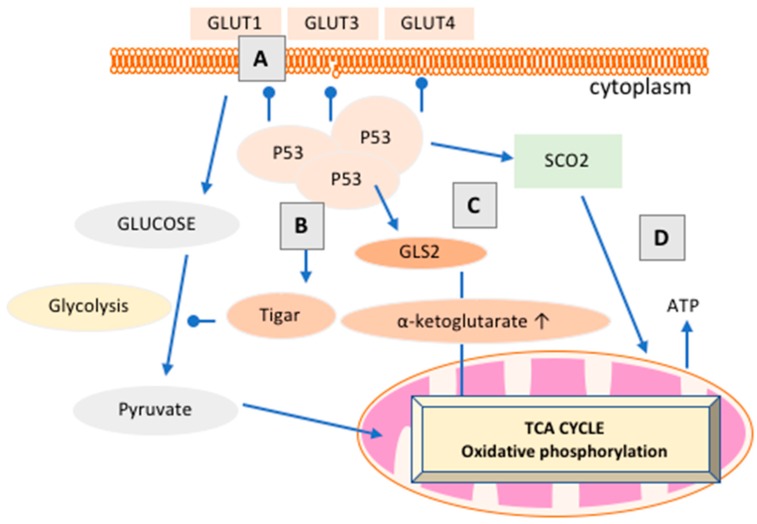
p53 balances glycolysis and mitochondrial respiration. The roles of p53 in cancer metabolism include: (A) suppressing the first step of glycolysis by direct downregulation of glucose-type transporters (GLUT) including GLUT 1, GLUT3, and GLUT4 receptors, which are typically overexpressed in the membranes of cancer cells to facilitate glucose flux [110,133]; (B) negative regulation of glycolysis by increasing expression of TP53-induced glycolysis regulator (TIGAR) [133]; (C) regulation of glutaminase-2, leading to an increase in the metabolite α-ketoglutarate. This, in turn, promotes the TCA cycle and mitochondrial respiration [134]. (D) The upregulation of the cytochrome C oxidase (COX) complex, via p53 targeting the cytochrome c oxidase assembly protein, increases mitochondrial respiration. COX is a vital transmembrane protein that accepts oxygen in mitochondrial respiration [17]. This figure has been adapted from [1].
Figure 3
Figure 3
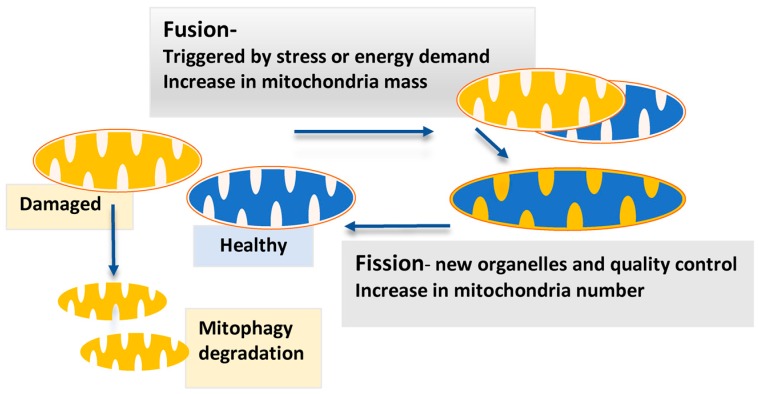
Mitochondrial fission–fusion cycle sustaining mitochondria function, number and genetic health. Under stressful or energy-demanding conditions, mitochondria undergo fusion to complement damaged (yellow) and healthy (blue) mitochondria. This allows for a mixing of constituents alongside increasing membrane surface area, which optimizes bioenergetic functioning. An imbalance between fission and fusion—for instance, greater fission—leads to mitochondrial fragmentation and may increase the number of mitochondria if mitophagy does not eliminate mitochondria. Conversely, more fusion is seen to form large tubular networks. The biogenesis of mitochondria occurs to increase mitochondrial biomass or compensate for mitochondrial degradation. Thus, imbalances between mitochondrial fission, fusion, biogenesis, and degradation appear to regulate the mitochondrial number, shape, size, and biomass [141,144]. Mitochondrial fission has been associated with sensitizing cells to apoptosis during highly stressful conditions and with environments of nutrient excess. However, fission has also been implicated in the “housekeeping” of mitochondria to produce new mitochondria (blue) and remove old/damaged mitochondria.
Figure 4
Figure 4
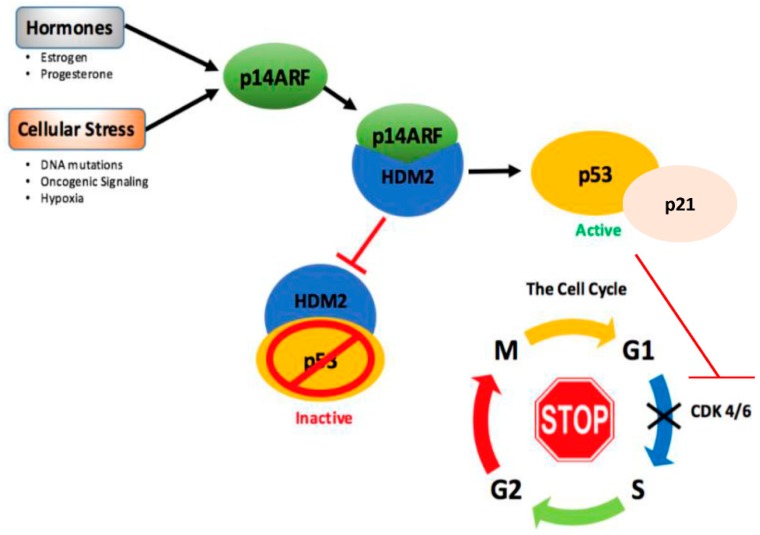
The p14ARF-p53 pathway. HDM2 sustains low basal levels of p53 by its continuous degradation [160,161]. p14ARF, activated by cellular stress signals and potentially regulated by estrogen and progesterone hormones in the breast [93,168,169,170,171], causes inhibition of the HDM2–p53 complex, therefore stabilizing p53. p53 is able to bring about cell cycle arrest at the G1/S phase through the activation of the CDK inhibitor p21, which inhibits downstream CDK 4 and 6 [66,68,69]. Both CDK 4 and 6 are well-known mediators of G1/S cell cycle progression, hence their inhibition by p21 halts the cell cycle [66].

References

    1. Vousden K.H., Ryan K.M. P53 and metabolism. Nat. Rev. Cancer. 2009;9:691–700. doi: 10.1038/nrc2715. - DOI - PubMed
    1. Vousden K.H., Prives C. Blinded by the light: The growing complexity of p53. Cell. 2009;137:413–431. doi: 10.1016/j.cell.2009.04.037. - DOI - PubMed
    1. Levine A.J., Oren M. The first 30 years of p53: Growing ever more complex. Nat. Rev. Cancer. 2009;9:749–758. doi: 10.1038/nrc2723. - DOI - PMC - PubMed
    1. Itahana Y., Itahana K. Emerging roles of p53 family members in glucose metabolism. Int. J. Mol. Sci. 2018;19:776. doi: 10.3390/ijms19030776. - DOI - PMC - PubMed
    1. Gnanapradeepan K., Basu S., Barnoud T., Budina-Kolomets A., Kung C.P., Murphy M.E. The p53 tumor suppressor in the control of metabolism and ferroptosis. Front. Endocrinol. 2018;9:124. doi: 10.3389/fendo.2018.00124. - DOI - PMC - PubMed

LinkOut - more resources