


Heavy Metals' Effect on Susceptibility to Attention-Deficit/Hyperactivity Disorder: Implication of Lead, Cadmium, and Antimony
- PMID: 29890770
- PMCID: PMC6025252
- DOI: 10.3390/ijerph15061221
Heavy Metals' Effect on Susceptibility to Attention-Deficit/Hyperactivity Disorder: Implication of Lead, Cadmium, and Antimony
Abstract
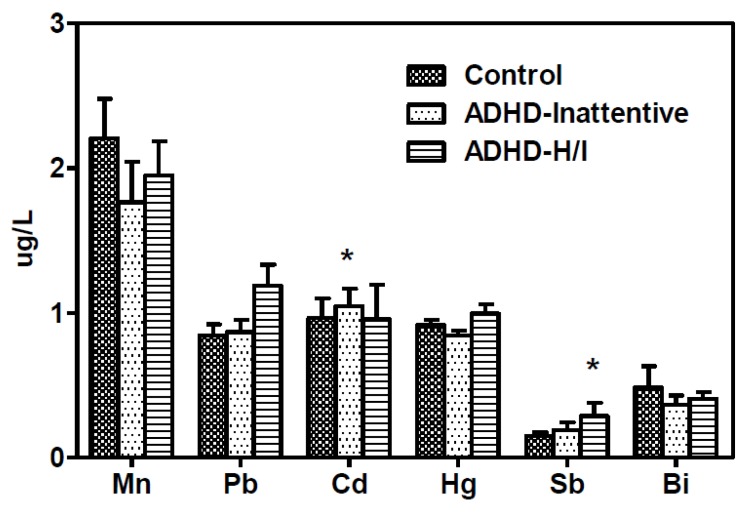
Background: Heavy metals are known to be harmful for neurodevelopment and they may correlate to attention deficit/hyperactivity disorder (ADHD). In this study, we aim to explore the relationships between multiple heavy metals (manganese, lead, cadmium, mercury, antimony, and bismuth), neurocognitive function, and ADHD symptoms. Methods: We recruited 29 patients with ADHD inattentive type (ADHD-I), 47 patients with ADHD hyperactivity/impulsivity type (ADHD-H/I), and 46 healthy control children. Urine samples were obtained to measure the levels of the aforementioned heavy metals in each child. Participants’ cognitive function and clinical symptoms were assessed, respectively. Results: We found ADHD-H/I patients demonstrated the highest antimony levels (p = 0.028), and ADHD-I patients demonstrated the highest cadmium levels (p = 0.034). Antimony levels were positively correlated with the severity of ADHD symptoms that were rated by teachers, and cadmium levels were negatively correlated with the Full Scale Intelligence Quotient. Lead levels were negatively correlated with most indices of the Wechsler Intelligence Scale for Children⁻Fourth Edition (WISC-IV), but positively correlated with inattention and hyperactivity/impulsivity symptoms (p < 0.05). Conclusion: Lead, cadmium and antimony were associated with susceptibility to ADHD and symptom severity in school-age children. Eliminating exposure to heavy metals may help to prevent neurodevelopmental disorders in children.
Keywords: ADHD; antimony; clinical symptoms; intelligence quotient; lead.
Conflict of interest statement
The authors declare no competing financial interests.
Figures
References
-
- CDC Increasing prevalence of parent-reported attention-deficit/hyperactivity disorder among children-United States, 2003 and 2007. Morb. Mortal. Wkly. Rep. 2010;59:1439–1443. - PubMed
-
- Kessler R.C., Adler L., Barkley R., Biederman J., Conners C.K., Demler O., Faraone S.V., Greenhill L.L., Howes M.J., Secnik K., et al. The prevalence and correlates of adult ADHD in the United States: Results from the National Comorbidity Survey Replication. Am. J. Psychiatry. 2006;163:716–723. doi: 10.1176/ajp.2006.163.4.716. - DOI - PMC - PubMed
-
- Huang S., Hu H., Sanchez B.N., Peterson K.E., Ettinger A.S., Lamadrid-Figueroa H., Schnaas L., Mercado-Garcia A., Wright R.O., Basu N., et al. Childhood Blood Lead Levels and Symptoms of Attention Deficit Hyperactivity Disorder (ADHD): A Cross-Sectional Study of Mexican Children. Environ. Health Perspect. 2016;124:868–874. doi: 10.1289/ehp.1510067. - DOI - PMC - PubMed
Publication types
MeSH terms
Substances
LinkOut - more resources
Full Text Sources
Other Literature Sources
Medical
