


Deaf Qualitative Health Research: Leveraging Technology to Conduct Linguistically and Sociopolitically Appropriate Methods of Inquiry
- PMID: 29890891
- PMCID: PMC6449691
- DOI: 10.1177/1049732318779050
Deaf Qualitative Health Research: Leveraging Technology to Conduct Linguistically and Sociopolitically Appropriate Methods of Inquiry
Abstract
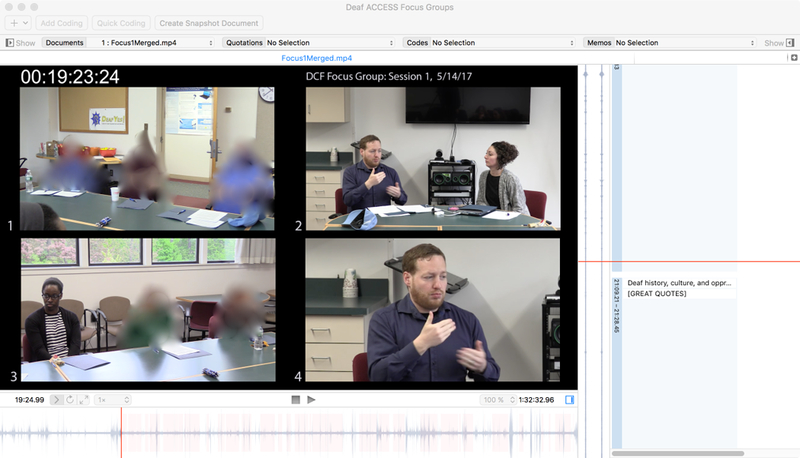
One of the most understudied health disparity populations in the United States is the Deaf community-a sociolinguistic minority group of at least 500,000 individuals who communicate using American Sign Language. Research within this population is lacking, in part, due to researchers' use of methodologies that are inaccessible to Deaf sign language users. Traditional qualitative methods were developed to collect and analyze participants' spoken language. There is, therefore, a paradigm shift that must occur to move from an auditory data schema to one that prioritizes the collection and analysis of visual data. To effectively navigate this shift when working with Deaf sign language users, there are unique linguistic and sociopolitical considerations that should be taken into account. The current article explores these considerations and outlines an emerging method of conducting qualitative analysis that, we argue, has the potential to enhance qualitative researchers' work regardless of the population of focus.
Keywords: USA; cultural competence; deaf; health disparities; participatory action research; qualitative research; social equality.
Conflict of interest statement
Declaration of Conflicting Interests
The Authors declare that there is no conflict of interest.
Figures
References
-
- Arnold RA (2016). Sign writing. In Gertz G & Boudreault P (Eds.), The SAGE deaf studies encyclopedia. Thousand Oaks, CA: SAGE Publications Ltd.
Publication types
MeSH terms
Grants and funding
LinkOut - more resources
Full Text Sources
Other Literature Sources
