


Systems, supplies, and staff: a mixed-methods study of health care workers' experiences and health facility preparedness during a large national cholera outbreak, Kenya 2015
- PMID: 29890963
- PMCID: PMC5996545
- DOI: 10.1186/s12889-018-5584-5
Systems, supplies, and staff: a mixed-methods study of health care workers' experiences and health facility preparedness during a large national cholera outbreak, Kenya 2015
Abstract
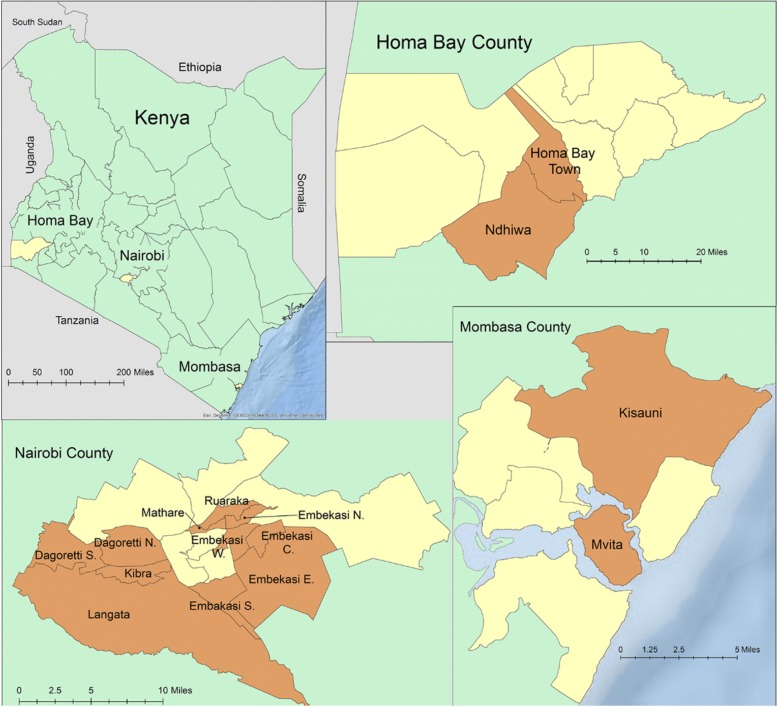
Background: From December 2014 to September 2016, a cholera outbreak in Kenya, the largest since 2010, caused 16,840 reported cases and 256 deaths. The outbreak affected 30 of Kenya's 47 counties and occurred shortly after the decentralization of many healthcare services to the county level. This mixed-methods study, conducted June-July 2015, assessed cholera preparedness in Homa Bay, Nairobi, and Mombasa counties and explored clinic- and community-based health care workers' (HCW) experiences during outbreak response.
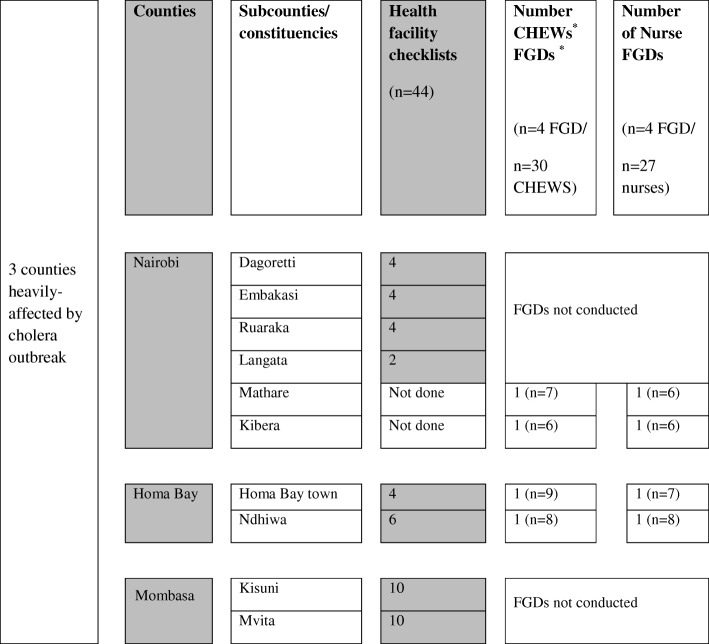
Methods: Counties were selected based on cumulative cholera burden and geographic characteristics. We conducted 44 health facility cholera preparedness checklists (according to national guidelines) and 8 focus group discussions (FGDs). Frequencies from preparedness checklists were generated. To determine key themes from FGDs, inductive and deductive codes were applied; MAX software for qualitative data analysis (MAXQDA) was used to identify patterns.
Results: Some facilities lacked key materials for treating cholera patients, diagnosing cases, and maintaining infection control. Overall, 82% (36/44) of health facilities had oral rehydration salts, 65% (28/43) had IV fluids, 27% (12/44) had rectal swabs, 11% (5/44) had Cary-Blair transport media, and 86% (38/44) had gloves. A considerable number of facilities lacked disease reporting forms (34%, 14/41) and cholera treatment guidelines (37%, 16/43). In FDGs, HCWs described confusion regarding roles and reporting during the outbreak, which highlighted issues in coordination and management structures within the health system. Similar to checklist findings, FGD participants described supply challenges affecting laboratory preparedness and infection prevention and control. Perceived successes included community engagement, health education, strong collaboration between clinic and community HCWs, and HCWs' personal passion to help others.
Conclusions: The confusion over roles, reporting, and management found in this evaluation highlights a need to adapt, implement, and communicate health strategies at the county level, in order to inform and train HCWs during health system transformations. International, national, and county stakeholders could strengthen preparedness and response for cholera and other public health emergencies in Kenya, and thereby strengthen global health security, through further investment in the existing Integrated Disease Surveillance and Response structure and national cholera prevention and control plan, and the adoption of county-specific cholera control plans.
Keywords: Cholera; Decentralization; Devolution; Global health security; Kenya; Mixed-methods; Outbreak response; Preparedness; Surveillance.
Conflict of interest statement
Ethics approval and consent to participate
This evaluation was reviewed in accordance with human subjects protection policy and was determined to be nonresearch, routine public health activities, by the Human Research Protection Office of the National Center for Emerging and Zoonotic Infectious Diseases (NCEZID) of the Centers for Disease Control and Prevention, Atlanta, GA, USA (determination # 061215CO) and the Kenya Ministry of Health, Disease Surveillance and Response Unit and Department of Preventive and Promotive Health. All participants provided oral informed consent, which was documented by a facilitator before commencing focus group discussions (CDC NCEZID determination # 061215CO).
Competing interests
The authors declare that they have no competing interests.
Publisher’s Note
Springer Nature remains neutral with regard to jurisdictional claims in published maps and institutional affiliations.
Figures
References
-
- Control of Communicable Diseases Manual 19th. Washington, DC: American Public Health Association; 2008.
-
- Gaffga NH, Tauxe RV, Mintz ED. Cholera: a new homeland in Africa? Am J Trop Med Hyg. 2007;77(4):705–713. - PubMed
-
- Disease Surveillance and Epidemic Response Unit . In: Outbreak Situation Report as at 13th September, 2016. Kenya Ministry of Health, editor. 2016.
-
- WHO. Weekly Epidemiological Record. 38th ed. Geneva; 2016. p. 433–40.
MeSH terms
LinkOut - more resources
Full Text Sources
Other Literature Sources
Medical
