


Amino Acid Chiral Selection Via Weak Interactions in Stellar Environments: Implications for the Origin of Life
- PMID: 29891867
- PMCID: PMC5995967
- DOI: 10.1038/s41598-018-27110-z
Amino Acid Chiral Selection Via Weak Interactions in Stellar Environments: Implications for the Origin of Life
Abstract
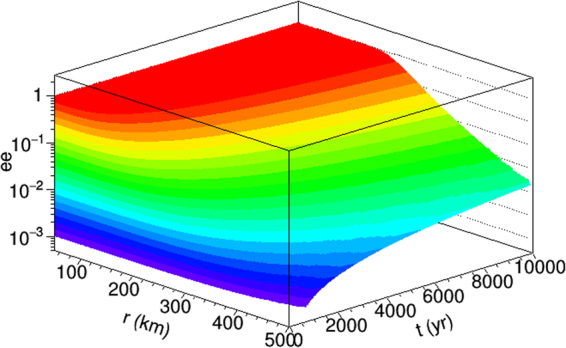
Magnetochiral phenomena may be responsible for the selection of chiral states of biomolecules in meteoric environments. For example, the Supernova Amino Acid Processing (SNAAP) Model was proposed previously as a possible mode of magnetochiral selection of amino acids by way of the weak interaction in strong magnetic fields. In earlier work, this model was shown to produce an enantiomeric excess (ee) as high as 0.014% for alanine. In this paper we present the results of molecular quantum chemistry calculations from which ees are determined for the α-amino acids plus isovaline and norvaline, which were found to have positive ees in meteorites. Calculations are performed for both isolated and aqueous states. In some cases, the aqueous state was found to produce larger ees reaching values as high as a few percent under plausible conditions.
Conflict of interest statement
The authors declare no competing interests.
Figures

References
-
- Boyd RN. Stardust, Supernovae and the Molecules of Life. New York: Springer-Verlag; 2012.
-
- Famiano M, et al. Determining amino acid chirality in the supernova neutrino processing model. Symmetry. 2014;6:909–925. doi: 10.3390/sym6040909. - DOI
-
- Famiano, M. A. & Boyd, R. N. Determining Amino Acid Chirality in the Supernova Neutrino Processing Model, 1–17 (Springer International Publishing, 2016).
Publication types
MeSH terms
Substances
LinkOut - more resources
Full Text Sources
Other Literature Sources
Molecular Biology Databases
