. 2018 Jun 11;8(1):8897.
doi: 10.1038/s41598-018-27072-2.

Scaling photonic lanterns for space-division multiplexing

Affiliations

Scaling photonic lanterns for space-division multiplexing

Amado M Velázquez-Benítez et al. Sci Rep. .

Abstract

We present a new technique allowing the fabrication of large modal count photonic lanterns for space-division multiplexing applications. We demonstrate mode-selective photonic lanterns supporting 10 and 15 spatial channels by using graded-index fibres and microstructured templates. These templates are a versatile approach to position the graded-index fibres in the required geometry for efficient mode sampling and conversion. Thus, providing an effective scalable method for large number of spatial modes in a repeatable manner. Further, we demonstrate the efficiency and functionality of our photonic lanterns for optical communications. Our results show low insertion and mode dependent losses, as well as enhanced mode selectivity when spliced to few mode transmission fibres. These photonic lantern mode multiplexers are an enabling technology for future ultra-high capacity optical transmission systems.


Conflict of interest statement

The authors declare no competing interests.

Figures
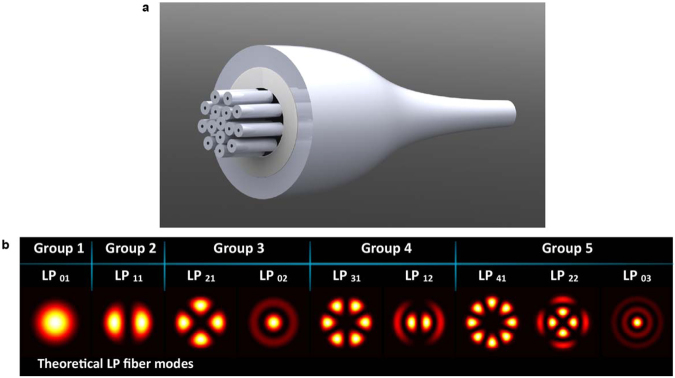
Figure 1
Figure 1
All-fibre photonic lantern. (a) Illustration of a photonic lantern fabricated using 15 fibres, and (b) theoretical LP fibre modes attainable with this device.
Figure 2
Figure 2
SMFs distribution for higher-order all-fibre photonic lanterns. (a) Spot array configurations required for the 10- and 15-fibre PLs construction. (b) Illustration of a microstructured preform for PLs fabrication, and (c) microscope images of the microstructured preforms assembled for PLs fabrication.
Figure 3
Figure 3
Optical fibre core diameters and positions used for the construction of the PLs. Mode-selective PLs consisting of (a) 10 and (c) 15 fibres, and the 15-fibres MGS-PL (e). Microscope image from the end facet of the cleaved MSPLs: (b) 10- and (d) 15-fibres.
Figure 4
Figure 4
Intensity patterns obtained with the 10-fibers mode selective photonic. (a) Near field and (b) far field mode profiles at λ = 1550 nm; notice that the degenerate modes (LP11, LP 21, LP31, LP12) can be independently excited by launching light in the corresponding input fibre. (c) Near field mode profiles from the same devices obtained with a laser diode with λ = 980 nm.
Figure 5
Figure 5
Intensity patterns obtained with the 15-fibres mode selective photonic. (a) Near field and (b) far field mode profiles at λ = 1550 nm. (c) Near field mode profiles from the same devices obtained with a laser diode with λ = 980 nm.
Figure 6
Figure 6
Near field intensity-profiles at λ = 1550 nm from a mode-group-selective photonic lantern fabricated using 15 fibres.
Figure 7
Figure 7
Intensity-distribution mode profiles. (a) Near and (b) far field plots of the mode profiles for the MSPLs and their respective mode purity.
Figure 8
Figure 8
Fibre splice response and mode selectivity analysis of the PLs. (a) Near field intensity-mode profiles from a 6-LP modes FMF spliced to a 10-fibres MSPL, and typical MDL results. Transfer matrix showing the normalized light intensity in mode groups from: (b) ideal 10-fibres MSPL, (c) experimental 10-fibres MSPL, and (d) a 15-fibres PL without modal selectivity. (e) Mode selectivity obtained from the comparison between photonic lanterns with modal selectivity (10-fibres MSPLs) and without any modal selectivity (15-fibres non-MSPLs).

References

    1. Essiambre RJ, Kramer G, Winzer PJ, Foschini GJ, Goebel B. Capacity Limits of Optical Fibre Networks. J. Lightwave Technol. 2010;28(4):662–701. doi: 10.1109/JLT.2009.2039464. - DOI
    1. Richardson DJ, Fini JM, Nelson LE. Space-division multiplexing in optical fibres. Nat. Photonics. 2013;7(5):354–362. doi: 10.1038/nphoton.2013.94. - DOI
    1. Sillard P. Next-Generation Fibres for Space-Division-Multiplexed Transmissions. J. Lightwave Technol. 2015;33(5):1092–1099. doi: 10.1109/JLT.2014.2371134. - DOI
    1. Van Uden RGH, et al. Ultra-high-density spatial division multiplexing with a few-mode multicore fibre. Nat. Photon. 2014;8(11):865–870. doi: 10.1038/nphoton.2014.243. - DOI
    1. Mizuno T, Takara H, Sano A, Miyamoto Y. Dense Space-Division Multiplexed Transmission Systems Using Multi-Core and Multi-Mode Fibre. J. Lightwave Technol. 2016;34(2):582–592. doi: 10.1109/JLT.2015.2482901. - DOI
