. 2018 Jul;50(7):1032-1040.
doi: 10.1038/s41588-018-0130-z. Epub 2018 Jun 11.

An interactome perturbation framework prioritizes damaging missense mutations for developmental disorders

Affiliations

An interactome perturbation framework prioritizes damaging missense mutations for developmental disorders

Siwei Chen et al. Nat Genet. 2018 Jul.

Abstract

Identifying disease-associated missense mutations remains a challenge, especially in large-scale sequencing studies. Here we establish an experimentally and computationally integrated approach to investigate the functional impact of missense mutations in the context of the human interactome network and test our approach by analyzing ~2,000 de novo missense mutations found in autism subjects and their unaffected siblings. Interaction-disrupting de novo missense mutations are more common in autism probands, principally affect hub proteins, and disrupt a significantly higher fraction of hub interactions than in unaffected siblings. Moreover, they tend to disrupt interactions involving genes previously implicated in autism, providing complementary evidence that strengthens previously identified associations and enhances the discovery of new ones. Importantly, by analyzing de novo missense mutation data from six disorders, we demonstrate that our interactome perturbation approach offers a generalizable framework for identifying and prioritizing missense mutations that contribute to the risk of human disease.


Conflict of interest statement

Competing Interests

The authors declare no competing financial interests.

Figures
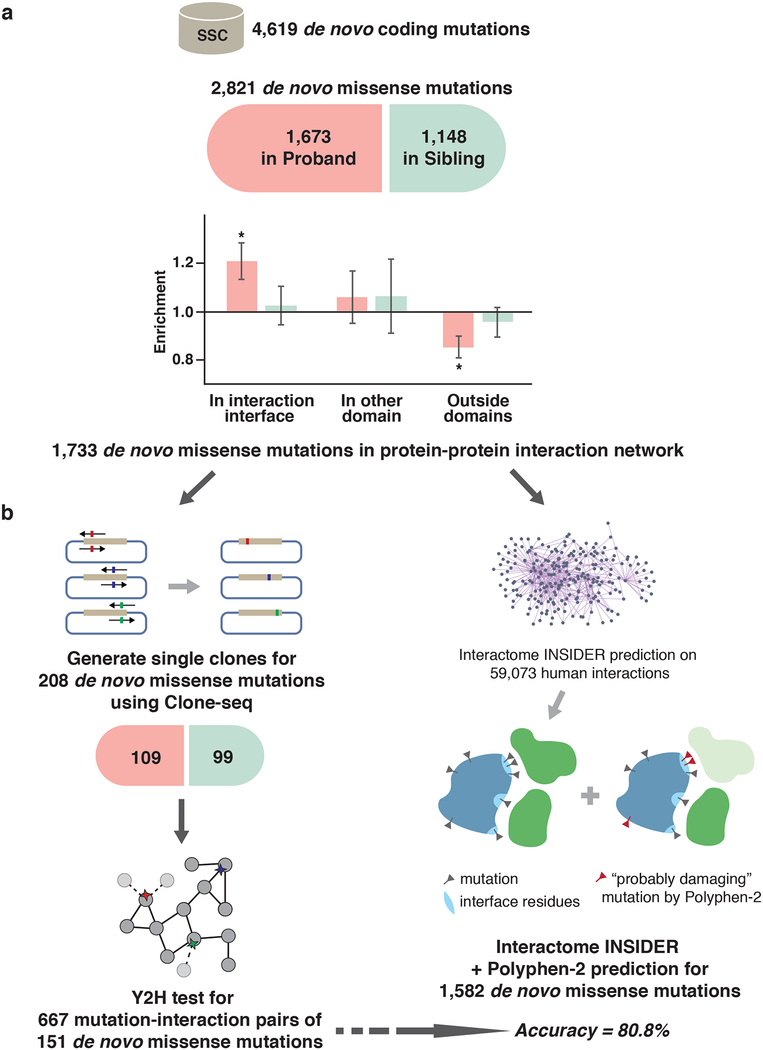
Fig. 1.
Fig. 1.
Workflow of our integrated experimental-computational interactome perturbation framework. (a) Distribution of de novo missense (dnMis) mutations from SSC across different protein locations. Enrichment was calculated by the ratio of the observed fraction of dnMis mutations that occur on interaction interfaces over the fraction of interface residues on corresponding proteins (expected fraction). P-values were calculated using two-tail exact binomial test (*P < 0.05; Online Methods). Error bars indicate ± standard error. (b) Experimental (left) and computational (right) pipelines for assessing the functional impact of dnMis mutations on protein-protein interactions.
Fig. 2.
Fig. 2.
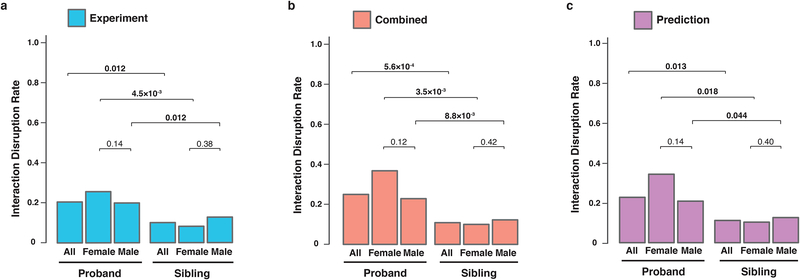
dnMis mutations are more disruptive in ASD probands than in unaffected siblings. Interaction disruption rates of dnMis mutations (a) tested experimentally, (b) by combining experimental results and predictions, and (c) predicted computationally. Probands and unaffected siblings are divided by sex. The count of disruptions per subject was modeled with a negative binomial model (P < 0.05 in bold). Combined: 1,080 out of 4,275 measured interactions were disrupted in ASD probands (25.3%) and 322 out of 2,973 were disrupted in unaffected siblings (10.8%). The interaction disruption rate is significantly higher in ASD probands than that in unaffected siblings (FC = 2.34 [1.44–3.79, 95% CI], P = 5.6×10⁻⁴ by two-tail negative binomial test). The trend persists in male and female subgroups: 23.1% disruption rate in male probands versus 12.3% in male siblings (FC = 2.21 [1.15–4.25, 95% CI], P = 8.8×10⁻³ by one-tail negative binomial test); 37.3% disruption rate in female probands versus 9.9% in female siblings (FC = 3.50 [1.41–8.72, 95% CI], P = 3.5 10−3). Comparing disruption rates between males and females revealed a higher rate, although not quite significant, in females than males in ASD probands (FC = 1.71 [0.71–4.09, 95% CI], P = 0.12 by one-tail negative binomial test), whereas similar rates were observed in female and male siblings (FC = 1.08 [0.52–2.22, 95% CI], P = 0.42).
Fig. 3.
Fig. 3.
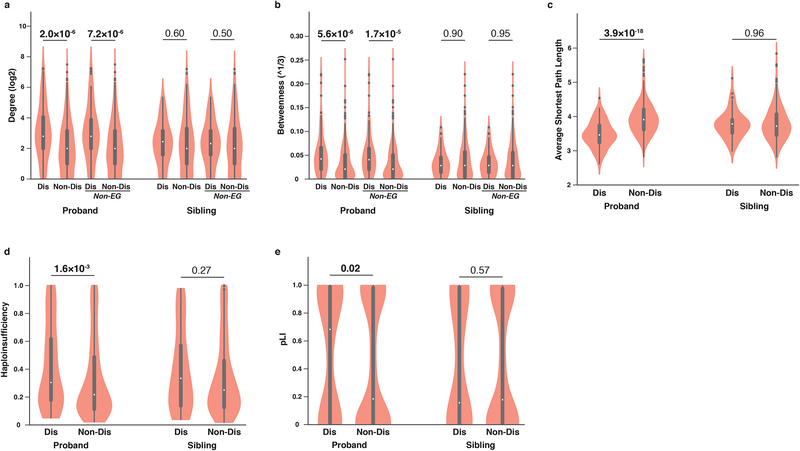
Disruptive proband dnMis mutations exhibit characteristic network and haploinsufficiency properties. (a) Degree and (b) betweenness distributions of proteins with interaction-disrupting (Dis, n = 109 in probands and n = 68 in siblings) or non-disrupting (Non-Dis, n = 342 in probands and n = 241 in siblings) dnMis mutations across all proteins and across non-essential gene-encoded proteins (Non-EG) in ASD probands (Dis: n = 106; Non-Dis: n = 338) and unaffected siblings (Dis: n = 66; Non-Dis: n = 238). (c) Average shortest path length distributions of proteins with dnMis mutations (in probands, Dis: n = 109, Non-Dis: n = 342; in siblings, Dis: n = 68, Non-Dis: n = 241). (d) Haploinsufficiency and (e) pLI distributions of genes with dnMis mutations. Genes with available haploinsufficiency or pLI scores were included in corresponding analyses (haploinsufficiency: in probands, Dis: n = 95, Non-Dis: n = 304; in siblings, Dis: n = 63, Non-Dis: n = 217; pLI: in probands, Dis: n = 106, Non-Dis: n = 338; in siblings, Dis: n = 63, Non-Dis: n = 237). Genes carrying de novo protein truncating variants (dnPTVs) in SSC data were excluded from all analyses. Violin plots: thick black bar, interquartile range; white dot, median; whiskers, upper and lower limits; points, outliers; while the width of each ‘violin’ is proportional to element abundance. P-values were calculated using two-tail U-test (P < 0.05 in bold).
Fig. 4.
Fig. 4.
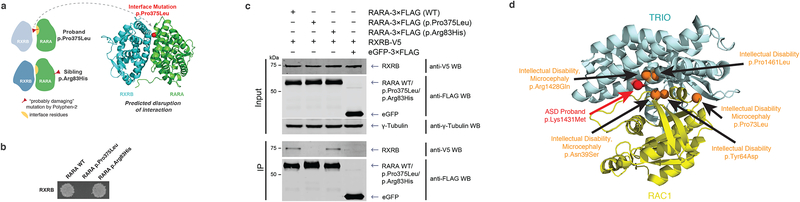
Identification of candidate ASD-associated genes and mutations through our interactome perturbation framework. (a) Computational prediction of the effects of RARA p.Pro375Leu and RARA p.Arg83His on the RARA-RXRB interaction. A homology model highlighting the RARA p.Pro375Leu interface mutation is shown. (b) RARA p.Pro375Leu disruption and RARA p.Arg83His non-disruption of RARA-RXRB interaction by Y2H. (c) Co-immunoprecipitation confirming RARA p.Pro375Leu disruption and RARA p.Arg83His non-disruption of RARA-RXRB interaction in HEK 293T cells. See Supplementary Fig. 10 for uncropped gel images. (d) Co-crystal structure of TRIO-RAC1 (PDB ID: 2NZ8) displaying the structural locations of proband ASD (red) and intellectual disability and/or microcephaly (orange) dnMis mutations across the interaction interfaces.
Fig. 5.
Fig. 5.
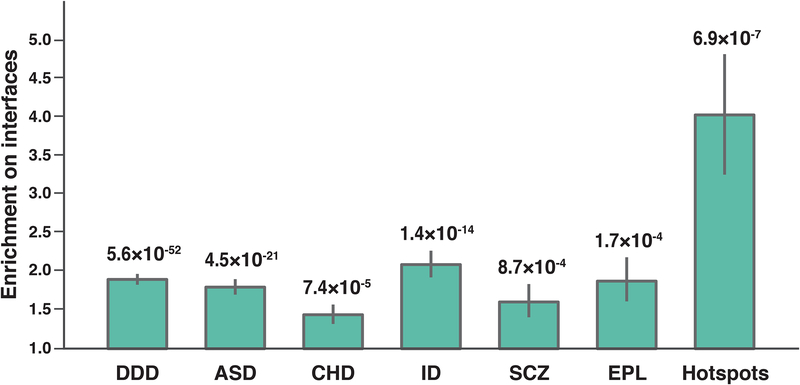
dnMis mutations are enriched on protein interaction interfaces in developmental disorders. Enrichment was calculated by the ratio of the observed fraction of dnMis mutations that occur on interaction interfaces over the fraction of interface residues on corresponding proteins (expected fraction). Error bars indicate ± standard error. P-values were calculated using two-tail exact binomial test. DDD (Deciphering Developmental Disorders project, n = 2,914 dnMis mutations): Enrichment = 1.90 (1.76–2.04, 95% CI); ASD (autism spectrum disorder, n = 1,512): Enrichment = 1.80 (1.61–2.00, 95% CI); CHD (congenital heart disease, n = 759): Enrichment = 1.44 (1.21–1.70, 95% CI); ID (intellectual disability, n = 498): Enrichment = 2.09 (1.77–2.44, 95% CI); SCZ (schizophrenia, n = 312): Enrichment = 1.61 (1.22–2.06, 95% CI); EPL (epilepsy, n = 181): Enrichment = 1.88 (1.36–2.48, 95% CI); Hotspots (n = 31): Enrichment = 4.03 (2.51–5.58, 95% CI).

References

    1. Ropers HH Genetics of early onset cognitive impairment. Annu Rev Genomics Hum Genet 11, 161–87 (2010). - PubMed
    1. Mefford HC, Batshaw ML & Hoffman EP Genomics, intellectual disability, and autism. N Engl J Med 366, 733–43 (2012). - PMC - PubMed
    1. Devlin B & Scherer SW Genetic architecture in autism spectrum disorder. Curr Opin Genet Dev 22, 229–37 (2012). - PubMed
    1. Bruneau BG The developmental genetics of congenital heart disease. Nature 451, 943–8 (2008). - PubMed
    1. Deciphering Developmental Disorders Study. Prevalence and architecture of de novo mutations in developmental disorders. Nature 542, 433–438 (2017). - PMC - PubMed

Publication types