Infectious Adverse Events Following Acupuncture: Clinical Progress and Microbiological Etiology
- PMID: 29892207
- PMCID: PMC5990445
- DOI: 10.3346/jkms.2018.33.e164
Infectious Adverse Events Following Acupuncture: Clinical Progress and Microbiological Etiology
Abstract
Background: We investigated the clinical progress and bacteriological characteristics of infectious adverse events (AEs) following acupuncture and compared patient characteristics between serious and non-serious outcome groups.
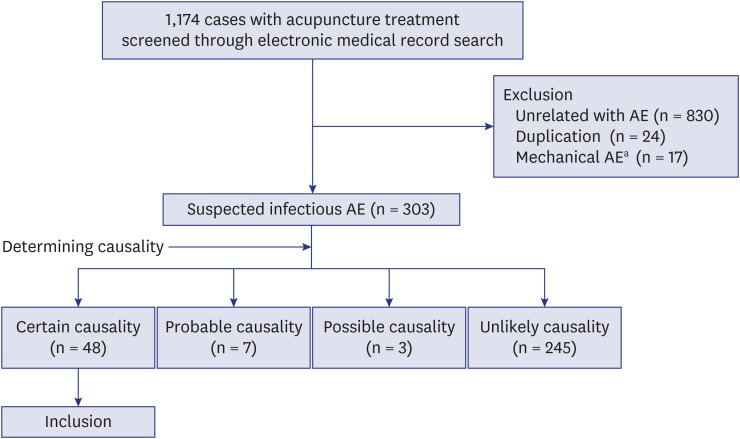
Methods: A retrospective observational study was conducted in 1,174 patients with infectious complications associated with acupuncture at the emergency department (ED) in a tertiary hospital in Korea between 2010 and 2014. Serious outcome was defined as development of septic shock, admission to intensive care unit (ICU) or attaining permanent morbidity.
Results: Forty-eight patients had certain causality and cellulitis, necrotizing fasciitis and osteomyelitis were common in order. Among them, 9 patients (18.8%) were categorized into serious outcome group, and they showed devastating outcomes such as septic shock (n = 2), ICU admission (n = 4), and permanent sequelae (n = 5). The serious group had delayed admission to the ED after acupuncture (30.0 [4.0-55.0] vs. 3.0 [1.0-10.0] days, P = 0.023). Methicillin-sensitive Staphylococcus aureus was the most frequently identified microorganism. The patients in the serious group required longer treatment duration (139.0 [49.0-183.5] vs. 14.0 [7.0-34.0] days, P < 0.001) as well as more operation with local (44.4% vs. 10.3%, P = 0.031) or general anaesthesia (33.3% vs. 2.6%, P = 0.017).
Conclusion: The infectious AEs after acupuncture may cause serious outcomes. Patients and primary physicians should be aware of the risk of infectious complications and make efforts to prevent them.
Keywords: Acupuncture; Complications; Infection.
Conflict of interest statement
Disclosure: The authors have no potential conflicts of interest to disclose.
Figures
References
-
- Park SM, Kim WJ, Mun JH, Kim HS, Ko HC, Kim BS, et al. Adverse events associated with acupuncture: a clinicopathologic review. Int J Dermatol. 2016;55(7):757–763. - PubMed
-
- Woo PC, Lau SK, Wong SS, Yuen KY. Staphylococcus aureus subcutaneous abscess complicating acupuncture: need for implementation of proper infection control guidelines. New Microbiol. 2003;26(2):169–174. - PubMed
-
- Clean Needle Technique Manual: Best Practices for Acupuncture Needle Safety and Related Procedures. 7th ed. Baltimore, MD: Council of Colleges of Acupuncture and Oriental Medicine; 2015.
-
- Ernst G, Strzyz H, Hagmeister H. Incidence of adverse effects during acupuncture therapy-a multicentre survey. Complement Ther Med. 2003;11(2):93–97. - PubMed
-
- Lao L, Hamilton GR, Fu J, Berman BM. Is acupuncture safe? A systematic review of case reports. Altern Ther Health Med. 2003;9(1):72–83. - PubMed
MeSH terms
LinkOut - more resources
Full Text Sources
Other Literature Sources
Medical