


Chimpanzee quiet hoo variants differ according to context
- PMID: 29892396
- PMCID: PMC5990785
- DOI: 10.1098/rsos.172066
Chimpanzee quiet hoo variants differ according to context
Abstract
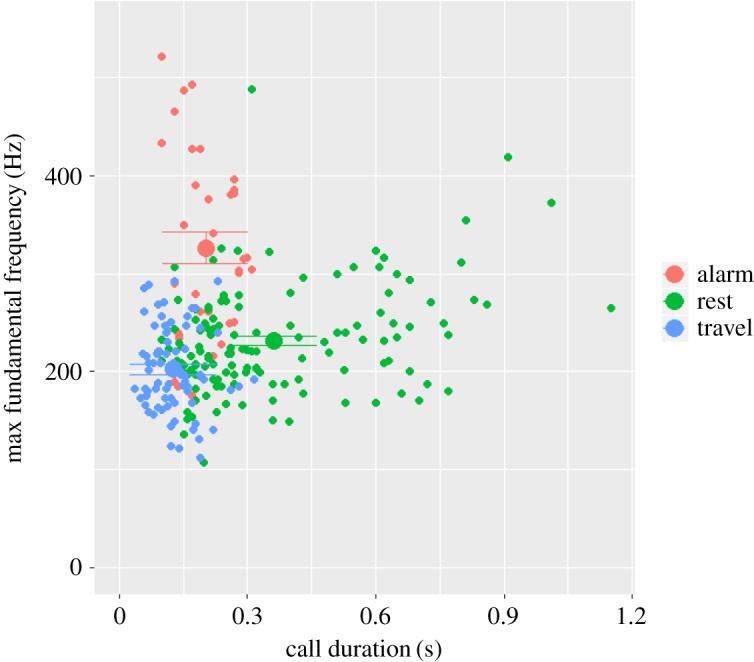
In comparative studies of evolution of communication, the function and use of animal quiet calls have typically been understudied, despite that these signals are presumably under selection like other vocalizations, such as alarm calls. Here, we examine vocalization diversification of chimpanzee quiet 'hoos' produced in three contexts-travel, rest and alert-and potential pressures promoting diversification. Previous playback and observational studies have suggested that the overarching function of chimpanzee hoos is to stay in contact with others, particularly bond partners. We conducted an acoustic analysis of hoos using audio recordings from wild chimpanzees (Pan troglodytes schweinfurthii) of Budongo Forest, Uganda. We identified three acoustically distinguishable, context-specific hoo variants. Each call variant requires specific responses from receivers to avoid breaking up the social unit. We propose that callers may achieve coordination by using acoustically distinguishable calls, advertising their own behavioural intentions. We conclude that natural selection has acted towards acoustically diversifying an inconspicuous, quiet vocalization, the chimpanzee hoo. This evolutionary process may have been favoured by the fact that signallers and recipients share the same goal, to maintain social cohesion, particularly among those who regularly cooperate, suggesting that call diversification has been favoured by the demands of cooperative activities.
Keywords: animal communication; call diversification; chimpanzee; cooperation.
Conflict of interest statement
We have no competing interests.
Figures


References
-
- Wheeler BC, Fischer J. 2012. Functionally referential signals: a promising paradigm whose time has passed. Evol. Anthropol. 21, 195–205. (doi:10.1002/evan.21319) - DOI - PubMed
-
- Scarantino A, Clay Z. 2015. Contextually variable signals can be functionally referential. Anim. Behav. 100, e1–e8. (doi:10.1016/j.anbehav.2014.08.017) - DOI
-
- Sievers C, Gruber T. 2016. Reference in human and non-human primate communication: what does it take to refer? Anim. Cogn. 19, 759–768. (doi:10.1007/s10071-016-0974-5) - DOI - PubMed
-
- Wheeler BC, Fischer J. 2015. The blurred boundaries of functional reference: a response to Scarantino & Clay. Anim. Behav. 100, e9–e13. (doi:10.1016/j.anbehav.2014.11.007) - DOI
-
- Fischer J, Price T. 2016. Meaning, intention, and inference in primate vocal communication. Neurosci. Biobehav. Rev. 82, 22–31. (doi:10.1016/j.neubiorev.2016.10.014) - DOI - PubMed
Associated data
LinkOut - more resources
Full Text Sources
Other Literature Sources
Miscellaneous
