. 2018 Jun 11;30(33):e1706910.
doi: 10.1002/adma.201706910. Online ahead of print.

Wearables in Medicine

Affiliations

Wearables in Medicine

Ali K Yetisen et al. Adv Mater. .

Abstract

Wearables as medical technologies are becoming an integral part of personal analytics, measuring physical status, recording physiological parameters, or informing schedule for medication. These continuously evolving technology platforms do not only promise to help people pursue a healthier life style, but also provide continuous medical data for actively tracking metabolic status, diagnosis, and treatment. Advances in the miniaturization of flexible electronics, electrochemical biosensors, microfluidics, and artificial intelligence algorithms have led to wearable devices that can generate real-time medical data within the Internet of things. These flexible devices can be configured to make conformal contact with epidermal, ocular, intracochlear, and dental interfaces to collect biochemical or electrophysiological signals. This article discusses consumer trends in wearable electronics, commercial and emerging devices, and fabrication methods. It also reviews real-time monitoring of vital signs using biosensors, stimuli-responsive materials for drug delivery, and closed-loop theranostic systems. It covers future challenges in augmented, virtual, and mixed reality, communication modes, energy management, displays, conformity, and data safety. The development of patient-oriented wearable technologies and their incorporation in randomized clinical trials will facilitate the design of safe and effective approaches.

Keywords: biosensors; diagnostics; drug delivery; personalized medicine; telemedicine.


Conflict of interest statement

The authors declare no conflict of interest.

Figures
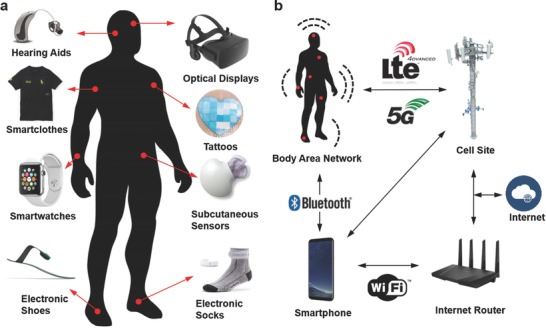
Figure 1
Figure 1
Wearables devices for medical applications. a) Wearable devices (in vitro) have loose or conformal contact with the skin, or worn/inserted through body orifices. The most common interface is loose skin contact wearables, which measure electrophysiological signal via optics and electrodes. b) Information transfer from wearables. The data collected from wearable devices can be transmitted to the Internet or other devices via a body area network, Bluetooth, Wi‐Fi, LTE, 3G, 4G, or 5G connection. The medical data can be sent to a healthcare provider to receive therapeutic feedback or acted upon automatically by other devices in the network.
Figure 2
Figure 2
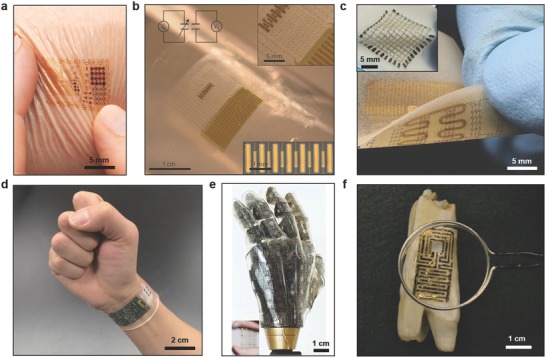
Applications of wearable devices. a) Electronic tattoos conformally attached to the skin via van der Waals forces. Reproduced with permission.15 Copyright 2011, American Association for the Advancement of Science. b) A compliant modulus sensor comprising nanoribbons of lead zirconate titanate in arrays of mechanical actuators and sensors. The upper and lower insets show the interconnected array and actuator/sensing regions. Reproduced with permission.16 Copyright 2015, Nature Publishing Group. c) A wearable device that can monitor muscle activity, store data, and wirelessly communicate data closed‐loop therapy. The inset shows a wearable RAM array (10 × 10) on the patch. Reproduced with permission.19 Copyright 2014, Nature Publishing Group. d) A wearable wristband consisting of electrochemical sensors for the quantification of concentrations of glucose, lactate, electrolytes (Na+, K+ ions), and temperature for application in real‐time perspiration analysis. Reproduced with permission.28 Copyright 2016, Nature Publishing Group. e) Prosthetic skin featuring pressure, strain, humidity and temperature sensors, as well as electroresistive heaters for creating a skin‐like perception. The inset shows the prosthetic skin under ≈20% strain. Reproduced with permission.32 Copyright 2014, Nature Publishing Group. f) A antimicrobial peptide‐functionalized graphene sensor on a tooth for wireless detection of bacteria. Reproduced with permission.47 Copyright 2012, Nature Publishing Group.
Figure 3
Figure 3
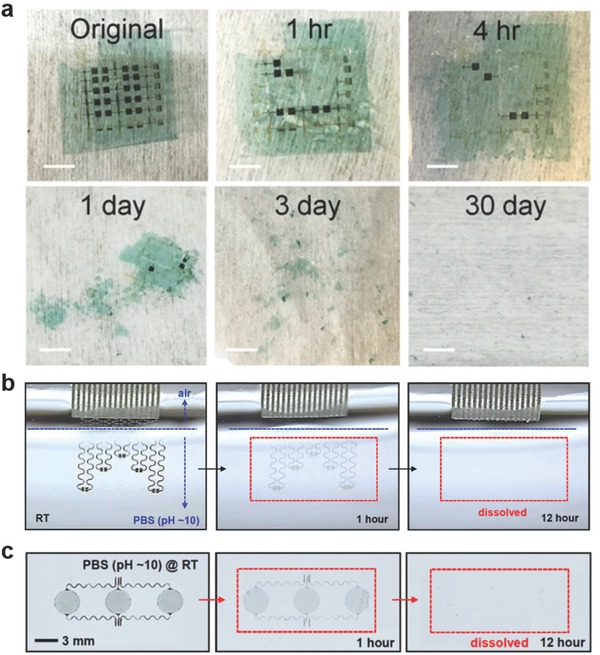
Transient electronics. a) Disintegrable electronics comprising iron as electrodes at various stages of disintegration in a pH 4.6 buffer solution (scale bars = 5 mm). Reproduced with permission.90 Copyright 2017, United States National Academy of Sciences. b) A biodegradable pH sensor based on doped silicon nanoribbons (Si NRs) at different stages of dissolution while submerged in PBS (pH 10) at 24 °C. Reproduced with permission.91 Copyright 2015, United States National Academy of Sciences. c) Capacitive biodegradable electrophysiological sensors and their dissolution in PBS (pH 10) at 24 °C. Reproduced with permission.91 Copyright 2015, United States National Academy of Sciences.
Figure 4
Figure 4
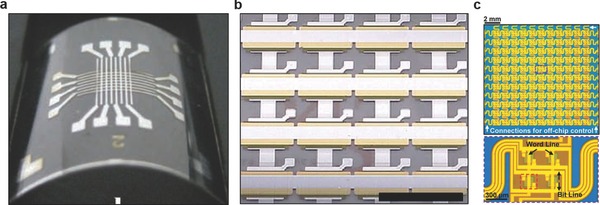
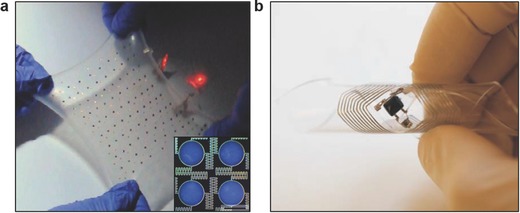
Advances in flexible data storage and memory units. a) Photograph of a flexible 8 × 8 array‐type Ti/Au/Al/PI:PCBM/Al organic memory device. Reproduced with permission.97 Copyright 2010, Wiley‐VCH Verlag GmbH & Co. KGaA, Weinheim. b) A flexible 1D‐1R organic resistive memory cell array on a flexible PEN substrate. Scale bar = 5 mm. Reproduced with permission.98 Copyright 2013, Nature Publishing Group. c) Photograph of a 22 × 22 multiplexed charge trap floating gate memory array (top) and a magnified image (bottom) illustrating four memory pixels interconnected with word and bit lines. Reproduced with permission.99 Copyright 2016, American Association for the Advancement of Science.
Figure 5
Figure 5
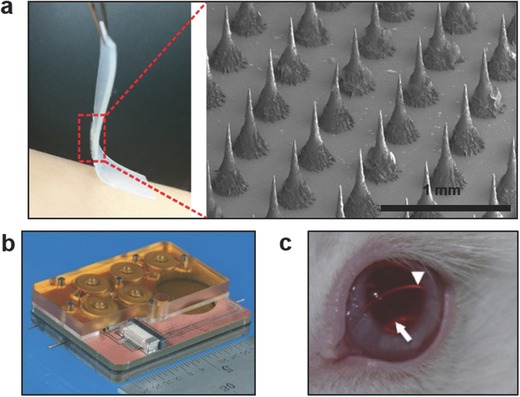
Applications of wearable devices in drug delivery. a) Stretch‐actuated drug delivery from elastomer films comprising microgel depots containing therapeutic nanoparticles for diabetes, anticancer, and antibacterial treatments. The device comprises a microneedle array (SEM image) for stretch‐mediated control of insulin delivery. Reproduced with permission.138 Copyright 2015, The American Chemical Society. b) A microfluidic reciprocating pump and electromagnetic actuators for intracochlear drug delivery. Reproduced with permission.148 Copyright 2016, The Royal Society of Chemistry. c) Latanoprost‐eluting contact lenses on the surface of a rabbit's eye for glaucoma treatment. The arrowhead illustrates the lens edge and the arrow show inner diameter of drug‐polymer film. Reproduced with permission.149 Copyright 2014, Elsevier.
Figure 6
Figure 6
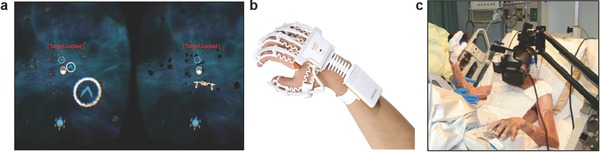
Applications of virtual reality in medicine. a) Dichoptic training game seen through a head‐mounted optical display in virtual reality. The amblyopic eye views the left side of the image to fly the spaceship through the blue gates. Spaceship is only seen with the dominant eye (right side). Reproduced with permission.161 Copyright 2017, Springer. b) The RAPAEL Smart Glove system tracks the posture and the motion of a user's distal limb. Reproduced with permission.138, 162 Copyright 2016, BioMed Central Ltd. c) The use of head‐mounted optical displays with virtual reality in a pediatric burn patient during motion exercises. Reproduced with permission.163 Copyright 2014, Mary Ann Liebert, Inc.
Figure 7
Figure 7
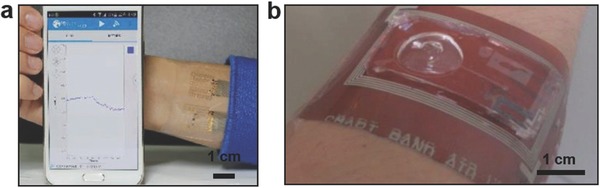
Closed‐loop wearables. a) A wearable device for glucose monitoring and drug‐delivery that can wirelessly communicates with smartphones via Bluetooth. Reproduced with permission.167 Copyright 2016, Nature Publishing Group. b) A microfluidic bandage on the arm. The wearable device consists of a capacitive touch detector, a temperature sensor, and a drug delivery pump. Reproduced with permission.168 Copyright 2014, Wiley‐VCH Verlag GmbH & Co. KGaA, Weinheim.
Figure 8
Figure 8
Flexible batteries and wires energy transfer for wearable devices. a) Photograph of a biaxially stretched (300%) battery with serpentine interconnects. The inset shows the electrode pads and interconnects of the battery. Scale bar = 2.0 mm. Reproduced with permission.187 Copyright 2013, Nature Publishing Group. b) A flexible liquid alloy coil for wireless power transfer. Reproduced with permission.194 Copyright 2015, Nature Publishing Group.
Figure 9
Figure 9
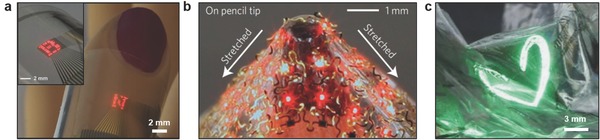
Flexible displays for wearable devices. a) Photograph of flexible display having a 16 × 16 array of ILEDs on a sheet of plastic (PET) wrapped around a thumb. The inset shows the display around a cylindrical glass tube (radius ≈12 mm). Reproduced with permission.194, 197 Copyright 2009, American Association for the Advancement of Science. b) An image of an array of ILEDs array (6 × 6), stretched on the sharp tip of a pencil. Reproduced with permission.198 Copyright 2010, Nature Publishing Group. c) A photograph of green QLEDs laminated on wrinkled Al foil. Reproduced with permission.199 Copyright 2015, Nature Publishing Group.
Figure 10
Figure 10
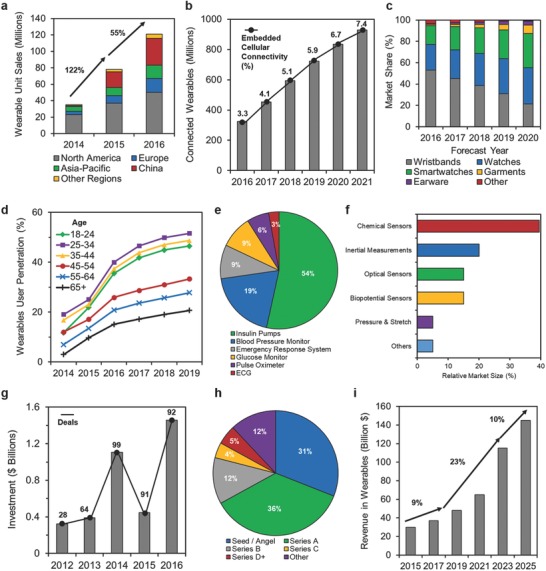
The wearables market. a) Unit sales worldwide by region. b) Number of connected wearable devices worldwide. c) Wearables forecast by product type worldwide. d) User penetration by age group. e) Regulated wearable devices by product category in the United States in 2016. f) Sensor type market projection of wearables market by 2020. g) Annual investment and the number of deals. h) Investment deal breakdown by stage (2013–2014). i) Revenues in wearables worldwide.

References

    1. a) Swan M., Int. J. Environ. Res. Public Health 2009, 6, 492; - PMC - PubMed
    2. b) Swan M., Big Data 2013, 1, 85. - PubMed
    1. Steinhubl S. R., Muse E. D., Topol E. J., Sci. Transl. Med. 2015, 7, 283rv3. - PMC - PubMed
    1. Khan Y., Ostfeld A. E., Lochner C. M., Pierre A., Arias A. C., Adv. Mater. 2016, 28, 4373. - PubMed
    1. Zeng W., Shu L., Li Q., Chen S., Wang F., Tao X. M., Adv. Mater. 2014, 26, 5310. - PubMed
    1. Yetisen A. K., Qu H., Manbachi A., Butt H., Dokmeci M. R., Hinestroza J. P., Skorobogatiy M., Khademhosseini A., Yun S. H., ACS Nano 2016, 10, 3042. - PubMed