


Prospective assessment of combined handgrip strength and Mini-Cog identifies hospitalized heart failure patients at increased post-hospitalization risk
- PMID: 29893487
- PMCID: PMC6165927
- DOI: 10.1002/ehf2.12300
Prospective assessment of combined handgrip strength and Mini-Cog identifies hospitalized heart failure patients at increased post-hospitalization risk
Abstract
Aims: The utility of combined assessment of both frailty and cognitive impairment in hospitalized heart failure (HF) patients for incremental post-discharge risk stratification, using handgrip strength and Mini-Cog as feasible representative parameters, was investigated.
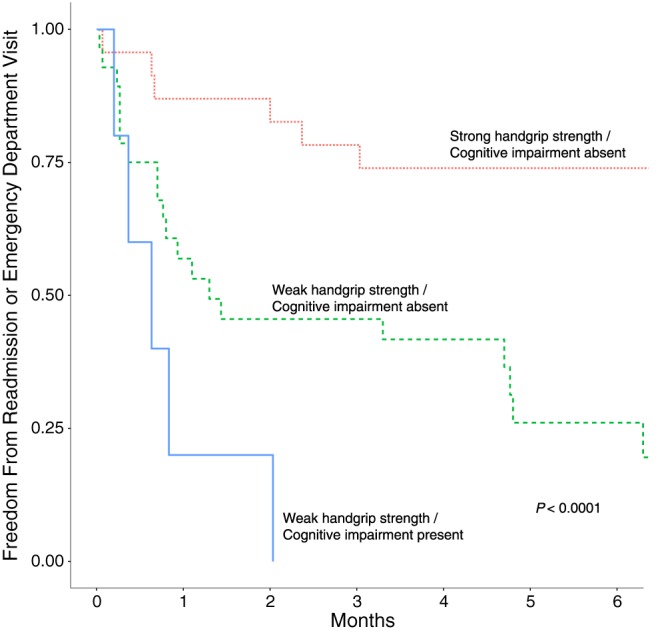
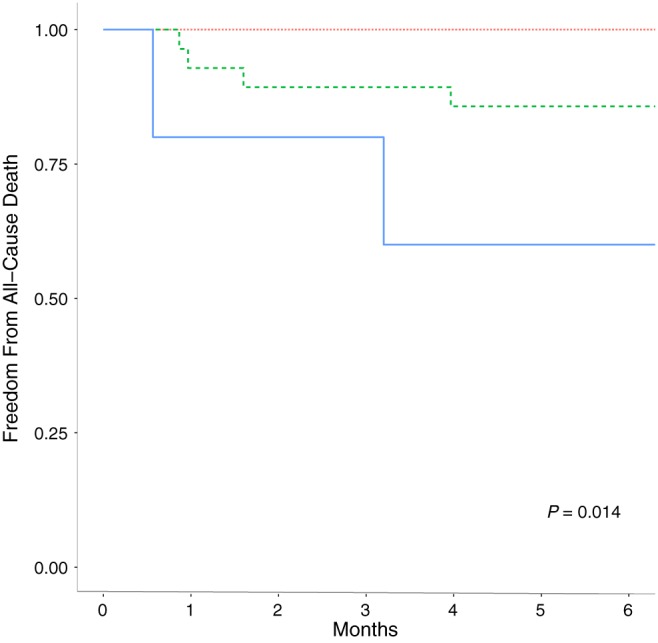
Methods and results: A prospective, single-centre cohort study of older adults (age ≥65) hospitalized for HF being discharged to home was performed. Pre-discharge, grip strength was assessed using a dynamometer (Jamar hydrolic hand dynamometer, Lafayette Instruments, Lafayette, IN, USA) and was defined as weak if the maximal value was below the gender-derived and body mass index-derived cut-offs according to Fried criteria. Cognition was assessed using the Mini-Cog. The presence of impairment was defined as a score of <2. Outcome measures were all-cause readmission or emergency department visit (primary) or all-cause mortality (secondary) at 6 months. A total of 56 patients (mean age 77 ± 7 years, 73% male) were enrolled. The majority (n = 33, 59%) had weak grip strength, either with (n = 5) or without (n = 28) cognitive impairment. The highest risk for both readmission and mortality occurred in those with weak grip strength and cognitive impairment in combination (log-rank P < 0.0001 and P = 0.01, respectively).
Conclusions: Patients who are frail by grip strength assessment and cognitively impaired according to severely reduced Mini-Cog performance show the worst midterm post-discharge outcomes after HF hospitalization.
Keywords: Cognitive impairment; Frailty; Grip strength; Hospitalized heart failure; Readmission.
© 2018 The Authors. ESC Heart Failure published by John Wiley & Sons Ltd on behalf of the European Society of Cardiology.
Figures
References
-
- Fried LP, Tangen CM, Walston J, Newman AB, Hirsch C, Gottdiener J, Seeman T, Tracy R, Kop WJ, Burke G, McBurnie MA, Cardiovascular Health Study Collaborative Research Group . Frailty in older adults: evidence for a phenotype. J Gerontol A Biol Sci Med Sci 2001; 56: M146–M156. - PubMed
-
- Chung CJ, Wu C, Jones M, Kato TS, Dam TT, Givens RC, Templeton DL, Maurer MS, Naka Y, Takayama H, Mancini DM, Schulze PC. Reduced handgrip strength as a marker of frailty predicts clinical outcomes in patients with heart failure undergoing ventricular assist device placement. J Card Fail 2014; 20: 310–315. - PMC - PubMed
-
- Joyce E. Frailty in advanced heart failure. Heart Fail Clin 2016; 12: 363–374. - PubMed
Publication types
MeSH terms
LinkOut - more resources
Full Text Sources
Other Literature Sources
Medical
Research Materials
Miscellaneous
