


Removal of hyperpolarized 129 Xe gas-phase contamination in spectroscopic imaging of the lungs
- PMID: 29893992
- PMCID: PMC6291357
- DOI: 10.1002/mrm.27349
Removal of hyperpolarized 129 Xe gas-phase contamination in spectroscopic imaging of the lungs
Abstract
Purpose: A novel technique is presented for retrospective estimation and removal of gas-phase hyperpolarized Xenon-129 (HP 129 Xe) from images of HP 129 Xe dissolved in the barrier (comprised of parenchymal lung tissue and blood plasma) and red blood cell (RBC) phases. The primary aim is mitigating RF pulse performance limitations on measures of gas exchange (e.g., barrier-gas and RBC-gas ratios). Correction for gas contamination would simplify technical dissemination of HP 129 Xe applications across sites with varying hardware performance, scanner vendors, and models.
Methods: Digital lung phantom and human subject experiments (N = 8 healthy; N = 1 with idiopathic pulmonary fibrosis) were acquired with 3D radial trajectory and 1-point Dixon spectroscopic imaging to assess the correction method for mitigating barrier and RBC imaging artifacts. Dependence of performance on TE, image SNR, and gas contamination level were characterized. Inter- and intra-subject variation in the dissolved-phase ratios were quantified and compared to human subject experiments before and after correction.
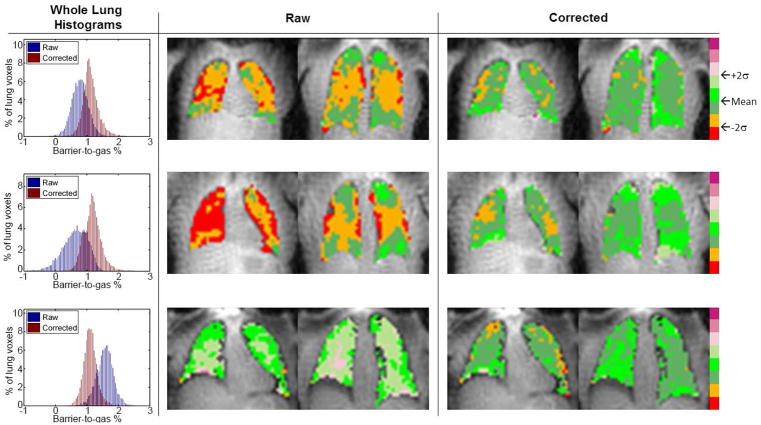
Results: Gas contamination resulted in image artifacts similar to those in disease that were mitigated after correction in both simulated and human subject data; for simulation experiments performance varied with TE, but was independent of image SNR and the amount of gas contamination. Artifacts and variation of barrier and RBC components were reduced after correction in both simulation and healthy human lungs (barrier, P = 0.01; RBC, P = 0.045).
Conclusion: The proposed technique significantly reduced regional variations in barrier and RBC ratios, separated using a 1-point Dixon approach, with improved accuracy of dissolved-phase HP 129 Xe images confirmed in simulation experiments.
Keywords: artifact correction; hyperpolarized MRI; idiopathic pulmonary fibrosis; lung; spectroscopic imaging; xenon MRI.
© 2018 International Society for Magnetic Resonance in Medicine.
Figures




References
-
- Driehuys B, Martinez-Jimenez S, Cleveland ZI, Metz GM, Beaver DM, Nouls JC, Kaushik SS, Firszt R, Willis C, Kelly KT, Wolber J, Kraft M, McAdams HP. Chronic Obstructive Pulmonary Disease: Safety and Tolerability of Hyperpolarized Xe-129 MR Imaging in Healthy Volunteers and Patients. Radiology. 2012;262(1):279–289. - PMC - PubMed
-
- Chen RY, Fan FC, Kim S, Jan KM, Usami S, Chien S. Tissue-blood partition coefficient for xenon: temperature and hematocrit dependence. J Appl Physiol. 1980;49(2):178–183. - PubMed
-
- Mugler JP, III, Altes TA, Ruset IC, Dregely IM, Mata JF, Miller GW, Ketel S, Ketel J, Hersman FW, Ruppert K. Simultaneous magnetic resonance imaging of ventilation distribution and gas uptake in the human lung using hyperpolarized xenon-129. Proc Natl Acad Sci USA. 2010;107:21707–21712. - PMC - PubMed
-
- Mugler JP, Altes TA, Ruset IC, Miller GW, Mata JF, Qing K, Tsentalovich I, Hersman FW, Ruppert K. Image-based measurement of T2* for dissolved-phase Xe129 in the human lung. Proceedings of the International Society for Magnetic Resonance in Medicine; Melbourne, Australia. 2012.
Publication types
MeSH terms
Substances
Grants and funding
LinkOut - more resources
Full Text Sources
Other Literature Sources
Research Materials
Miscellaneous
