Review
. 2018 Jun 12;221(Pt 11):jeb159533.
doi: 10.1242/jeb.159533.

The origins and evolution of sleep

Affiliations
Review

The origins and evolution of sleep

Alex C Keene et al. J Exp Biol. .

Abstract

Sleep is nearly ubiquitous throughout the animal kingdom, yet little is known about how ecological factors or perturbations to the environment shape the duration and timing of sleep. In diverse animal taxa, poor sleep negatively impacts development, cognitive abilities and longevity. In addition to mammals, sleep has been characterized in genetic model organisms, ranging from the nematode worm to zebrafish, and, more recently, in emergent models with simplified nervous systems such as Aplysia and jellyfish. In addition, evolutionary models ranging from fruit flies to cavefish have leveraged natural genetic variation to investigate the relationship between ecology and sleep. Here, we describe the contributions of classical and emergent genetic model systems to investigate mechanisms underlying sleep regulation. These studies highlight fundamental interactions between sleep and sensory processing, as well as a remarkable plasticity of sleep in response to environmental changes. Understanding how sleep varies throughout the animal kingdom will provide critical insight into fundamental functions and conserved genetic mechanisms underlying sleep regulation. Furthermore, identification of naturally occurring genetic variation regulating sleep may provide novel drug targets and approaches to treat sleep-related diseases.

Keywords: Cavefish; Drosophila; Ecology; Genetic screen; Natural variation; zebrafish.


Conflict of interest statement

Competing interestsThe authors declare no competing or financial interests.

Figures
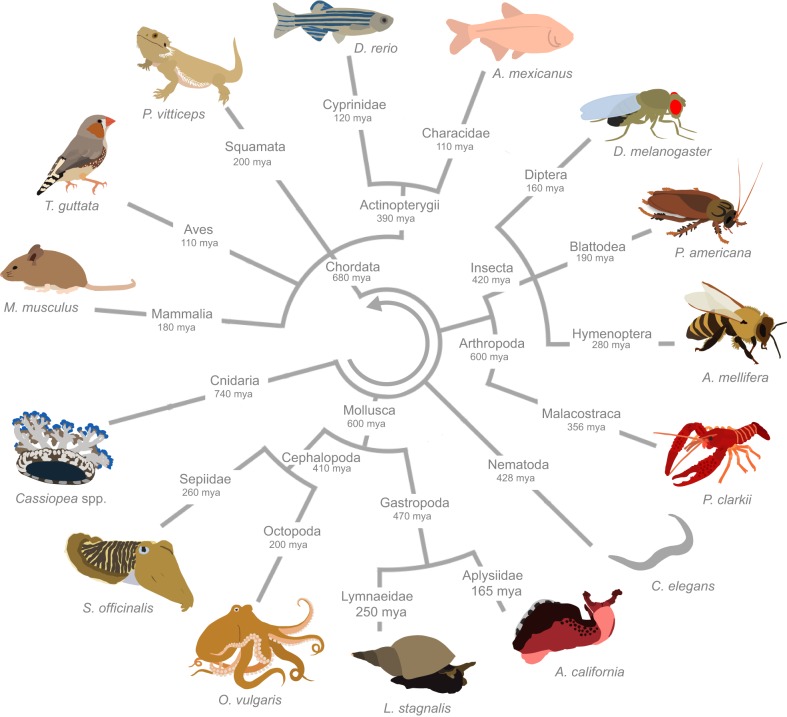
Fig. 1.
Fig. 1.
Small animal models of sleep research. This unrooted, pruned cladogram is inclusive of animals that have been established as models for studying sleep, demonstrating the diversity of sleep behaviors throughout the animal kingdom. Branches demonstrate broad relationships among animals, but do not represent actual distance measures. Taxonomic information was obtained from the NCBI Taxonomy Database and the tree generated with NCBI Common Tree (Sayers et al., 2012). The circular cladogram was generated using the Interactive Tree of Life (Letunic and Bork, 2016) and estimates of divergence were derived from the TimeTree Database (Hedges et al., 2015). mya, million years ago.
Fig. 2.
Fig. 2.
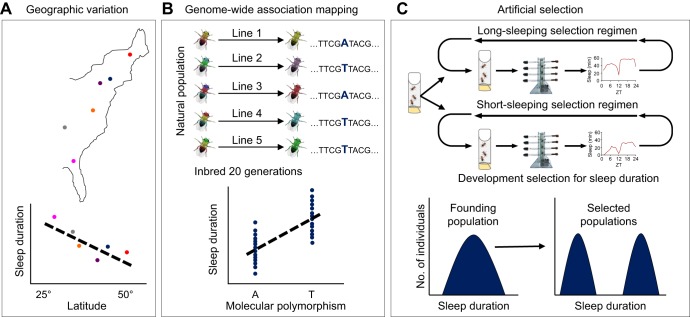
Approaches for studying the contributions of natural variation on sleep regulation in fruit flies. (A) Drosophila melanogaster from different geographical regions have been tested for sleep. Increased sleep duration is associated with proximity to the equator (Svetec et al., 2015). (B) Genome-wide association mapping studies have been performed using the Drosophila Genetics Research Panel. Individual inbred fly lines originating from wild-caught populations are tested for sleep and phenotypes are associated with genetic variation (Harbison et al., 2013). A and T represent single nucleotide genomic differences between individual lines. (C) Artificial selection of outbred lines for long- or short-sleep phenotypes, resulting in dramatic shifts in sleep duration. Flies were grown in vials and then selected as long or short sleepers using Drosophila Activity Monitors (DAMs) (Seugnet et al., 2009 and Masek et al., 2014).
Fig. 3.
Fig. 3.
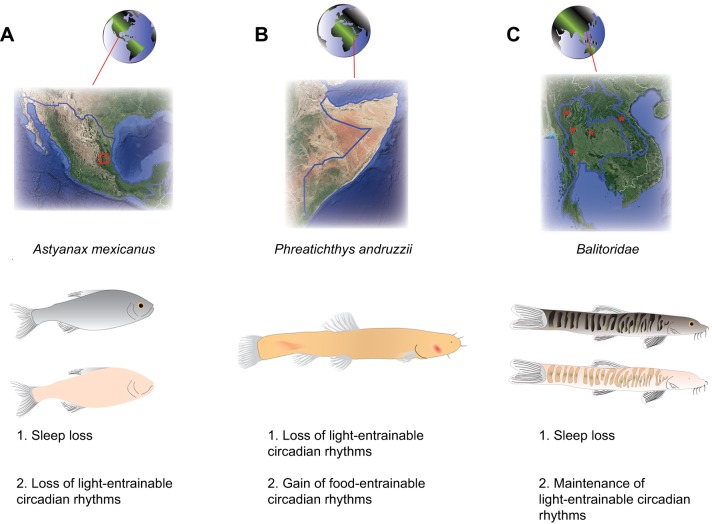
Sleep and circadian phenotypes in different cavefish species. (A) Cartoon diagram of A. mexicanus, with eyed surface populations (fish on top) found throughout Mexico and Southern Texas, and eyeless cave populations (fish on bottom) in various caves throughout North East Mexico (red box on map). Both a loss of sleep and loss of circadian rhythms have been described for these fish. (B) The Somalian cavefish, Phreatichthys andruzzii, are blind albino fish that inhabit caves in Somalia (map). A loss of light-entrainable rhythms and a gain of food-entrainable rhythms have been described for these fish. (C) Hillstream loaches, Balitoridae, are found throughout Southeast Asia (map). There are eyed, surface-dwelling species (top cartoon) and various populations of fish that have evolved in caves of Thailand and Laos (red asterisks on map). Cave Balitoridae species are either fully or partially eyeless. For all species of fish listed, average sizes are 5–10 cm in length.

References

    1. Ahrens M. B. and Engert F. (2015). Large-scale imaging in small brains. Curr. Opin. Neurobiol. 32, 78-86. 10.1016/j.conb.2015.01.007 - DOI - PMC - PubMed
    1. Alcazar R. M., Becker L., Hilliard A. T., Kent K. R. and Fernald R. D. (2016). Two types of dominant male cichlid fish: behavioral and hormonal characteristics. Biol. Open 5, 1061-1071. 10.1242/bio.017640 - DOI - PMC - PubMed
    1. Allada R. and Siegel J. M. (2008). Unearthing the phylogenetic roots of sleep. Curr. Biol. 18, R670-R679. 10.1016/j.cub.2008.06.033 - DOI - PMC - PubMed
    1. Allebrandt K. V., Amin N., Müller-Myhsok B., Esko T., Teder-Laving M., Azevedo R. V. D. M., Hayward C., van Mill J., Vogelzangs N., Green E. W. et al. (2013). A K(ATP) channel gene effect on sleep duration: from genome-wide association studies to function in Drosophila. Mol. Psychiatry 18, 122-132. 10.1038/mp.2011.142 - DOI - PubMed
    1. Anderson F. (1968). Sleep in moths and its dependence on the frequency of stimulation in Anagasta kuehniella. Opusc Ent 33, 15-24.

Publication types