Review
. 2018 May 29:12:359.
doi: 10.3389/fnins.2018.00359. eCollection 2018.

Epigenetic and Transcriptional Pre-patterning-An Emerging Theme in Cortical Neurogenesis

Affiliations
Review

Epigenetic and Transcriptional Pre-patterning-An Emerging Theme in Cortical Neurogenesis

Mareike Albert et al. Front Neurosci. .

Abstract

Neurogenesis is the process through which neural stem and progenitor cells generate neurons. During the development of the mouse neocortex, stem and progenitor cells sequentially give rise to neurons destined to different cortical layers and then switch to gliogenesis resulting in the generation of astrocytes and oligodendrocytes. Precise spatial and temporal regulation of neural progenitor differentiation is key for the proper formation of the complex structure of the neocortex. Dynamic changes in gene expression underlie the coordinated differentiation program, which enables the cells to generate the RNAs and proteins required at different stages of neurogenesis and across different cell types. Here, we review the contribution of epigenetic mechanisms, with a focus on Polycomb proteins, to the regulation of gene expression programs during mouse neocortical development. Moreover, we discuss the recent emerging concept of epigenetic and transcriptional pre-patterning in neocortical progenitor cells as well as post-transcriptional mechanisms for the fine-tuning of mRNA abundance.

Keywords: Polycomb; chromatin; epigenetics; gene regulation; histone methylation; neocortical development; neural progenitor cell; neurogenesis.


Figures
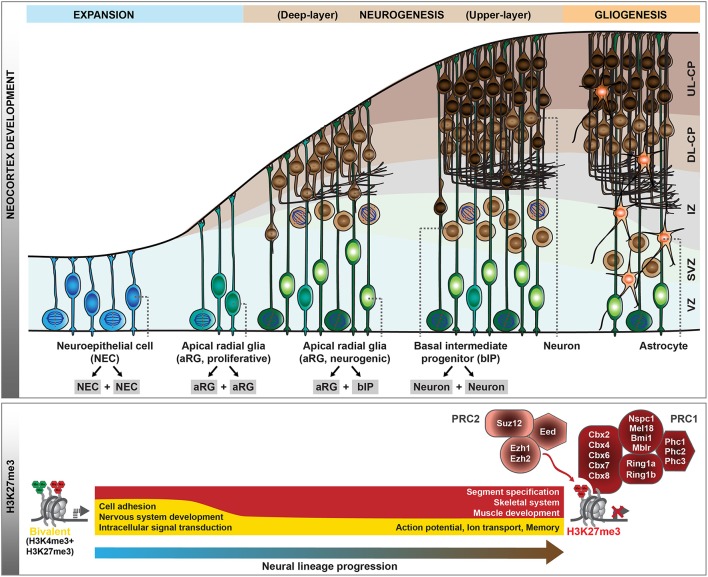
Figure 1
Figure 1
Polycomb-mediated histone methylation during mouse neocortex development. During the development of the mouse neocortex, neural progenitor cells pass through consecutive stages of expansion, neurogenesis, and gliogenesis (top scheme). aRG undergoing neurogenic divisions give rise to bIPs, which are the main source of neurons in the mouse. As neural progenitor cells transition from proliferation to neurogenic divisions, their histone methylation profiles change dynamically. Whereas, many genes are in a bivalent configuration in early proliferative progenitor cells, many of these poised domains are resolved with progressive lineage commitment. The gene ontology categories characteristic of the genes marked by H3K27me3 (red) or bivalent modifications (yellow) during early neurogenesis and in neurons are indicated (bottom scheme). In addition, the core components of Polycomb repressive complex 1 (PRC1) and 2 (PRC2) are shown. VZ, ventricular zone; SVZ, subventricular zone; IZ, intermediate zone; CP, cortical plate; DL, deep-layer; UL, upper-layer.
Figure 2
Figure 2
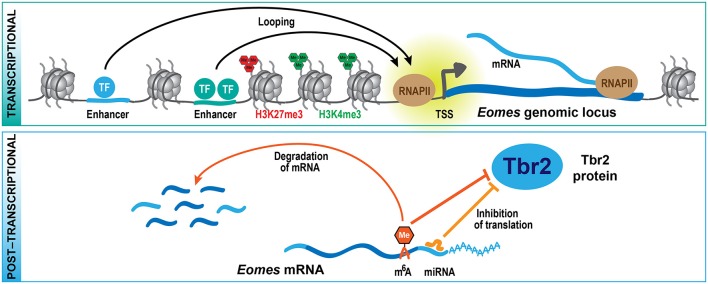
Multi-layered regulation of gene expression. At the transcriptional level (top scheme), cell type-specific expression of genes is regulated by transcription factors that bind to regulatory sequences, including distal enhancers that contact their respective target genes by looping. Histone methylation, mediated by TrxG (H3K4me3) and PcG (H3K27me3) proteins, is part of an epigenetic system that also contributes to the regulation of specific gene expression. At the post-transcriptional level (bottom scheme), the translation and stability of mRNAs is regulated by miRNAs and epitranscriptomic mechanisms including m6A, providing a multi-layered system for the control of protein expression during development. These mechanisms are exemplified here for the key transcription factor Tbr2 (Eomes), which regulates bIP generation during neocortex development.

References

    1. Albert M., Kalebic N., Florio M., Lakshmanaperumal N., Haffner C., Brandl H., et al. (2017). Epigenome profiling and editing of neocortical progenitor cells during development. EMBO J. 36, 2642–2658. 10.15252/embj.201796764 - DOI - PMC - PubMed
    1. Aprea J., Prenninger S., Dori M., Ghosh T., Monasor L. S., Wessendorf E., et al. (2013). Transcriptome sequencing during mouse brain development identifies long non-coding RNAs functionally involved in neurogenic commitment. EMBO J. 32, 3145–3160. 10.1038/emboj.2013.245 - DOI - PMC - PubMed
    1. Arcila M. L., Betizeau M., Cambronne X. A., Guzman E., Doerflinger N., Bouhallier F., et al. (2014). Novel primate miRNAs coevolved with ancient target genes in germinal zone-specific expression patterns. Neuron 81, 1255–1262. 10.1016/j.neuron.2014.01.017 - DOI - PMC - PubMed
    1. Arnold S. J., Huang G. J., Cheung A. F., Era T., Nishikawa S., Bikoff E. K., et al. (2008). The T-box transcription factor Eomes/Tbr2 regulates neurogenesis in the cortical subventricular zone. Genes Dev. 22, 2479–2484. 10.1101/gad.475408 - DOI - PMC - PubMed
    1. Ayoub A. E., Oh S., Xie Y., Leng J., Cotney J., Dominguez M. H., et al. (2011). Transcriptional programs in transient embryonic zones of the cerebral cortex defined by high-resolution mRNA sequencing. Proc. Natl. Acad. Sci. U.S.A. 108, 14950–14955. 10.1073/pnas.1112213108 - DOI - PMC - PubMed

LinkOut - more resources