


Evaluation of the efficacy of rezafungin, a novel echinocandin, in the treatment of disseminated Candida auris infection using an immunocompromised mouse model
- PMID: 29897469
- PMCID: PMC6070025
- DOI: 10.1093/jac/dky153
Evaluation of the efficacy of rezafungin, a novel echinocandin, in the treatment of disseminated Candida auris infection using an immunocompromised mouse model
Abstract
Background: Multiple cases of Candida auris infection have been reported with high mortality rates owing to its MDR nature. Rezafungin (previously CD101) is a novel echinocandin with enhanced stability and pharmacokinetics that achieves high plasma drug exposure and allows for once weekly dose administration.
Objectives: Evaluate the efficacy of rezafungin in the treatment of disseminated C. auris infection using a mouse model of disseminated candidiasis.
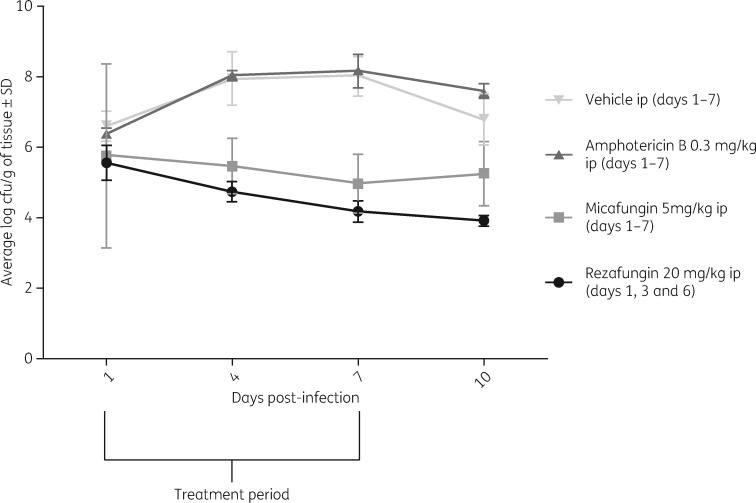
Methods: Mice were immunosuppressed 3 days prior to infection and 1 day post-infection. On the day of infection, mice were inoculated with 3 × 10⁷C. auris blastospores via the tail vein. Mice were randomized into four groups (n = 20): rezafungin at 20 mg/kg, amphotericin B at 0.3 mg/kg, micafungin at 5 mg/kg and a vehicle control. Treatments were administered 2 h post-infection. Rezafungin was given additionally on days 3 and 6 for a total of three doses, while the remaining groups were treated every day for a total of seven doses. Five mice from each group were sacrificed on days 1, 4, 7 and 10 of the study. Kidneys were removed from each mouse to determine the number of cfu for each respective day.
Results: Rezafungin had significantly lower average log10 cfu/g of tissue compared with amphotericin B- and vehicle-treated mice on all days when kidneys were harvested. Additionally, rezafungin-treated mice had significantly lower average log10 cfu/g of tissue compared with micafungin-treated mice on day 10.
Conclusions: Our findings show that rezafungin possesses potent antifungal activity against C. auris in a disseminated model of candidiasis.
Figures
References
-
- CDC. Global Emergence of Invasive Infections Caused by the Multidrug-Resistant Yeast Candida auris. Atlanta, GA, USA: CDC, 2016. https://www.cdc.gov/fungal/diseases/candidiasis/candida-auris-alert.html.
-
- Calvo B, Melo AS, Perozo-Mena A. et al. First report of Candida auris in America: clinical and microbiological aspects of 18 episodes of candidemia. J Infect 2016; 73: 369–74. - PubMed
Publication types
MeSH terms
Substances
Supplementary concepts
Grants and funding
LinkOut - more resources
Full Text Sources
Other Literature Sources
Medical
