


Tillage intensity and pasture in rotation effectively shape soil microbial communities at a landscape scale
- PMID: 29897676
- PMCID: PMC6460278
- DOI: 10.1002/mbo3.676
Tillage intensity and pasture in rotation effectively shape soil microbial communities at a landscape scale
Abstract
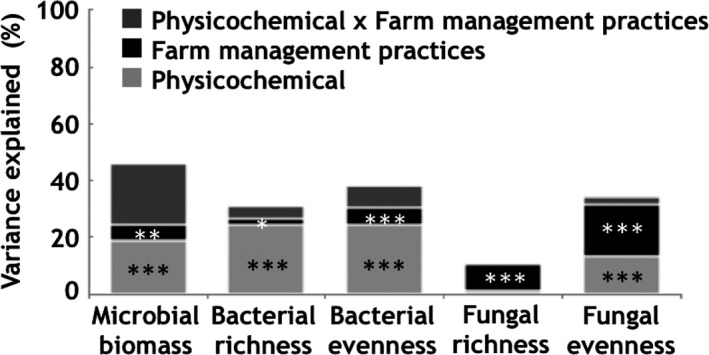
Soil microorganisms are essential to agroecosystem functioning and services. Yet, we still lack information on which farming practices can effectively shape the soil microbial communities. The aim of this study was to identify the farming practices, which are most effective at positively or negatively modifying bacterial and fungal diversity while considering the soil environmental variation at a landscape scale. A long-term research study catchment (12 km2 ) representative of intensive mixed farming (livestock and crop) in Western Europe was investigated using a regular grid for soil sampling (n = 186). Farming systems on this landscape scale were described in terms of crop rotation, use of fertilizer, soil tillage, pesticides treatments, and liming. Molecular microbial biomass was estimated by soil DNA recovery. Bacterial and fungal communities were analyzed by 16S and 18S rRNA gene pyrosequencing. Microbial biomass was significantly stimulated by the presence of pasture during the crop rotation since temporary and permanent pastures, as compared to annual crops, increased the soil microbial biomass by +23% and +93% respectively. While soil properties (mainly pH) explained much of the variation in bacterial diversity, soil tillage seemed to be the most influential among the farming practices. A 2.4% increase in bacterial richness was observed along our gradient of soil tillage intensity. In contrast, farming practices were the predominant drivers of fungal diversity, which was mainly determined by the presence of pastures during the crop rotation. Compared to annual crops, temporary and permanent pastures increased soil fungal richness by +10% and +14.5%, respectively. Altogether, our landscape-scale investigation allows the identification of farming practices that can effectively shape the soil microbial abundance and diversity, with the goal to improve agricultural soil management and soil ecological integrity.
Keywords: agricultural practices; bacteria; farmers; fungi; sustainable landuse.
© 2018 The Authors. MicrobiologyOpen published by John Wiley & Sons Ltd.
Conflict of interest statement
The authors declare no conflict of interest.
Figures
References
-
- Altieri, M. A. (1989). Agroecology: A new research and development paradigm for world agriculture. Agriculture Ecosystem and Environment, 27, 37–46. 10.1016/0167-8809(89)90070-4 - DOI
-
- Castellanos, T. , Dohrmann, A. B. , Imfeld, G. , Baumgarte, S. , & Tebbe, C. C. (2009). Search of environmental descriptors to explain the variability of the bacterial diversity from maize rhizospheres across a regional scale. European Journal of Soil Biology, 45, 383–393. 10.1016/j.ejsobi.2009.07.006 - DOI
-
- Chan, K. Y. , Conyers, M. K. , Li, G. D. , Helyar, K. R. , Poile, G. , Oates, A. , & Barchia, I. M. (2011). Soil carbon dynamics under different cropping and pasture management in temperate Australia: Results of three long‐term experiments. Soil Research, 49, 320–328. 10.1071/SR10185 - DOI
-
- Constancias, F. , Chemidlin Prévost‐Bouré, N. , Terrat, S. , Aussmens, S. , Nowak, V. , Guillemin, J. P. , … Ranjard, L. (2014). Microscale evidence for a high decrease of soil bacterial density and diversity by cropping. Agronomy for Sustainable Development, 34(4), 831–840. 10.1007/s13593-013-0204-3 - DOI
Publication types
MeSH terms
Substances
LinkOut - more resources
Full Text Sources
Other Literature Sources
Medical
