


Prenatal Exposure to Perfluoroalkyl Substances and IQ Scores at Age 5; a Study in the Danish National Birth Cohort
- PMID: 29897723
- PMCID: PMC6084884
- DOI: 10.1289/EHP2754
Prenatal Exposure to Perfluoroalkyl Substances and IQ Scores at Age 5; a Study in the Danish National Birth Cohort
Abstract
Background: Perfluoroalkyl substances (PFASs) are widespread persistent organic compounds that have been suggested to affect neurodevelopment.
Objective: We aimed to evaluate whether prenatal exposure to PFASs is associated with IQ in children.
Methods: We studied 1,592 pregnancies enrolled in the Danish National Birth Cohort (DNBC) during 1996-2002. Sixteen PFASs were measured in maternal plasma collected in early gestation. Child IQ was assessed at 5 y of age using the Wechsler Primary and Preschool Scales of Intelligence-Revised (WPPSI-R) administered by trained psychologists. Using multivariable linear regression models, we estimated the differences in child IQ scores according to PFAS concentration [per natural-log (ng/mL) unit increase or values categorized in quartiles].
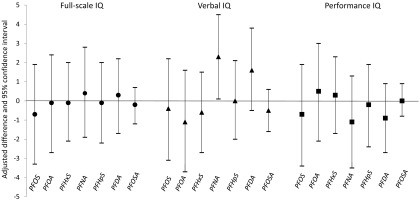
Results: Perfluorooctane sulfonate (PFOS) and perfluorooctanoic acid (PFOA) were detected in all samples, and five additional PFASs were quantified in >80% of the samples. Overall, we found no strong associations between a natural-log unit increase in each of the seven PFASs we evaluated and child IQ scores. A few positive and negative associations were found in the sex-stratified PFAS quartile analyses, but the patterns were inconsistent.
Conclusion: Overall, we did not find consistent evidence to suggest prenatal exposure to PFASs to be associated with child IQ scores at 5 y of age in the DNBC. Some of the sex-specific observations warrant further investigation. Additional studies should examine offspring IQ at older ages and assess other functional cognitive and neuropsychiatric measures in addition to intelligence. Postnatal exposures to PFASs and mixture effects for PFASs and PFASs with other environmental pollutants should also be considered in future research. https://doi.org/10.1289/EHP2754.
Figures
References
-
- Ballesteros V, Costa O, Iñiguez C, Fletcher T, Ballester F, Lopez-Espinosa MJ. 2017. Exposure to perfluoroalkyl substances and thyroid function in pregnant women and children: a systematic review of epidemiologic studies. Environ Int 99:15–28, PMID: 27884404, 10.1016/j.envint.2016.10.015. - DOI - PubMed
-
- Bellinger DC, Stiles KM, Needleman HL. 1992. Low-level lead exposure, intelligence and academic achievement: a long-term follow-up study. Pediatrics 90(6):855–861, PMID: 1437425. - PubMed
Publication types
MeSH terms
Substances
Grants and funding
LinkOut - more resources
Full Text Sources
Other Literature Sources
Molecular Biology Databases