


Impact of climate variability on the transmission risk of malaria in northern Côte d'Ivoire
- PMID: 29897901
- PMCID: PMC5999085
- DOI: 10.1371/journal.pone.0182304
Impact of climate variability on the transmission risk of malaria in northern Côte d'Ivoire
Abstract
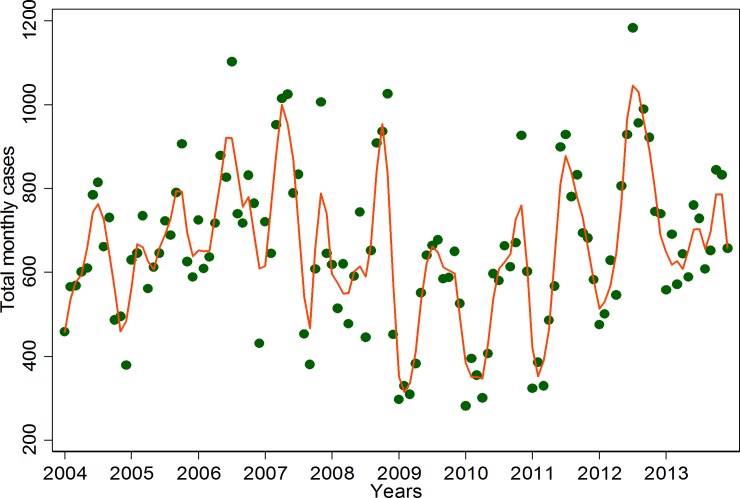
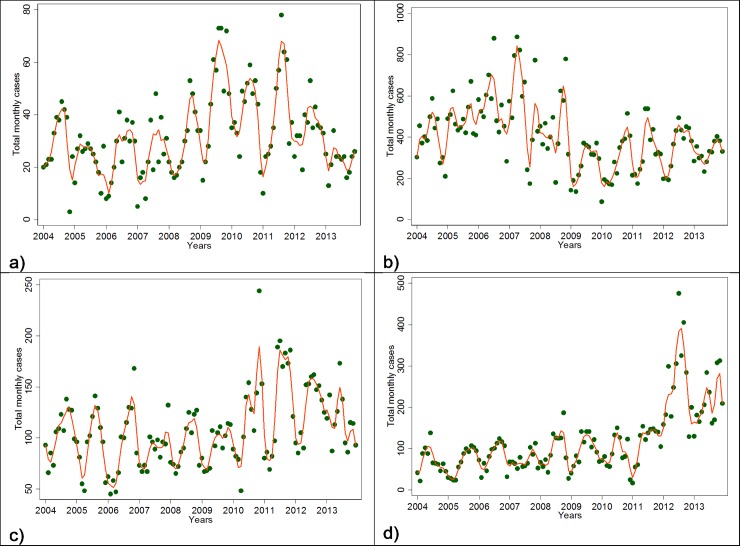
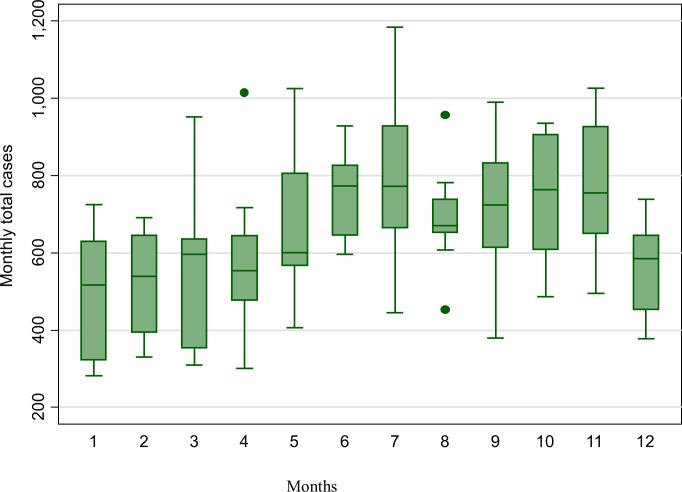
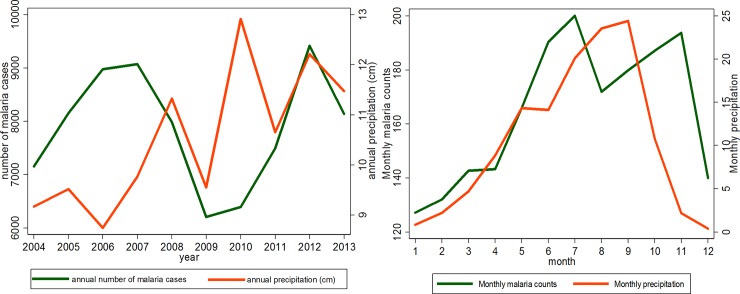
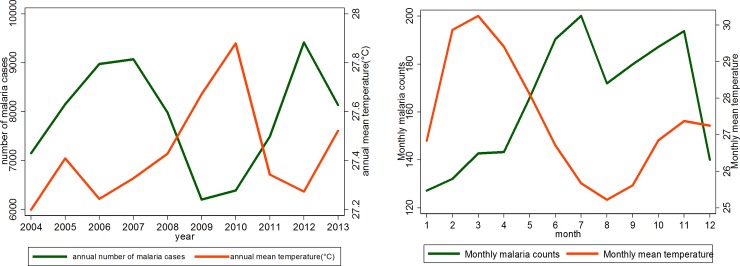
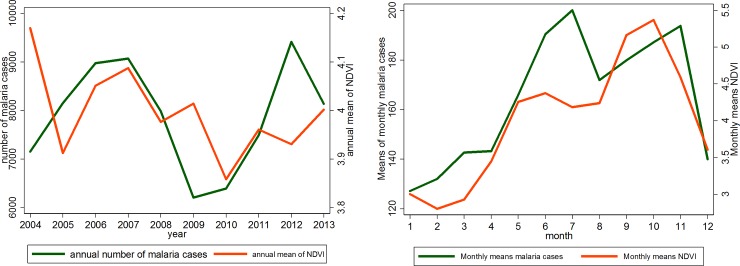
Since the 1970s, the northern part of Côte d'Ivoire has experienced considerable fluctuation in its meteorology including a general decrease of rainfall and increase of temperature from 1970 to 2000, a slight increase of rainfall since 2000, a severe drought in 2004-2005 and flooding in 2006-2007. Such changing climate patterns might affect the transmission of malaria. The purpose of this study was to analyze climate and environmental parameters associated with malaria transmission in Korhogo, a city in northern Côte d'Ivoire. All data were collected over a 10-year period (2004-2013). Rainfall, temperature and Normalized Difference Vegetation Index (NDVI) were the climate and environmental variables considered. Association between these variables and clinical malaria data was determined, using negative binomial regression models. From 2004 to 2013, there was an increase in the annual average precipitation (1100.3-1376.5 mm) and the average temperature (27.2°C-27.5°C). The NDVI decreased from 0.42 to 0.40. We observed a strong seasonality in these climatic variables, which resembled the seasonality in clinical malaria. An incremental increase of 10 mm of monthly precipitation was, on average, associated with a 1% (95% Confidence interval (CI): 0.7 to 1.2%) and a 1.2% (95% CI: 0.9 to 1.5%) increase in the number of clinical malaria episodes one and two months later respectively. A 1°C increase in average monthly temperature was, on average, associated with a decline of a 3.5% (95% CI: 0.1 to 6.7%) in clinical malaria episodes. A 0.1 unit increase in monthly NDVI was associated with a 7.3% (95% CI: 0.8 to 14.1%) increase in the monthly malaria count. There was a similar increase for the preceding-month lag (6.7% (95% CI: 2.3% to 11.2%)). The study results can be used to establish a malaria early warning system in Korhogo to prepare for outbreaks of malaria, which would increase community resilience no matter the magnitude and pattern of climate change.
Conflict of interest statement
The authors have declared that no competing interests exist.
Figures
References
-
- Craig MH, Snow RW, le Sueur D. A Climate-based Distribution Model of Malaria Transmission in Sub-Saharan Africa. Parasitology Today, vol. 15, no. 3, 1999. - PubMed
-
- Bhatt S, Weiss DJ, Cameron E, Bisanzio D, Mappin B, Dalrymple U, et al. , The effect of malaria control on Plasmodium falciparum in Africa between 2000 and 2015. Nature,Vol 526, 8 October 2015. doi: 10.1038/nature15535 pp 207–211. - DOI - PMC - PubMed
-
- WHO. World Malaria Report 2015 Geneva: World Health Organization, 2015. Available from: http://www.who.int/mediacentre/factsheets/fs094/en/.
-
- The World Health Report: reducing risks, promoting healthy life. Geneva, World Health Organization, 2002. 19 p. Available from: http://www.who.int/whr/2002/en/.
-
- McMichael AJ. Globalization, Climate Change, and Human Health. Review article, The new england journal of medicine, N Engl J Med 2013; 368:1335–43. doi: 10.1056/NEJMra1109341 PP. 1335–1343. - DOI - PubMed
Publication types
MeSH terms
LinkOut - more resources
Full Text Sources
Other Literature Sources
Medical
