Comparative Study
. 2018 Jul 31;92(16):e00754-18.
doi: 10.1128/JVI.00754-18. Print 2018 Aug 15.

The Influenza B Virus Hemagglutinin Head Domain Is Less Tolerant to Transposon Mutagenesis than That of the Influenza A Virus

Affiliations
Comparative Study

The Influenza B Virus Hemagglutinin Head Domain Is Less Tolerant to Transposon Mutagenesis than That of the Influenza A Virus

Benjamin O Fulton et al. J Virol. .

Abstract

Influenza A and B viruses can continuously evade humoral immune responses by developing mutations in the globular head of the hemagglutinin (HA) that prevent antibody binding. However, the influenza B virus HA over time displays less antigenic variation despite being functionally and structurally similar to the influenza A virus HA. To determine if the influenza B virus HA is under constraints that limit its antigenic variation, we performed a transposon screen to compare the mutational tolerance of the currently circulating influenza A virus HAs (H1 and H3 subtypes) and influenza B virus HAs (B/Victoria87 and B/Yamagata88 antigenic lineages). A library of insertional mutants for each HA was generated and deep sequenced after passaging to determine where insertions were tolerated in replicating viruses. The head domains of both viruses tolerated transposon mutagenesis, but the influenza A virus head was more tolerant to insertions than the influenza B virus head domain. Furthermore, all five of the known antigenic sites of the influenza A virus HA were tolerant of 15 nucleotide insertions, while insertions were detected in only two of the four antigenic sites in the influenza B virus head domain. Our analysis demonstrated that the influenza B virus HA is inherently less tolerant of transposon-mediated insertions than the influenza A virus HA. The reduced insertional tolerance of the influenza B virus HA may reveal genetic restrictions resulting in a lower capacity for antigenic evolution.IMPORTANCE Influenza viruses cause seasonal epidemics and result in significant human morbidity and mortality. Influenza viruses persist in the human population through generating mutations in the hemagglutinin head domain that prevent antibody recognition. Despite the similar selective pressures on influenza A and B viruses, influenza A virus displays a higher rate and breadth of antigenic variability than influenza B virus. A transposon mutagenesis screen was used to examine if the reduced antigenic variability of influenza B virus was due to inherent differences in mutational tolerance. This study demonstrates that the influenza A virus head domain and the individual antigenic sites targeted by humoral responses are more tolerant to insertions than those of influenza B virus. This finding sheds light on the genetic factors controlling the antigenic evolution of influenza viruses.

Keywords: influenza virus; insertional mutagenesis; transposons; viral evolution.


Figures

FIG 1
FIG 1
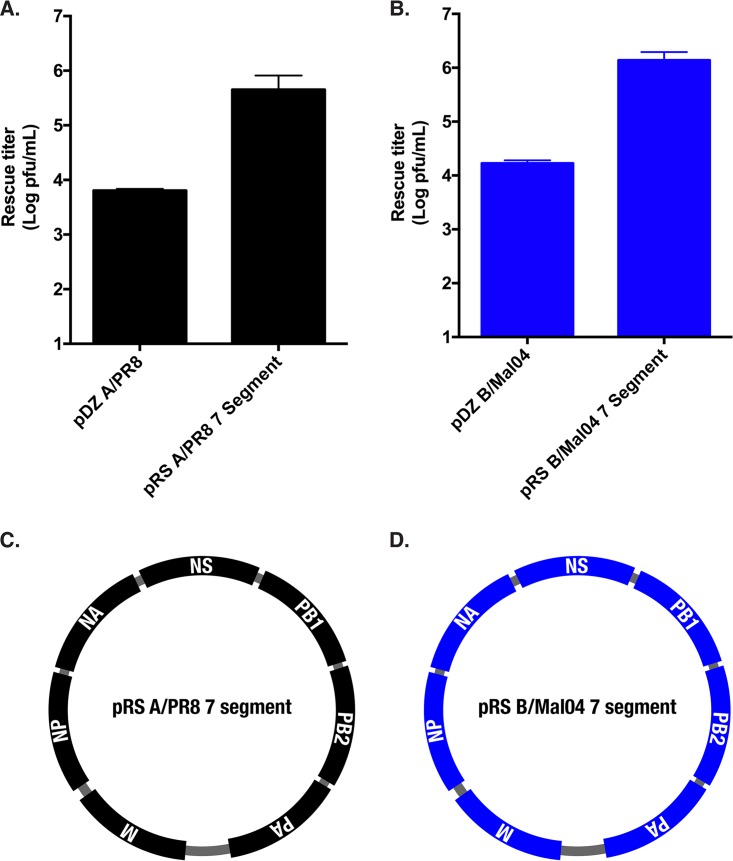
The pRS 7 segment rescue systems produce high viral titers. (A and B) Rescue titers of WT A/PR8 HA (A) and B/Mal04 HA (B) in the pDZ and pRS segment plasmid backbones were compared. The pDZ WT HA expression vector was transfected into 293T cells with either the seven pDZ plasmids encoding the other viral segments or the pRS 7 segment plasmid. The supernatants were plaqued directly on MDCKs 48 h posttransfection. Data points are the means for three replicates, while the error bars represent the standard deviations. (C and D) Plasmid schematics of the pRS A/PR8 7 segment (C) and pRS B/Mal04 7 segment (D) plasmids. The segments are not to scale, but their order within the plasmid backbone is shown.
FIG 2
FIG 2
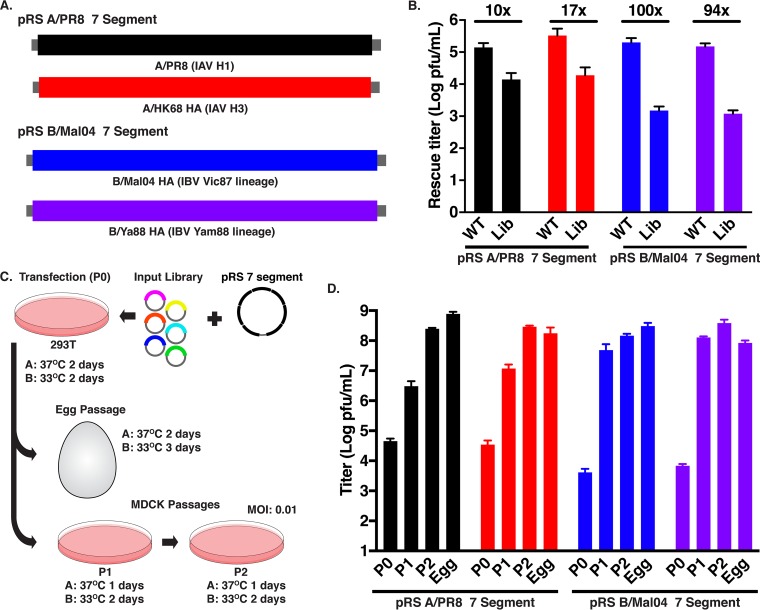
Characterization of the HA libraries. (A) Schematic of the A/PR8 (black), A/HK68 (red), B/Mal04 (blue), and B/Ya88 HA (purple) segments utilized in the screen. Color schemes are consistent throughout the figure. (B) Rescue titers of the WT HA and mutagenized HA libraries for the A/PR8, A/HK68, B/Mal04, and B/Ya88 viruses in the pRS 7 segment backbone. The WT HA and the HA library were transfected into 293T cells with the pRS 7 segment plasmid, and the supernatants were plaqued at 48 h posttransfection. The numbers above the graph indicate the fold reduction in rescue titer of the HA library from the WT HA. Data points are the means for four replicates, while the error bars represent the standard deviations. (C) Protocol for rescuing and passaging the HA libraries. The HA library was transfected into 293T cells with the appropriate pRS 7 segment plasmid. This and all following steps were performed at 37°C for A/HAs and 33°C for B/HAs. Two days posttransfection, the supernatants were collected and passaged in 8-day-old embryonated eggs or on MDCK cells. For the egg passage, the viruses were incubated for 2 days for IAV or 3 days for IBV. For the MDCK cell passages, the remaining supernatant was used to infect MDCK cells for 24 h for IAV and 48 h for IBV. Supernatants were collected, and their titers were determined. A second MDCK cell passage was then performed at an MOI of 0.01. RNA was collected from purified virions for the egg passage and from the cells for the MDCK passage 2. (D) Titers of the rescue (P0), MDCK passage 1 (P1), MDCK passage 2 (P2), and egg (Egg) passages. Data points are the means for three replicates, while the error bars represent the standard deviations.
FIG 3
FIG 3
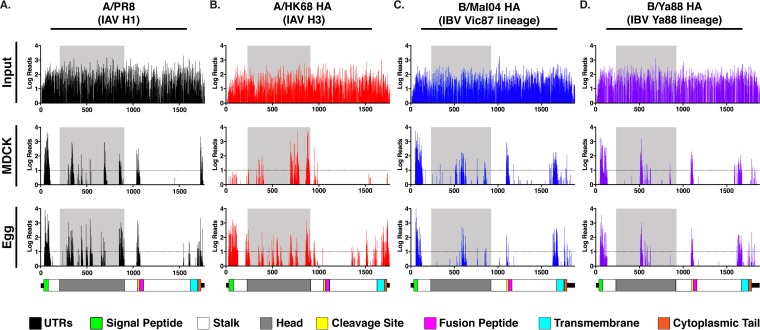
Transposon insertions are tolerated in the head domains of the influenza A and B viral HAs. Deep sequencing data for A/PR8 (black) (A), A/HK68 (red) (B), B/Mal04 (blue) (C), and B/Ya88 HA (purple) (D) input libraries (top row), MDCK passage 2 (middle row), and egg passages (bottom row). The number of reads containing transposon insertions is indicated on the y axis, and the numbers along the x axis of the graphs indicate the nucleotide positions in the segment. Dashed lines indicate a threshold of 10 or more reads. A schematic of the HA segments is shown to scale at the bottom to identify the location of insertions: untranslated regions (UTR, black), signal peptide (green), stalk (white), head (gray), cleavage site (yellow), fusion peptide (pink), transmembrane domain (cyan), and cytoplasmic tail (orange). The data for the 15 amino acids at the distal ends of the ectodomain, the cleavage site, and the fusion peptide are shown here but are not included in the analysis in Fig. 7.
FIG 4
FIG 4
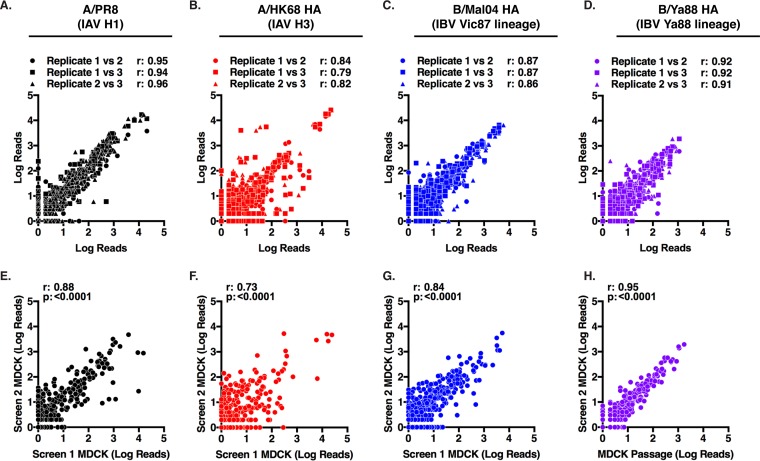
Consistency of the HA transposon screens. Pairwise analysis of the representation of each insertion mutant between each replicate of a single screen (A to D) and second independent screen performed in MDCK cells (E to H) for A/PR8 (black), A/HK68 (red), B/Mal04 (blue), and B/Ya88 HA (purple). The scatter plot shows the number of reads for a site in one sample plotted against the number of reads for that site in another sample. The r and P values for Pearson's correlation are displayed.
FIG 5
FIG 5
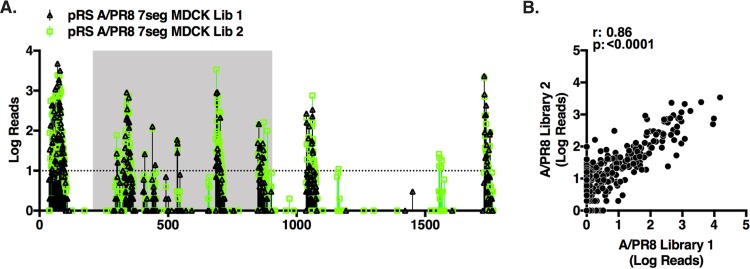
An independently generated A/PR8 HA library produces results similar to those of the original library. (A) A new A/PR8 HA library (A/PR8 library 2) was generated and rescued as before. Deep-sequencing data from the second MDCK cell passage for the A/PR8 HA library 1 (black, triangles) and library 2 (green, squares) are plotted. The number of reads containing transposon insertions is indicated on the y axis, and the numbers along the x axis of the graph indicate the nucleotide position in the segment. The dashed line indicates a threshold of 10 or more reads. (B) Comparison of the abundance of each mutant after passage in MDCKs between A/PR8 HA library 1 and library 2. The scatter plot shows the number of reads for a site in one sample plotted against the number of reads for that site in another sample. The r and P values for Pearson's correlation are displayed.
FIG 6
FIG 6
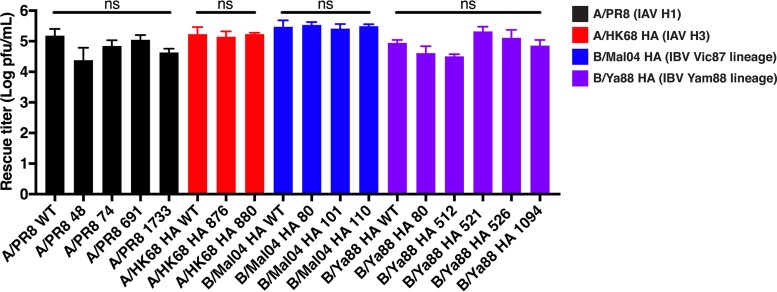
Mutants bearing individual insertions are recoverable at titers comparable to those of the wild-type virus. Rescue titers of the WT HAs and mutant HAs bearing individual insertions are shown. The HA mutants are numbered by the nucleotide position prior to the insertion. The WT HAs or the mutant HAs were transfected into 293T cells with the appropriate pRS 7 segment plasmid. Supernatants were plaqued at 48 h posttransfection. Data points are the means for four replicates, while the error bars represent the standard deviations. WT HA and mutant HA rescue titers were compared by a one-way analysis of variance (ANOVA) followed by Tukey's multiple-comparison test. NS, not significant.
FIG 7
FIG 7
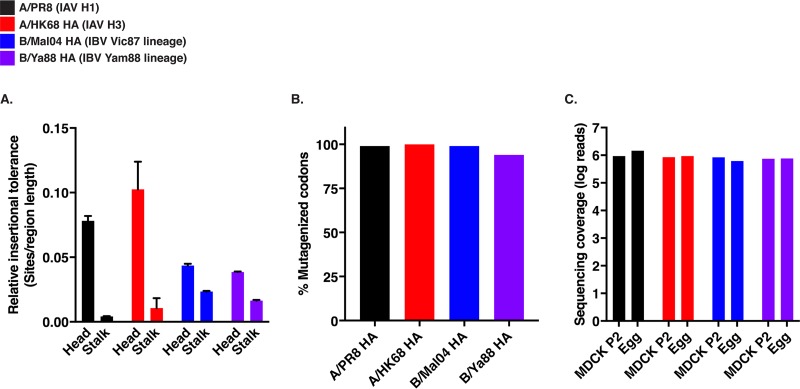
The head domains of IAV are more tolerant to insertions than those of IBV, and the stalk domains are less tolerant to insertions in all HAs. (A) The number of sites that could tolerate insertions in each region were normalized to the region size to give the relative insertional tolerance of the head and stalk for the A/PR8 (black), A/HK68 (red), B/Mal04 (blue), and B/Ya88 HA (purple) for the MDCK passage 2 data. Color schemes are consistent throughout the figure. Data points are the means for two independent screens in MDCK cells, while the error bars represent the standard errors of the means. The data for the 15 amino acids at the distal ends of the ectodomain, the cleavage site, and the fusion peptide were excluded from this analysis. (B) The proportion of codons mutagenized in each of the viral libraries is plotted. (C) The number of reads aligning to the HA segment are displayed for the MDCK cell and egg passages.
FIG 8
FIG 8
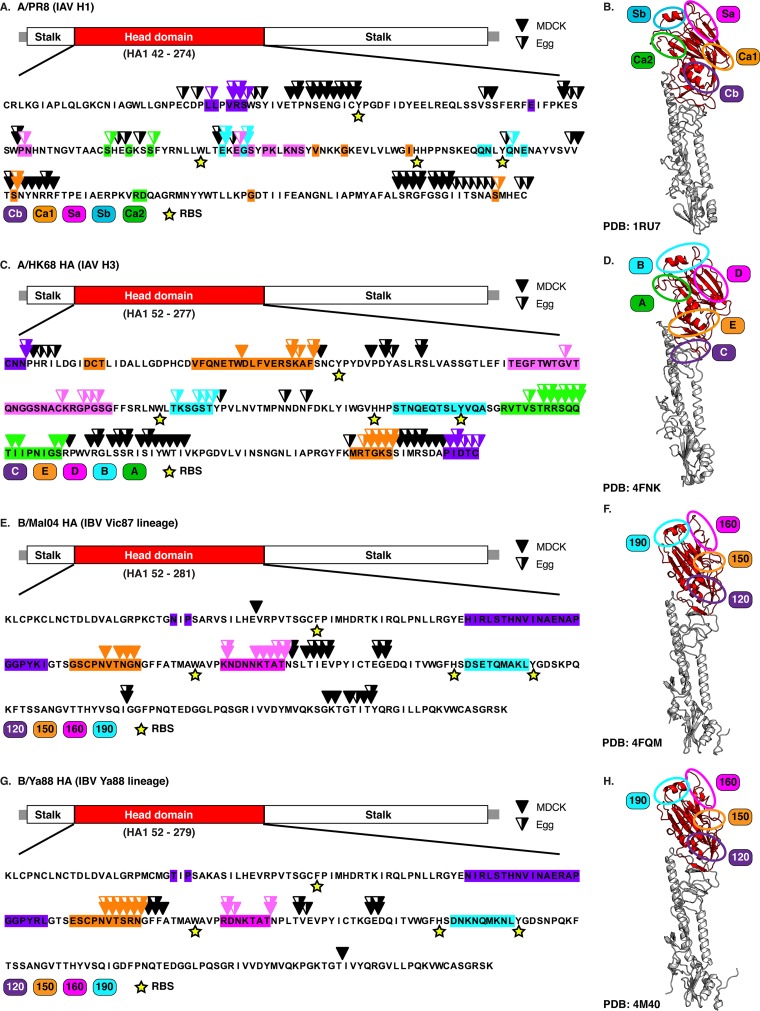
The antigenic sites of the IAV HAs are more tolerant to insertions than those of IBV. Locations of transposon insertions in the A/PR8 (A), A/HK68 (C), B/Mal04 (E), and B/Ya88 (G) HA head domains. (Top) Diagram of the HA segment showing the locations of the head (red), stalk (white), and UTRs (gray). The amino acid positions of the head domain in the HA1 protein are provided in parentheses below the schematic. (Bottom) The primary sequence for the head domain is displayed. All insertional mutants from the MDCK cell and egg passages are denoted on the primary sequence by solid and half-filled triangles, respectively. Locations of antigenic domains within the head domains are indicated by the colored boxes (30–32). The critical residues of the receptor binding pockets are indicated by yellow stars below the primary sequence. Insertions located in the antigenic domains are colored accordingly. Crystal structures of the HAs from lineages A/PR8 (PDB 1RU7) (52) (B), A/HK68 (PDB 4FNK) (53) (D), B/Vic87 lineage (PDB 4FQM) (19) (F), and B/Ya88 (PDB 4M40) (31) (H). The head domain is colored in red, while the stalk domain is colored in gray. Locations of the antigenic domains on the crystal structure are indicated.

References

    1. Shaw ML, Palese P. 2013. Fields virology, p 1151–1185. In Knipe DM, Howley PM, Griffin DE, Lamb RA, Martin MA, Roizman B, Straus SE (ed), Fields virology, 6th ed Lippincott Williams & Wilkins, Philadelphia, PA.
    1. Heikkinen T, Ikonen N, Ziegler T. 2014. Impact of influenza B lineage-level mismatch between trivalent seasonal influenza vaccines and circulating viruses, 1999-2012. Clin Infect Dis 59:1519–1524. doi: 10.1093/cid/ciu664. - DOI - PubMed
    1. Adlhoch C, Snacken R, Melidou A, Ionescu S, Penttinen P, The European Influenza Surveillance Network. 2018. Dominant influenza A(H3N2) and B/Yamagata virus circulation in EU/EEA, 2016/17 and 2017/18 seasons, respectively. Euro Surveill 23(13):18–00146. doi: 10.2807/1560-7917.ES.2018.23.13.18-00146. - DOI - PMC - PubMed
    1. WHO. 2018. Influenza (seasonal) fact sheet. http://www.who.int/mediacentre/factsheets/fs211/en/ Accessed 13 April 2018.
    1. Altman MO, Angeletti D, Yewdell JW. 2018. Antibody immunodominance: the key to understanding influenza virus antigenic drift. Viral Immunol doi: 10.1089/vim.2017.0129. - DOI - PMC - PubMed

Publication types

MeSH terms

Substances