


Easy Synthesis and Characterization of Holmium-Doped SPIONs
- PMID: 29899262
- PMCID: PMC6027423
- DOI: 10.3390/nano8060430
Easy Synthesis and Characterization of Holmium-Doped SPIONs
Abstract
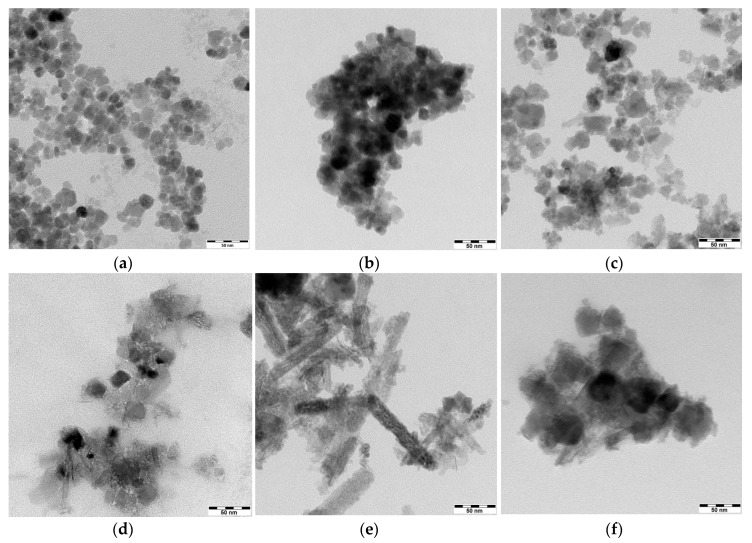
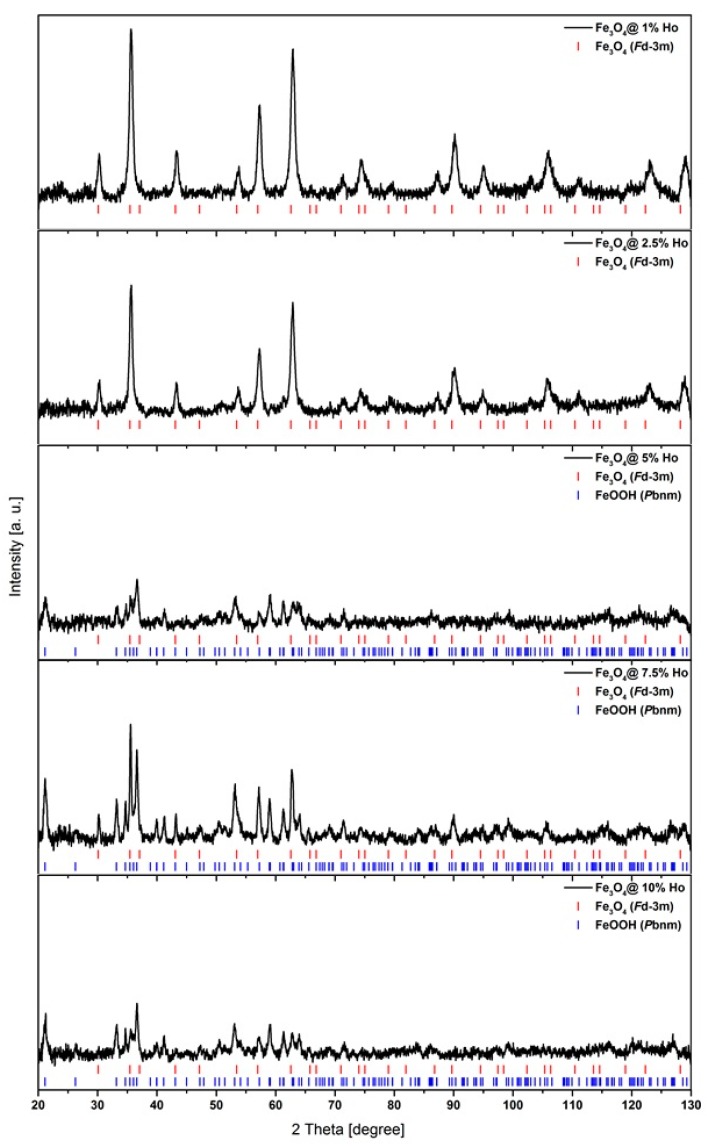
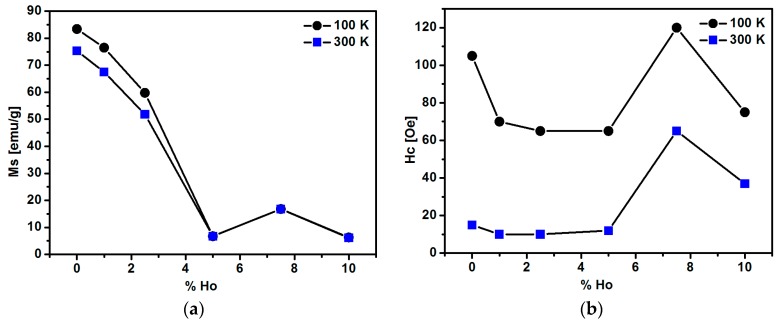
The exceptional magnetic properties of superparamagnetic iron oxide nanoparticles (SPIONs) make them promising materials for biomedical applications like hyperthermia, drug targeting and imaging. Easy preparation of SPIONs with the controllable, well-defined properties is a key factor of their practical application. In this work, we report a simple synthesis of Ho-doped SPIONs by the co-precipitation route, with controlled size, shape and magnetic properties. To investigate the influence of the ions ratio on the nanoparticles’ properties, multiple techniques were used. Powder X-ray diffraction (PXRD) confirmed the crystallographic structure, indicating formation of an Fe₃O₄ core doped with holmium. In addition, transmission electron microscopy (TEM) confirmed the correlation of the crystallites’ shape and size with the experimental conditions, pointing to critical holmium content around 5% for the preparation of uniformly shaped grains, while larger holmium content leads to uniaxial growth with a prism shape. Studies of the magnetic behaviour of nanoparticles show that magnetization varies with changes in the initial Ho3+ ions percentage during precipitation, while below 5% of Ho in doped Fe₃O₄ is relatively stable and sufficient for biomedicine applications. The characterization of prepared nanoparticles suggests that co-precipitation is a simple and efficient technique for the synthesis of superparamagnetic, Ho-doped SPIONs for hyperthermia application.
Keywords: SPIONs; endoradiotherapy; holmium; rare-earth doping; superparamagnetic iron oxide nanoparticles.
Conflict of interest statement
The authors declare no conflict of interest. The founding sponsors had no role in the design of the study; in the collection, analyses, or interpretation of data; in the writing of the manuscript, and in the decision to publish the results.
Figures




References
-
- Brzozowska M., Krysinski P. Synthesis and functionalization of magnetic nanopartciles with covalently bound electroactive compound doxorubicine. Electrochim. Acta. 2009;54:5065–5070. doi: 10.1016/j.electacta.2008.11.018. - DOI
-
- Tsuotoaka T. Frequency dispersion of complex permeability in Mn-Zn and Ni-Zn spinel ferrites and their composite materials. J. Appl. Phys. 2003;93:2789–2796. doi: 10.1063/1.1542651. - DOI
-
- Hartshorne H., Backhouse C.J., Lee W.E. Ferrofluid-based microchip pump and valve. Sens. Actuators B. 2004;99:592–600. doi: 10.1016/j.snb.2004.01.016. - DOI
LinkOut - more resources
Full Text Sources
Other Literature Sources
Molecular Biology Databases
