


The role of water in fault lubrication
- PMID: 29899500
- PMCID: PMC5998041
- DOI: 10.1038/s41467-018-04782-9
The role of water in fault lubrication
Abstract
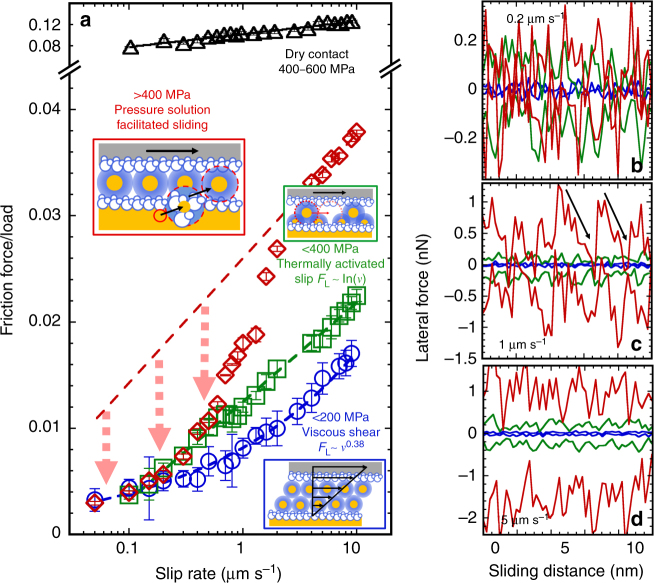
The friction between two adjacent tectonic plates under shear loading may dictate seismic activities. To advance the understanding of mechanisms underlying fault strength, we investigate the frictional characteristics of calcite in an aqueous environment. By conducting single-asperity friction experiments using an atomic force microscope, here we show three pathways of energy dissipation with increasing contact stresses: viscous shear of a lubricious solution film at low normal stresses; shear-promoted thermally activated slip, similar to dry friction but influenced by the hydrated ions localized at the interface; and pressure-solution facilitated slip at sufficiently high stresses and slow sliding velocities, which leads to a prominent decrease in friction. It is also shown that the composition of the aqueous solution affects the frictional response. We use this nanoscale evidence to scrutinize the role of brines on fault behavior and argue that pressure solution provides a weakening mechanism of the fault strength at the level of single-asperity contacts.
Conflict of interest statement
The authors declare no competing interests.
Figures


References
-
- Scholz, C. H. The Mechanics of Earthquakes and Faulting, 2nd edn. (Cambridge University Press, Cambridge, 2002).
-
- Ruina A. Slip instability and state variable friction laws. J. Geophys. Res. 1983;88:359–370. doi: 10.1029/JB088iB12p10359. - DOI
-
- Audet P, Schwartz SY. Hydrologic control of forearc strength and seismicity in the Costa Rican subduction zone. Nat. Geosci. 2013;6:852–855. doi: 10.1038/ngeo1927. - DOI
-
- Marone C. Laboratory-derived friction laws and their application to seismic faulting. Annu. Rev. Earth. Planet. Sci. 1998;26:643–696. doi: 10.1146/annurev.earth.26.1.643. - DOI
Publication types
Grants and funding
LinkOut - more resources
Full Text Sources
Other Literature Sources
