. 2018 Jun 13;9(1):2252.
doi: 10.1038/s41467-018-04611-z.

Genetic inactivation of ANGPTL4 improves glucose homeostasis and is associated with reduced risk of diabetes

Viktoria Gusarova  1 Colm O'Dushlaine  2 Tanya M Teslovich  2 Peter N Benotti  3 Tooraj Mirshahi  3 Omri Gottesman  2 Cristopher V Van Hout  2 Michael F Murray  3 Anubha Mahajan  4 Jonas B Nielsen  5   6 Lars Fritsche  7 Anders Berg Wulff  8 Daniel F Gudbjartsson  9 Marketa Sjögren  10 Connor A Emdin  11 Robert A Scott  12 Wen-Jane Lee  13   14 Aeron Small  15   16 Lydia C Kwee  17 Om Prakash Dwivedi  18 Rashmi B Prasad  19 Shannon Bruse  2 Alexander E Lopez  2 John Penn  2 Anthony Marcketta  2 Joseph B Leader  3 Christopher D Still  3 H Lester Kirchner  3 Uyenlinh L Mirshahi  3 Amr H Wardeh  3 Cassandra M Hartle  3 Lukas Habegger  2 Samantha N Fetterolf  3 Teresa Tusie-Luna  20   21 Andrew P Morris  4   22   23 Hilma Holm  9 Valgerdur Steinthorsdottir  9 Patrick Sulem  9 Unnur Thorsteinsdottir  9 Jerome I Rotter  24 Lee-Ming Chuang  25   26 Scott Damrauer  27   28 David Birtwell  15   16 Chad M Brummett  29 Amit V Khera  11   30 Pradeep Natarajan  11   30 Marju Orho-Melander  10 Jason Flannick  11   31 Luca A Lotta  12 Cristen J Willer  5   6   32 Oddgeir L Holmen  33 Marylyn D Ritchie  3 David H Ledbetter  3 Andrew J Murphy  1 Ingrid B Borecki  2 Jeffrey G Reid  2 John D Overton  2 Ola Hansson  18   19 Leif Groop  18   19 Svati H Shah  17 William E Kraus  17 Daniel J Rader  15   16 Yii-Der I Chen  24 Kristian Hveem  33   34   35 Nicholas J Wareham  12 Sekar Kathiresan  30 Olle Melander  10 Kari Stefansson  9 Børge G Nordestgaard  36   37   38   39 Anne Tybjærg-Hansen  8   36   38   39 Goncalo R Abecasis  7 David Altshuler  11   40   41   42 Jose C Florez  43   44   45 Michael Boehnke  7 Mark I McCarthy  4   46   47 George D Yancopoulos  1 David J Carey  3 Alan R Shuldiner  2 Aris Baras  48 Frederick E Dewey  49 Jesper Gromada  50
Affiliations

Genetic inactivation of ANGPTL4 improves glucose homeostasis and is associated with reduced risk of diabetes

Viktoria Gusarova et al. Nat Commun. .

Abstract

Angiopoietin-like 4 (ANGPTL4) is an endogenous inhibitor of lipoprotein lipase that modulates lipid levels, coronary atherosclerosis risk, and nutrient partitioning. We hypothesize that loss of ANGPTL4 function might improve glucose homeostasis and decrease risk of type 2 diabetes (T2D). We investigate protein-altering variants in ANGPTL4 among 58,124 participants in the DiscovEHR human genetics study, with follow-up studies in 82,766 T2D cases and 498,761 controls. Carriers of p.E40K, a variant that abolishes ANGPTL4 ability to inhibit lipoprotein lipase, have lower odds of T2D (odds ratio 0.89, 95% confidence interval 0.85-0.92, p = 6.3 × 10⁻¹⁰), lower fasting glucose, and greater insulin sensitivity. Predicted loss-of-function variants are associated with lower odds of T2D among 32,015 cases and 84,006 controls (odds ratio 0.71, 95% confidence interval 0.49-0.99, p = 0.041). Functional studies in Angptl4-deficient mice confirm improved insulin sensitivity and glucose homeostasis. In conclusion, genetic inactivation of ANGPTL4 is associated with improved glucose homeostasis and reduced risk of T2D.


Conflict of interest statement

V.G., C.O.’D., T.M.T., O.G., C.V.V.H., S.B., A.E.L., J.P., A. Marcketta, L.H., A.J.M., I.B.B., J.G.R., J.D.O., G.D.Y., A.R.S., A.B., F.E.D. and J.G. were employees and/or stockholders at Regeneron Pharmaceuticals while engaged in the study. A.B.W. has received consultancy honoraria from Roche. D.F.G., H.H., V.S., P.S., U.T. and K.S. are employed by deCODE Genetics/Amgen Inc.

Figures
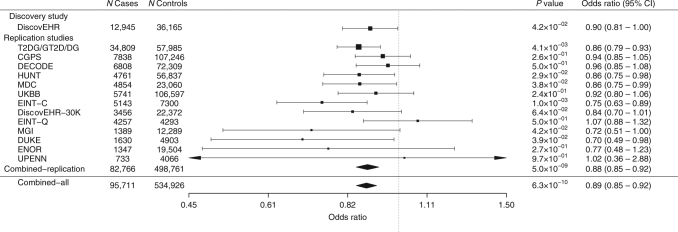
Fig. 1
Fig. 1
ANGPTL4 p.E40K associates with reduced risk of type 2 diabetes. The association between the p.E40K variant and type 2 diabetes was tested in each study using logistic or Firth logistic regression, coding genotypes according to an additive model. “Combined” effects were calculated using inverse variance weighted fixed-effects meta-analysis. For each study, the squares indicate the odds ratio and lines indicate 95% confidence intervals. The square size is proportional to the standard error of the estimate. CI confidence interval, CGPS Copenhagen General Population Studies, DECODE deCODE, DiscovEHR DiscovEHR Discovery Study, DiscovEHR DiscovEHR-30K, DiscovEHR 30K Replication Study, EINT-C EPIC interact–CoreExome, EINT-Q EPIC Interact–Quad660, ENOR EPIC Norfolk, HUNT the Nord-Trøndelag Health study, MDC Malmo Diet and Cancer Study, MGI the Michigan Genomics Initiative, TD2G/GT2D/DG combined analysis of T2D-GENES, GoT2D, and DIAGRAM studies, UKBB United Kingdom Biobank. The study populations are described in full in Supplementary Table 4 and in the Supplementary Note
Fig. 2
Fig. 2
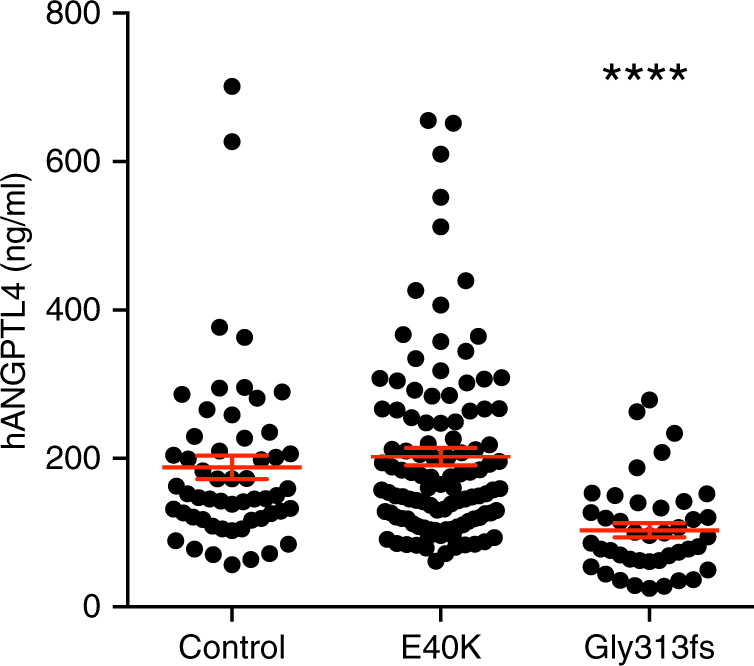
Plasma ANGPTL4 levels are reduced in p.G313fs carriers. ANGPTL4 plasma levels were measured in fasted serum from 86 heterozygous p.E40K, 42 heterozygous p.G313fs variant carriers, and 55 controls matched for age, sex, and body mass index. Statistics performed by unpaired t-test with Welch’s correction, comparing each variant carriers group to controls, ****p < 0.0001
Fig. 3
Fig. 3
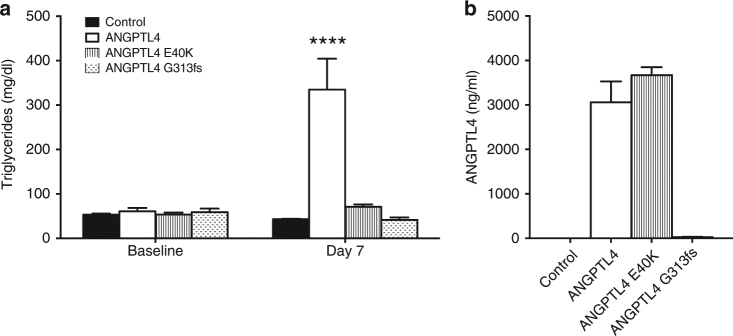
K40 and G313fs abolish ANGPTL4 effect on triglycerides. a Plasma triglycerides levels (4 h fasted) in C57Bl/6 mice before (Baseline) and 7 days after (Day 7) hydrodynamic delivery via tail vein injection of cDNA encoding human E40, K40, and Gly313fs ANGPTL4 variants. Control animals were injected with empty vector. b ANGPTL4 plasma levels were measured in the animals described in (a). All groups had five animals. Values are mean ± SEM. Statistics performed by two-way ANOVA with Bonferroni correction, ****p < 0.0001 vs control
Fig. 4
Fig. 4
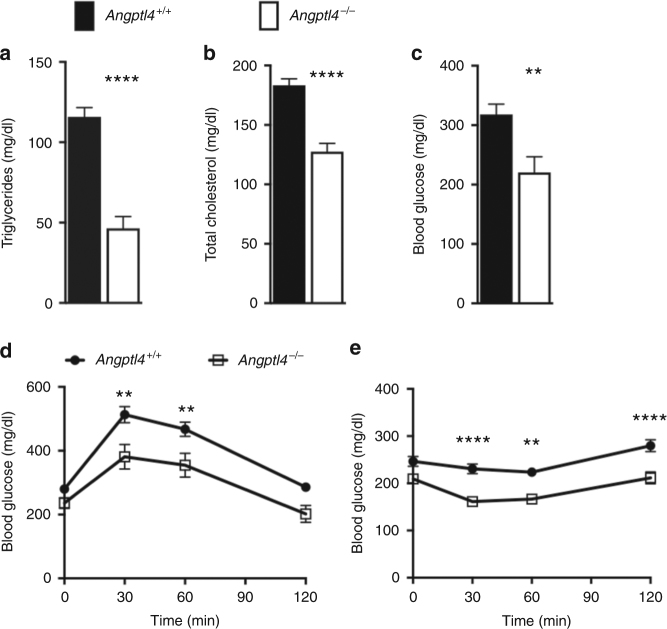
Angptl4−/− mice have improved glucose homeostasis. a Serum triglycerides, (b) total cholesterol, and (c) blood glucose levels in Angptl4−/− and littermate control mice on a high-fat diet for 9 weeks. d Oral glucose tolerance test and (e) insulin tolerance test in the animals described in (ac). All groups had 9–11 animals. Values are mean ± SEM. Statistical analysis by Welch’s t-test (a) and 2-way ANOVA with Sidak’s post-test (d, e), **p < 0.001, ****p < 0.0001. The study was conducted in three different cohorts of mice, with qualitatively similar results in each replicate
Fig. 5
Fig. 5
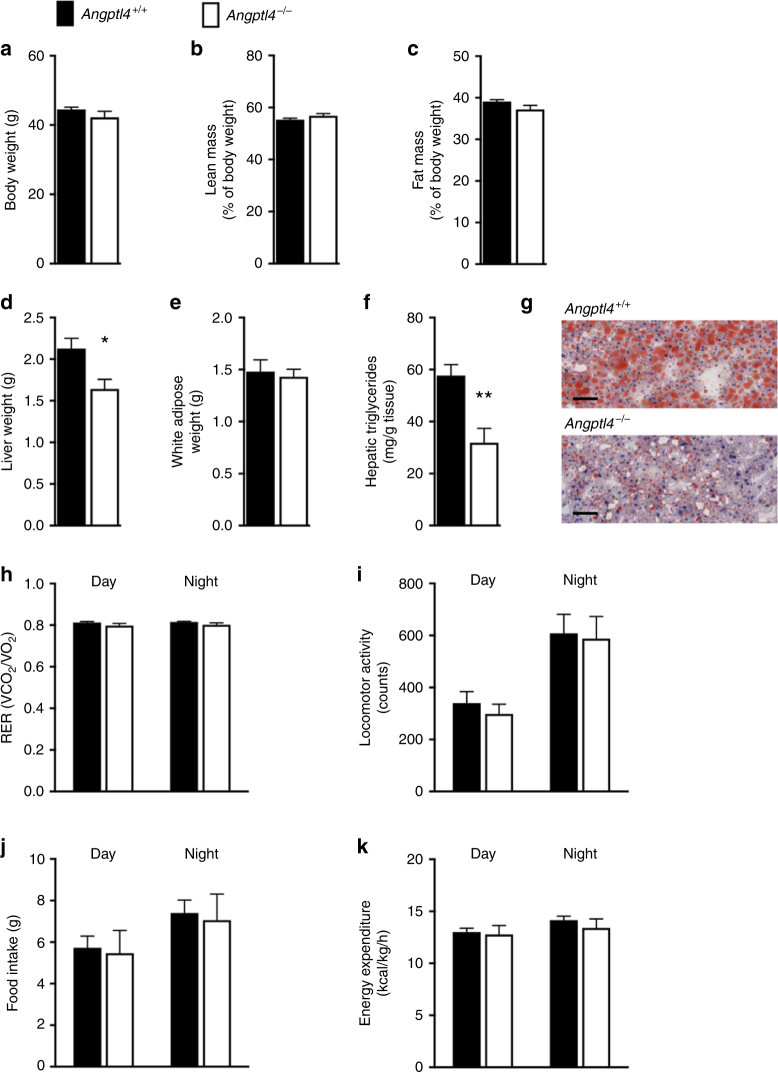
Angptl4−/− mice have reduced liver fat. a Body weight, (b) lean and (c) fat mass in Angptl4−/− and littermate control mice on a high-fat diet. d Liver and (e) epididymal white fat weights were evaluated in mice described in (a–c) at the time of killing. f Hepatic triglyceride levels and (g) neutral lipid staining in the livers described in (d), scale bar = 200 µm. h Respiratory exchange ratio (RER), (i) locomotor activity, (j) food intake, and (k) energy expenditure were measured during dark and light cycles in Angptl4−/− and littermate control mice on a high-fat diet. All values are mean ± SEM. Statistical analysis was conducted by Welch’s t-test; *p < 0.05; **p < 0.01. The study was conducted in two different cohorts of mice, with qualitatively similar results in each replicate

References

    1. Yoshida K, Shimizugawa T, Ono M, Furukawa H. Angiopoietin-like protein 4 is a potent hyperlipidemia-inducing factor in mice and inhibitor of lipoprotein lipase. J. Lipid Res. 2002;43:1770–1772. doi: 10.1194/jlr.C200010-JLR200. - DOI - PubMed
    1. Yau MH, et al. A highly conserved motif within the NH2-terminal coiled-coil domain of angiopoietin-like protein 4 confers its inhibitory effects on lipoprotein lipase by disrupting the enzyme dimerization. J. Biol. Chem. 2009;284:11942–11952. doi: 10.1074/jbc.M809802200. - DOI - PMC - PubMed
    1. Sukonina V, Lookene A, Olivecrona T, Olivecrona G. Angiopoietin-like protein 4 converts lipoprotein lipase to inactive monomers and modulates lipase activity in adipose tissue. Proc. Natl. Acad. Sci. USA. 2006;103:17450–17455. doi: 10.1073/pnas.0604026103. - DOI - PMC - PubMed
    1. Koster A, et al. Transgenic angiopoietin-like (angptl)4 overexpression and targeted disruption of angptl4 and angptl3: regulation of triglyceride metabolism. Endocrinology. 2005;146:4943–4950. doi: 10.1210/en.2005-0476. - DOI - PubMed
    1. Romeo S, et al. Population-based resequencing of ANGPTL4 uncovers variations that reduce triglycerides and increase HDL. Nat. Genet. 2007;39:513–516. doi: 10.1038/ng1984. - DOI - PMC - PubMed

MeSH terms