


Visual Acuity in Late Adolescence and Future Psychosis Risk in a Cohort of 1 Million Men
- PMID: 29901774
- PMCID: PMC6483575
- DOI: 10.1093/schbul/sby084
Visual Acuity in Late Adolescence and Future Psychosis Risk in a Cohort of 1 Million Men
Abstract
Background: We aimed to determine whether late adolescent visual impairment is associated with later psychosis.
Methods: We conducted a longitudinal cohort study of Swedish male military conscripts aged 18 or 19 years from January 1, 1974, through December 31, 1997 (N = 1140710). At conscription, uncorrected and optometry-lens-corrected distance visual acuity was measured. Participants were then followed up to see if they received an inpatient diagnosis of non-affective psychotic disorder, including schizophrenia (N = 10769). Multivariable Cox modeling was used to estimate differences between groups.
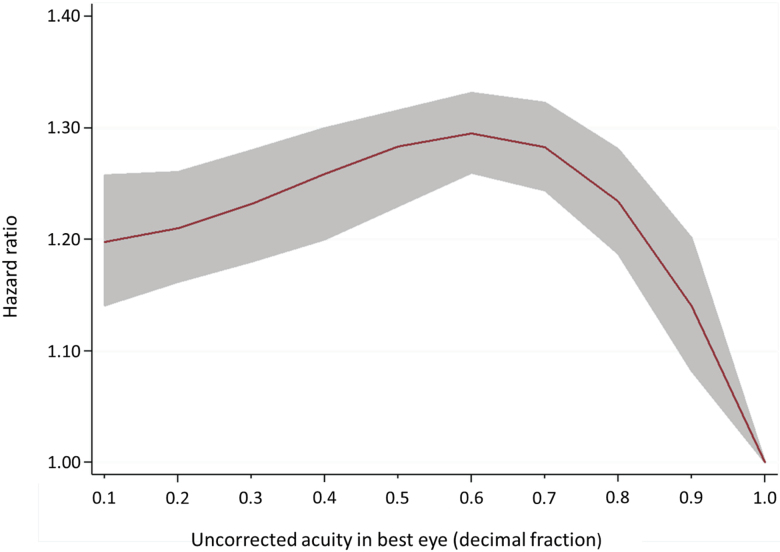
Results: After adjustment for confounders, those with severe impairment before optical correction in their best eye (decimal fraction <0.3) had an increased psychosis rate compared to those with normal uncorrected vision (decimal fraction 1.0) (hazard ratio [HR] 1.26, 95% CI 1.16-1.37). Larger interocular visual acuity difference was associated with an increased psychosis rate (adjusted HR 1.49, 95% CI 1.37-1.63 in those with differences >0.5 compared to those with no between eye acuity difference). Individuals with impaired vision that could not be corrected to normal with lenses had highest rates of psychosis (best eye adjusted HR 1.56; 95% CI 1.33-1.82), those with imperfect, but correctable vision also had elevated rates (best eye adjusted HR 1.21; 95% CI 1.15-1.28). Individuals with visual impairment had higher rates of psychosis than their full siblings with normal vision (adjusted HR 1.20, 95% CI 1.07-1.35).
Conclusions: Impaired visual acuity is associated with non-affective psychosis. Visual impairment as a phenotype in psychosis requires further consideration.
Keywords: eyesight; schizophrenia; sibling-design; vision.
© The Author(s) 2018. Published by Oxford University Press on behalf of the Maryland Psychiatric Research Center.
Figures
References
-
- Schubert EW, Henriksson KM, McNeil TF. A prospective study of offspring of women with psychosis: visual dysfunction in early childhood predicts schizophrenia-spectrum disorders in adulthood. Acta Psychiatr Scand. 2005;112:385–393. - PubMed
-
- Schiffman J, Maeda JA, Hayashi K, et al. Premorbid childhood ocular alignment abnormalities and adult schizophrenia-spectrum disorder. Schizophr Res. 2006;81:253–260. - PubMed
-
- Nieman D, Becker H, van de Fliert R, et al. Antisaccade task performance in patients at ultra high risk for developing psychosis. Schizophr Res. 2007;95:54–60. - PubMed
-
- Kiss I, Fábián A, Benedek G, Kéri S. When doors of perception open: visual contrast sensitivity in never-medicated, first-episode schizophrenia. J Abnorm Psychol. 2010;119:586–593. - PubMed
Publication types
MeSH terms
Grants and funding
LinkOut - more resources
Full Text Sources
Other Literature Sources
Medical
