


Statins increase the risk of herpes zoster: A propensity score-matched analysis
- PMID: 29902266
- PMCID: PMC6001979
- DOI: 10.1371/journal.pone.0198263
Statins increase the risk of herpes zoster: A propensity score-matched analysis
Abstract
Objectives: Statins, which are lipid-lowering agents, have anti-inflammatory and immunomodulatory properties that may affect the occurrence of various infectious diseases. We assessed whether statins increase the risk of herpes zoster (HZ) with propensity score-matching.
Methods: The study was based on the National Health Insurance database and its subset database of the "medical check-up" population of South Korea. These cohorts consist of about one million and 570,000 people, respectively, representative of the entire population of South Korea. We identified 103,930 statin users and 430,685 non-statin users. After propensity score-matching, 25,726 statin users and the same number of non-statin users were finally analyzed. The development of HZ was monitored in these matched pairs over the 11 years from 2003 to 2013.
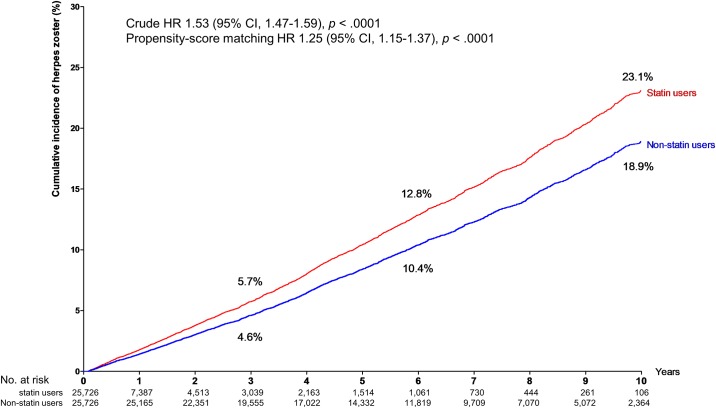
Results: Statin users had a significantly higher risk of HZ than non-statin users: hazard ratio (HR) 1.25 (95% CI, 1.15 to 1.37) (p < .0001). The risk of HZ associated with statins was especially high in the elderly: HR 1.39 (95% CI, 1.12 to 1.73) in the over 70-year-olds (p = 0.003) and HR 1.18 (95% CI, 1.00 to 1.39) in the 60-to-69-year-olds (p = 0.056). Furthermore, there was a significant p for trend in terms of cumulative dose effect between the risk of HZ and the duration of statin use (p < .0001).
Conclusions: These epidemiologic findings provide strong evidence for an association between HZ and statin use, and suggest that unnecessary statins should be avoided.
Conflict of interest statement
There are no potential conflicts of interest for any authors.
Figures

References
-
- Collins R, Reith C, Emberson J, Armitage J, Baigent C, Blackwell L, et al. Interpretation of the evidence for the efficacy and safety of statin therapy. Lancet. 2016; 388: 2532–2561. doi: 10.1016/S0140-6736(16)31357-5 - DOI - PubMed
-
- Kawai K, Gebremeskel BG, Acosta CJ. Systematic review of incidence and complications of herpes zoster: towards a global perspective. BMJ Open. 2014; 4: e004833 doi: 10.1136/bmjopen-2014-004833 - DOI - PMC - PubMed
-
- Thomas SL, Hall AJ. What does epidemiology tell us about risk factors for herpes zoster? Lancet Infect Dis. 2004; 4: 26–33. - PubMed
-
- Antoniou T, Zheng H, Singh S, Juurlink DN, Mamdani MM, Gomes T. Statins and the risk of herpes zoster: a population-based cohort study. Clin Infect Dis. 2014; 58: 350–356. doi: 10.1093/cid/cit745 - DOI - PMC - PubMed
-
- Chung SD, Tsai MC, Liu SP, Lin HC, Kang JH. Herpes zoster is associated with prior statin use: a population-based case-control study. PLoS One. 2014; 9: e111268 doi: 10.1371/journal.pone.0111268 - DOI - PMC - PubMed
Publication types
MeSH terms
Substances
LinkOut - more resources
Full Text Sources
Other Literature Sources
Medical
