. 2018;89(6):413-422.
doi: 10.1159/000488347. Epub 2018 Jun 14.

Congenital Hyperinsulinism in Infants with Turner Syndrome: Possible Association with Monosomy X and KDM6A Haploinsufficiency

Affiliations

Congenital Hyperinsulinism in Infants with Turner Syndrome: Possible Association with Monosomy X and KDM6A Haploinsufficiency

Christopher E Gibson et al. Horm Res Paediatr. 2018.

Abstract

Background: Previous case reports have suggested a possible association of congenital hyperinsulinism with Turner syndrome.

Objective: We examined the clinical and molecular features in girls with both congenital hyperinsulinism and Turner syndrome seen at The Children's Hospital of Philadelphia (CHOP) between 1974 and 2017.

Methods: Records of girls with hyperinsulinism and Turner syndrome were reviewed. Insulin secretion was studied in pancreatic islets and in mouse islets treated with an inhibitor of KDM6A, an X chromosome gene associated with hyperinsulinism in Kabuki syndrome.

Results: Hyperinsulinism was diagnosed in 12 girls with Turner syndrome. Six were diazoxide-unresponsive; 3 had pancreatectomies. The incidence of Turner syndrome among CHOP patients with hyperinsulinism (10 of 1,050 from 1997 to 2017) was 48 times more frequent than expected. The only consistent chromosomal anomaly in these girls was the presence of a 45,X cell line. Studies of isolated islets from 1 case showed abnormal elevated cytosolic calcium and heightened sensitivity to amino acid-stimulated insulin release; similar alterations were demonstrated in mouse islets treated with a KDM6A inhibitor.

Conclusion: These results demonstrate a higher than expected frequency of Turner syndrome among children with hyperinsulinism. Our data suggest that haploinsufficiency for KDM6A due to mosaic X chromosome monosomy may be responsible for hyperinsulinism in Turner syndrome.

Keywords: Beta cell; Congenital hyperinsulinism; Diazoxide; Genetics; Hypoglycemia; Pancreatectomy; Turner syndrome; X chromosome.


Figures

Fig. 1.
Fig. 1.
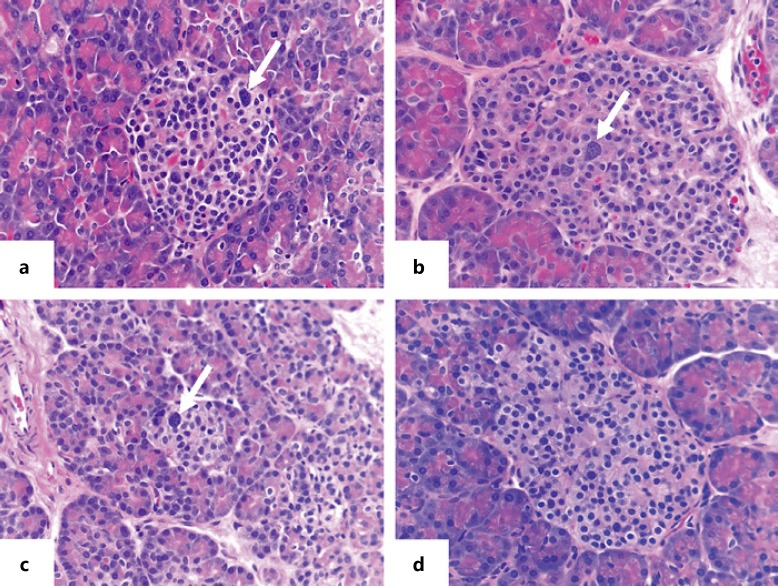
Pancreatic histology of congenital hyperinsulinism in Turner syndrome. a, b Appearance of pancreatic islets in case 3 and case 7 with Turner syndrome and hyperinsulinism. c Pancreas of infant with diffuse KATP hyperinsulinism. d Normal islet in the unaffected region of pancreas from an infant operated on for focal hyperinsulinism. Histopathology of the 2 Turner syndrome cases and the KATP hyperinsulinism case shows similar changes of scattered islet cell nucleomegaly (arrows) and normal lobular parenchymal architecture typical of diffuse hyperinsulinism. HE staining. 40× magnification.
Fig. 2.
Fig. 2.
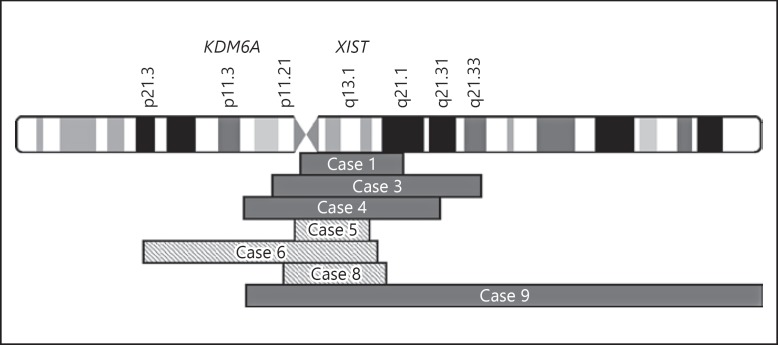
Regions retained on marker X chromosomes in 7 mosaic Turner syndrome girls with congenital hyperinsulinism. Marker X chromosomes ranged in size from 18 Mb (case 5) to approximately 109 Mb (case 9). Marker X chromosomes were confirmed to be in a ring conformation in cases 5, 6, and 8 (hatched). Case 9 had an isodicentric X chromosome. All abnormal X chromosomes retained the XIST locus (Xq13.1); only case 6 retained the KDM6A gene locus (Xp11.3).
Fig. 3.
Fig. 3.
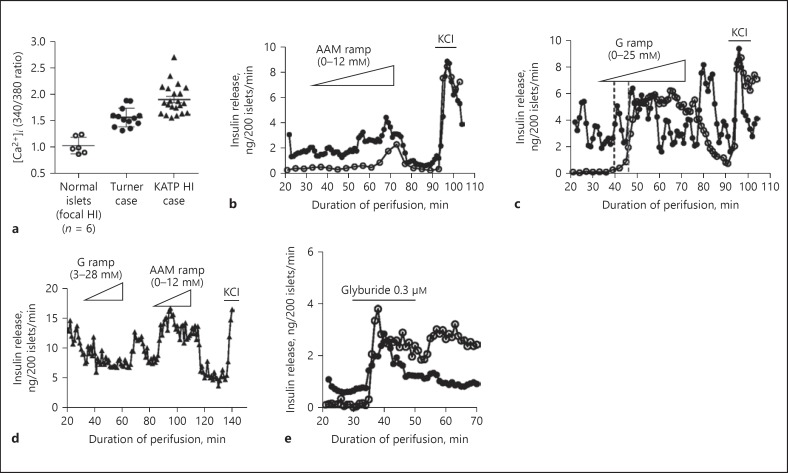
Functional studies of isolated islets from Turner syndrome case 7. a Basal cytosolic calcium was elevated in islets from case 7 (filled circles) compared to age-matched control islets (n = 6, open circles) and similar to islets from a child with loss of function mutations in the KATP gene ABCC8 (filled triangles). Basal calcium measurements from control islets from 6 individuals are shown as averages while the calcium measurements in islets from 1 Turner syndrome case and 1 KATP hyperinsulinism (HI) case are shown as individual islets. Note that basal insulin secretion was also elevated in islets from case 7 compared to control islets (b, c), similar to the elevation of basal insulin release in islets from a patient with KATP hyperinsulinism (d). b Insulin secretion was stimulated by an amino acid mixture (AAM) in islets from case 7 and was minimal in control islets. c Insulin secretion was stimulated by a glucose (G) ramp in normal islets and in islets from case 7 (dashed lines indicate threshold concentrations for insulin release: 2.5 mM in case 7 vs. 5.6 mM in control islets). d Islets from a child with hyperinsulinism due to compound heterozygous inactivating mutations of ABCC8 (c.2222 + 15c>a and c.1933delG) responded to stimulation with an amino acid mixture (AAM) ramp, but failed to respond to a glucose (G) ramp. e Insulin secretion was stimulated by glyburide, a KATP channel antagonist, in both control islets and in islets from case 7.
Fig. 4.
Fig. 4.
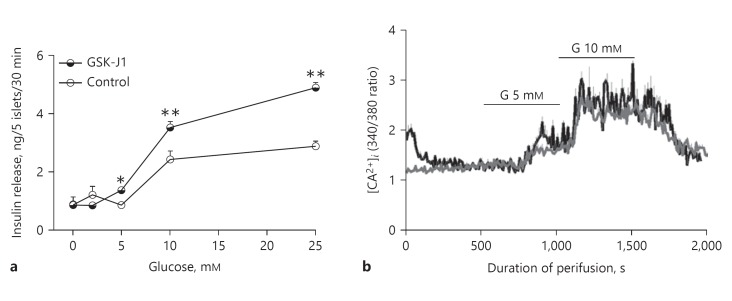
Effects of a KDM6A inhibitor (GSK-J1) on responses of normal isolated mouse islets. Isolated mouse islets were first cultured with KDM6A inhibitor (GSK-J1), 0.5 µM, for 3 days, removed from GSK-J1 during a 30-min glucose-free preincubation, and then exposed to different concentrations of glucose for another 30 min in the absence of the inhibitor. a GSK-J1-G SIS-mouse. Islets incubated with GSK-J1 (filled circles) exhibited a leftward shift in glucose-stimulated insulin secretion with increased release of insulin at 10 and 25 mM glucose compared to control islets (open circles). * p < 0.05, ** p < 0.01, vs. control. b Basal cytosolic calcium was initially elevated in islets following exposure to GSK-J1 inhibitor (black line) during 3 days of culture, but showed similar cytosolic calcium responses compared to control islets (grey line) during perifusion with 5 or 10 mM glucose (G) in the absence of GSK-J1.

References

    1. Bondy CA, Turner Syndrome Study Group Care of girls and women with Turner syndrome: a guideline of the Turner Syndrome Study Group. J Clin Endocrinol Metab. 2007 Jan;92((1)):10–25. - PubMed
    1. Gravholt CH, Andersen NH, Conway GS, Dekkers OM, Geffner ME, Klein KO, et al. International Turner Syndrome Consensus Group Clinical practice guidelines for the care of girls and women with Turner syndrome: proceedings from the 2016 Cincinnati International Turner Syndrome Meeting. Eur J Endocrinol. 2017 Sep;177((3)):G1–70. - PubMed
    1. Nielsen J, Wohlert M. Chromosome abnormalities found among 34,910 newborn children: results from a 13-year incidence study in Arhus, Denmark. Hum Genet. 1991 May;87((1)):81–3. - PubMed
    1. Shankar RK, Backeljauw PF. Current best practice in the management of Turner syndrome. Ther Adv Endocrinol Metab. 2018 Jan;9((1)):33–40. - PMC - PubMed
    1. Bakalov VK, Cooley MM, Quon MJ, Luo ML, Yanovski JA, Nelson LM, et al. Impaired insulin secretion in the Turner metabolic syndrome. J Clin Endocrinol Metab. 2004 Jul;89((7)):3516–20. - PubMed