Review
. 2018 Jun 14;10(6):201.
doi: 10.3390/cancers10060201.

Designer Oncolytic Adenovirus: Coming of Age

Affiliations
Review

Designer Oncolytic Adenovirus: Coming of Age

Alexander T Baker et al. Cancers (Basel). .

Abstract

The licensing of talimogene laherparepvec (T-Vec) represented a landmark moment for oncolytic virotherapy, since it provided unequivocal evidence for the long-touted potential of genetically modified replicating viruses as anti-cancer agents. Whilst T-Vec is promising as a locally delivered virotherapy, especially in combination with immune-checkpoint inhibitors, the quest continues for a virus capable of specific tumour cell killing via systemic administration. One candidate is oncolytic adenovirus (Ad); it’s double stranded DNA genome is easily manipulated and a wide range of strategies and technologies have been employed to empower the vector with improved pharmacokinetics and tumour targeting ability. As well characterised clinical and experimental agents, we have detailed knowledge of adenoviruses’ mechanisms of pathogenicity, supported by detailed virological studies and in vivo interactions. In this review we highlight the strides made in the engineering of bespoke adenoviral vectors to specifically infect, replicate within, and destroy tumour cells. We discuss how mutations in genes regulating adenoviral replication after cell entry can be used to restrict replication to the tumour, and summarise how detailed knowledge of viral capsid interactions enable rational modification to eliminate native tropisms, and simultaneously promote active uptake by cancerous tissues. We argue that these designer-viruses, exploiting the viruses natural mechanisms and regulated at every level of replication, represent the ideal platforms for local overexpression of therapeutic transgenes such as immunomodulatory agents. Where T-Vec has paved the way, Ad-based vectors now follow. The era of designer oncolytic virotherapies looks decidedly as though it will soon become a reality.

Keywords: adenovirus; cancer; immunotherapy; oncolytic; targeting; tropism; virotherapy; αvβ6 integrin.


Conflict of interest statement

The authors declare no conflict of interest.

Figures
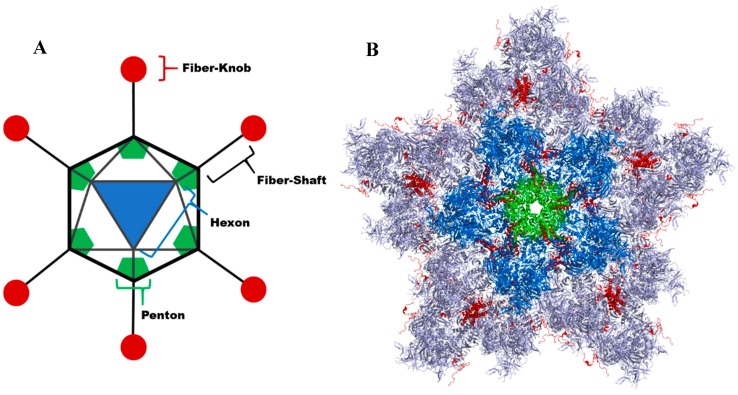
Figure 1
Figure 1
Adenovirus Structure. Cartoon view of adenovirus, highlighting the major capsid proteins as labelled (A). Structural view of an adenovirus vertex modelled from CryoEM structure (PDB: 6B1T) showing penton (green) with hexons (dark and light blue) and minor capsid proteins (red) (B).
Figure 2
Figure 2
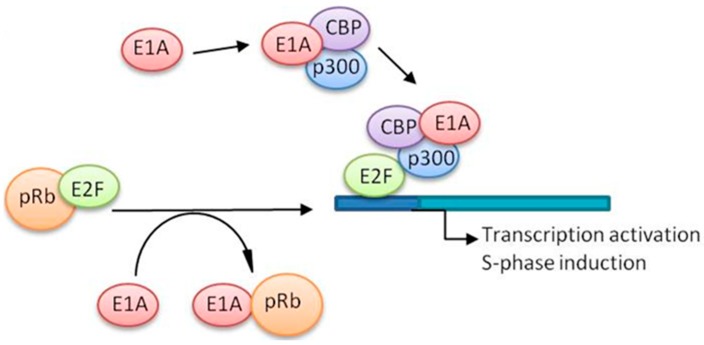
Schematic representation of E1A-mediated regulation of the cell cycle. The E1A adenoviral protein promotes S-phase induction by interacting with pRB and p300.
Figure 3
Figure 3
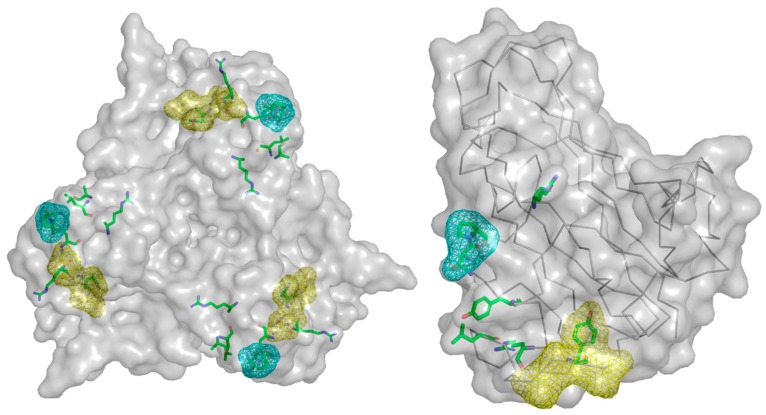
Coxsackie and Adenovirus Receptor (CAR) interacting residues within the Ad5 fiber knob domain. Known CAR interacting residues are shown as green sticks. The blue and yellow mesh shows the surface of the KO1 and ΔTAYT mutations, respectively. Structure from PDB: 1KNB.
Figure 4
Figure 4
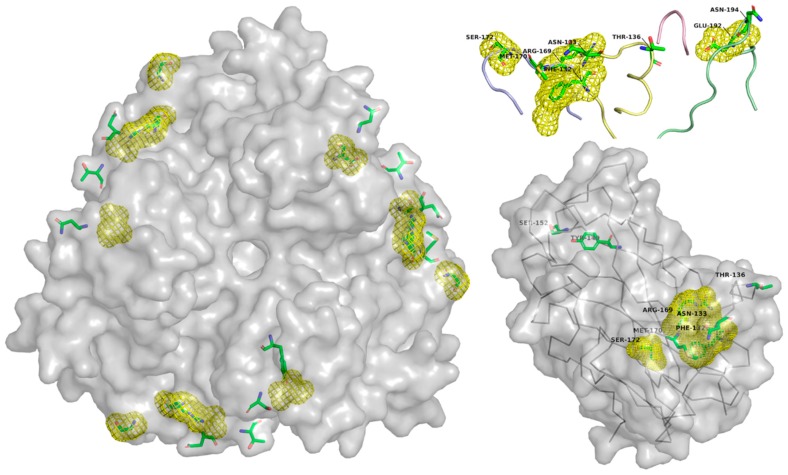
Membrane cofactor (CD46) interacting residues, and known mutation sites, within the Ad35 fiber knob domain: The key residues which interact with CD46 are shown as green sticks. The yellow surface shows the region in which known mutations which abrogate CD46 interaction occur. In the top right is a detailed view of the 4 loops which interact with CD46, HI (blue), DG (yellow), GH (red), and IJ (green). Structure from PDB: 2QLK.
Figure 5
Figure 5
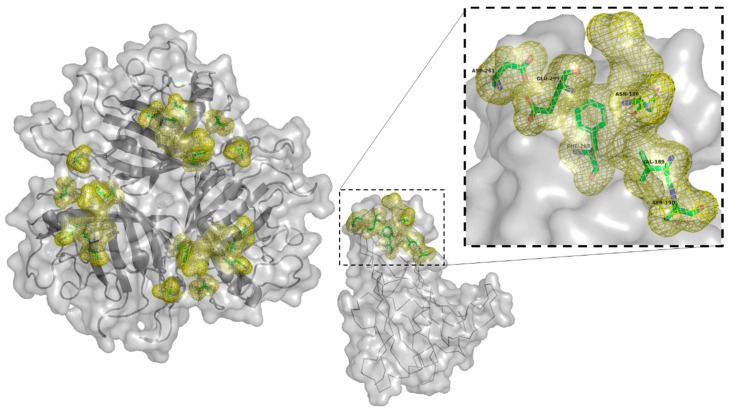
DSG2 interacting residues, and known mutation sites, within the Ad3 fiber knob domain: The key residues which interact with DSG2 are shown as green sticks. The yellow surface shows the region in which known mutations which abrogate DSG2 interaction occur. Structure from PDB: 1H7Z.
Figure 6
Figure 6
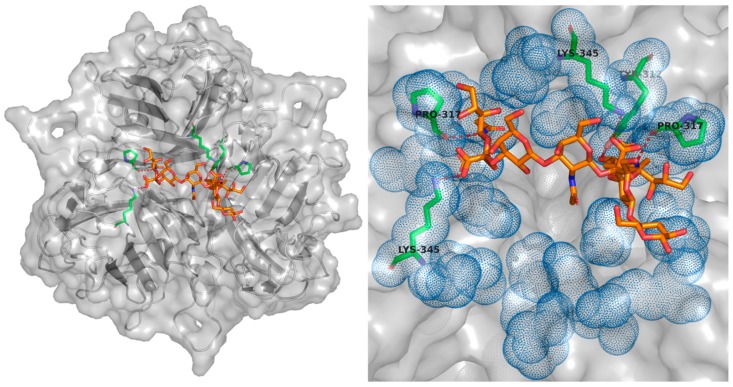
GD1a/Sialic Acid interacting residues within the Ad37 fiber knob domain. Key residues forming the GD1a-Ad37Fkn interaction are shown as green sticks, with the GD1a in orange, hydrogen bonds are shown by red dashes. While the interface can occur in three orientations, only one set of interacting residues is shown. The blue dots show the surface of all residues shown to be able to interact with GD1a or support the interaction, seen to create a large apical binding pocket. Structure from PDB: 3N0I.
Figure 7
Figure 7
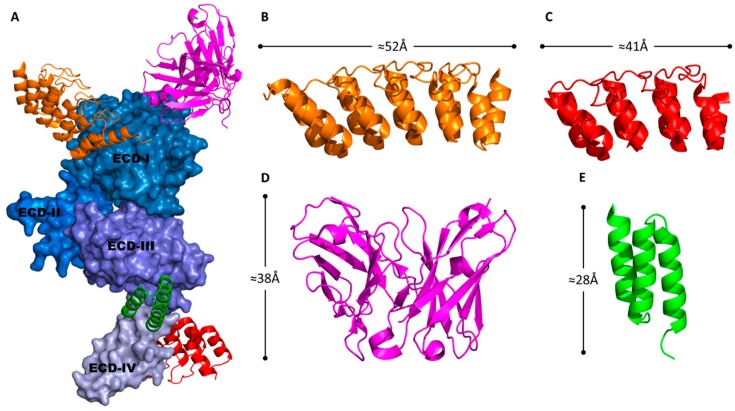
Overview of antibody-like proteins specific to Human Epidermal growth factor Receptor 2 (HER2) which have been genetically integrated into Adenovirus. HER2 is composed of 4 domains, Extra Cellular Domain (ECD) I-IV which can be bound by different proteins (A). The Designed Ankyrin Repeat Proteins (DARPIN’s) 9.29 (B) and G3 (C) are seen in orange and red complexing ECD-I and ECD-IV, respectively. ScFv chA21 (D) is seen in purple complexing ECD-1 (this particular ScFv has not previously been integrated to Adenovirus), and affibody ZHER2 (E) is seen in green binding at the ECD-III/IV interface. All molecules are shown to scale, structures from PDB: 4HRL, 4HRN, 3H3B, and 3MZW.

References

    1. Medawar P.B., Medawar J.S. Aristotle to Zoos: A Philosophical Dictionary of Biology. Harvard University Press; Cambridge, MA, USA: 1985.
    1. Koprowski H., Koprowska I., Love R. Ascites Tumor-Virus System as a Biological Tool. Proc. Natl. Acad. Sci. USA. 1953;39:1147–1148. doi: 10.1073/pnas.39.11.1147. - DOI - PMC - PubMed
    1. Harrington K.J., Vile R.G., Melcher A., Chester J., Pandha H.S. Clinical trials with oncolytic reovirus: Moving beyond phase I into combinations with standard therapeutics. Cytokine Growth Factor Rev. 2010;21:91–98. doi: 10.1016/j.cytogfr.2010.02.006. - DOI - PMC - PubMed
    1. Sanchala D.S., Bhatt L.K., Prabhavalkar K.S. Oncolytic Herpes Simplex Viral Therapy: A Stride toward Selective Targeting of Cancer Cells. Front. Pharmacol. 2017;8 doi: 10.3389/fphar.2017.00270. - DOI - PMC - PubMed
    1. Search of: Adenovirus OR Adv OR Adenoviral OR Ad|Recruiting, Not yet Recruiting, Active, Not Recruiting, Enrolling by Invitation Studies|Cancer NOT Communicable—List Results—ClinicalTrials.gov. [(accessed on 18 March 2018)]; Available online: https://clinicaltrials.gov/ct2/results?cond=Cancer+NOT+communicable&term...