. 2018 Jun 14;8(1):9139.
doi: 10.1038/s41598-018-26980-7.

Multi-material Additive Manufacturing of Metamaterials with Giant, Tailorable Negative Poisson's Ratios

Affiliations

Multi-material Additive Manufacturing of Metamaterials with Giant, Tailorable Negative Poisson's Ratios

Da Chen et al. Sci Rep. .

Abstract

Nature has evolved with a recurring strategy to achieve unusual mechanical properties through coupling variable elastic moduli from a few GPa to below KPa within a single tissue. The ability to produce multi-material, three-dimensional (3D) micro-architectures with high fidelity incorporating dissimilar components has been a major challenge in man-made materials. Here we show multi-modulus metamaterials whose architectural element is comprised of encoded elasticity ranging from rigid to soft. We found that, in contrast to ordinary architected materials whose negative Poisson's ratio is dictated by their geometry, these type of metamaterials are capable of displaying Poisson's ratios from extreme negative to zero, independent of their 3D micro-architecture. The resulting low density metamaterials is capable of achieving functionally graded, distributed strain amplification capabilities within the metamaterial with uniform micro-architectures. Simultaneous tuning of Poisson's ratio and moduli within the 3D multi-materials could open up a broad array of material by design applications ranging from flexible armor, artificial muscles, to actuators and bio-mimetic materials.


Conflict of interest statement

The programmable multi-material digital light manufacturing system was submitted for international patent application.

Figures
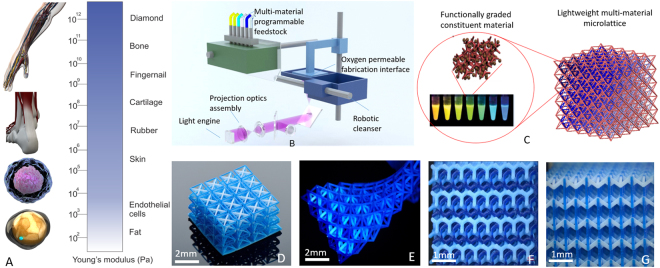
Figure 1
Figure 1
Fabrication of 3D multi-material microlattice with dissimilar constituent material (A) Schematic of 3D multi-material microlattice with encoded stiffness, (B) Experimental setup of modular digital light projection microstereolithgoraphy technique coupled with in situ-microfluidic systems for resin delivery. (C) As-fabricated bi-material lattice comprised of clear and yellow rigid polymer constituents. (D) As-fabricated isotropic re-entrant microlattice comprised of rigid polymer resin (blue) and ceramic polymer composite. (F) As-fabricated isotropic re-entrant microlattice comprised of a rubbery polymer and rigid polymer. (E) As-fabricated two-phase 3D gryoid separator.
Figure 2
Figure 2
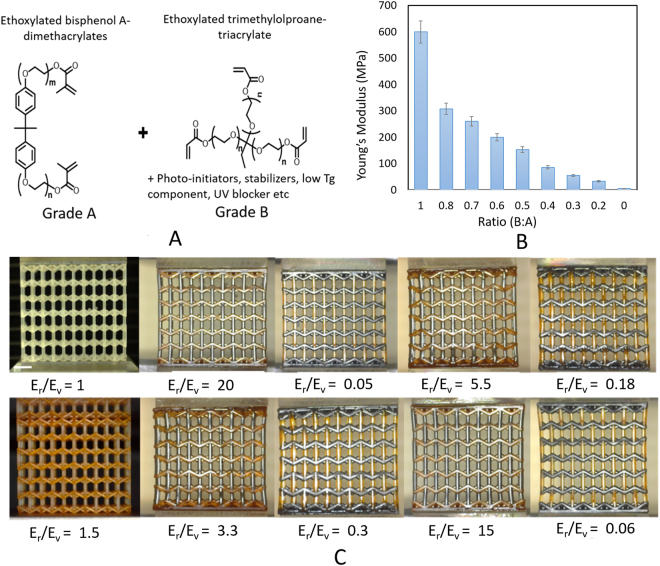
Constituent materials with large stiffness gradients. (A) Basic monomer composition that offer low and high stiffness. (B) Tunable bandwidth of stiffness in solidified photopolymers. (C) 3D printed multi-material microlattice with different stiffness ratio R varying between re-entrant and vertical strut members. Scale bar represents 2 mm.
Figure 3
Figure 3
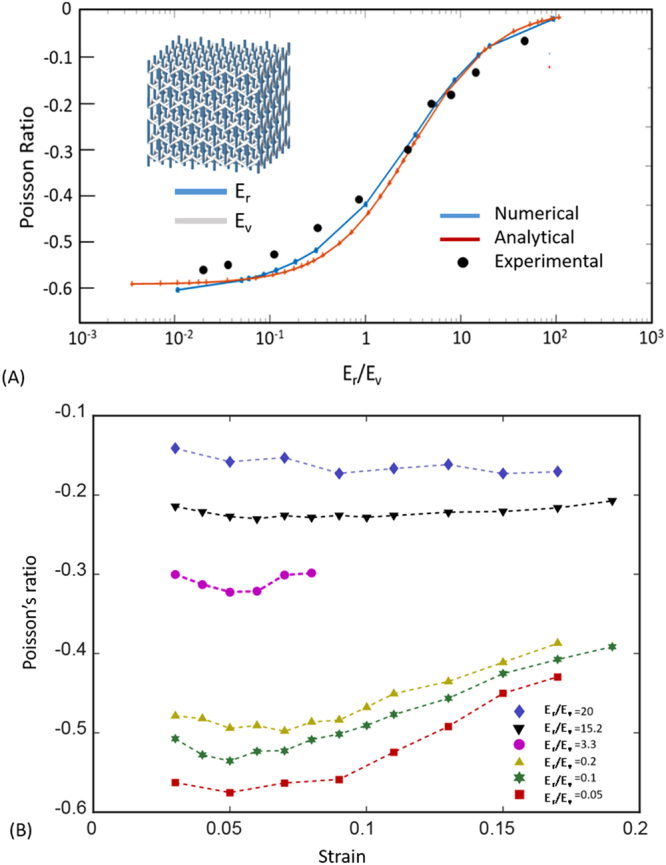
(A) Comparison between analytical, experimental and numerical calculation of tunable Poisson’s ratio from zero to negative as a function of dissimilar material stiffness ratio in an isotropic 3D re-entrant honeycomb metamaterial. (B) Effective Poisson ratios as a function of pulling strain in the longitudinal directions corresponding to metamaterial with different moduli ratios in 3D printed materials shown in Fig. 2C.
Figure 4
Figure 4
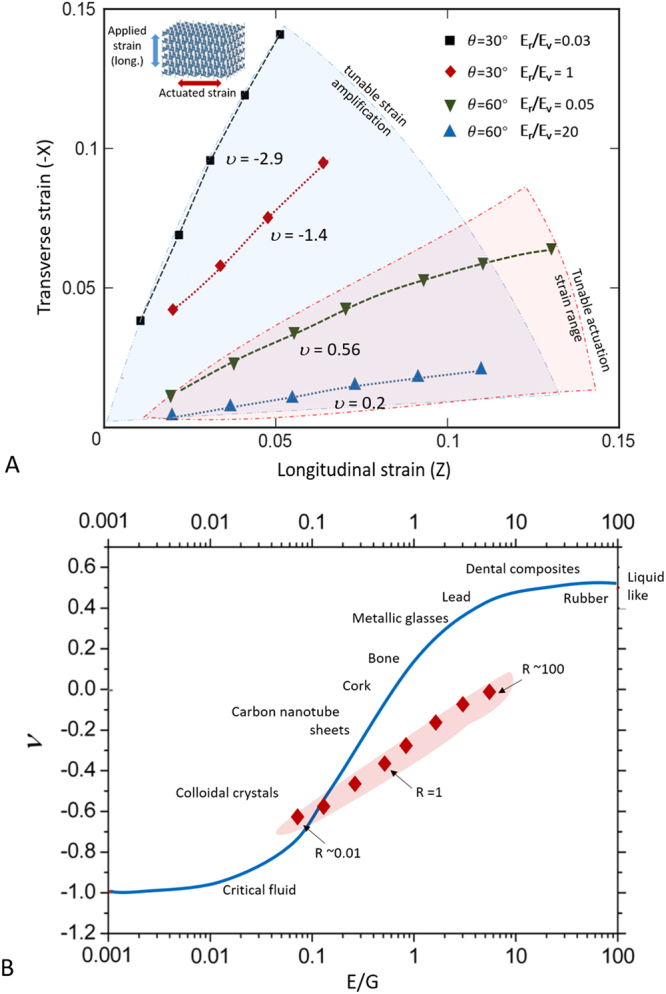
Tunable actuation strain and modulus in programmable multi-material metamaterials (A) Tunable transverse actuation strain tuning as a function of longitudinal strain. The negative expansion in transverse direction can be modulated through combinations of dissimilar Young’s modulus in (r) and (v) strut members within a single auxetic 3D honeycomb microlattice. (B) Plot of Poisson’s ratio vs. Young’s modulus/Shear modulus of architected metamaterials in comparison with bulk materials. R refers to Young’s modulus gradient within the micro-architecture of the metamaterials.

References

    1. Schaedler TA, et al. Ultralight Metallic Microlattices. Science. 2011;334:962–965. doi: 10.1126/science.1211649. - DOI - PubMed
    1. Zheng X, et al. Ultralight, ultrastiff mechaniacal metamaterials. Science. 2014;344:1373–1377. doi: 10.1126/science.1252291. - DOI - PubMed
    1. Meza LR, Das S, Greer JR. Strong, lightweight, and recoverable three-dimensional ceramic nanolattices. Science. 2014;345:1322–1326. doi: 10.1126/science.1255908. - DOI - PubMed
    1. Clausen A, Wang FW, Jensen JS, Sigmund O, Lewis JA. Topology Optimized Architectures with Programmable Poisson’s Ratio over Large Deformations. Adv Mater. 2015;27:5523–5527. doi: 10.1002/adma.201502485. - DOI - PubMed
    1. Bertoldi K, Reis PM, Willshaw S, Mullin T. Negative Poisson’s Ratio Behavior Induced by an Elastic Instability. Adv Mater. 2010;22:361–+. doi: 10.1002/adma.200901956. - DOI - PubMed

Publication types