


Breast cancer risk markedly lower with serum 25-hydroxyvitamin D concentrations ≥60 vs <20 ng/ml (150 vs 50 nmol/L): Pooled analysis of two randomized trials and a prospective cohort
- PMID: 29906273
- PMCID: PMC6003691
- DOI: 10.1371/journal.pone.0199265
Breast cancer risk markedly lower with serum 25-hydroxyvitamin D concentrations ≥60 vs <20 ng/ml (150 vs 50 nmol/L): Pooled analysis of two randomized trials and a prospective cohort
Abstract
Background: While numerous epidemiologic studies have found an association between higher serum 25-hydroxyvitamin D [25(OH)D] concentrations and lower breast cancer risk, few have assessed this association for concentrations >40 ng/ml.
Objective: To investigate the relationship between 25(OH)D concentration and breast cancer risk across a broad range of 25(OH)D concentrations among women aged 55 years and older.
Methods: Analyses used pooled data from two randomized clinical trials (N = 1129, N = 2196) and a prospective cohort (N = 1713) to examine a broad range of 25(OH)D concentrations. The outcome was diagnosis of breast cancer during the observation periods (median: 4.0 years). Three analyses were conducted: 1) Incidence rates were compared according to 25(OH)D concentration from <20 to ≥60 ng/ml (<50 to ≥150 nmol/L), 2) Kaplan-Meier plots were developed and 3) multivariate Cox regression was used to examine the association between 25(OH)D and breast cancer risk using multiple 25(OH)D measurements.
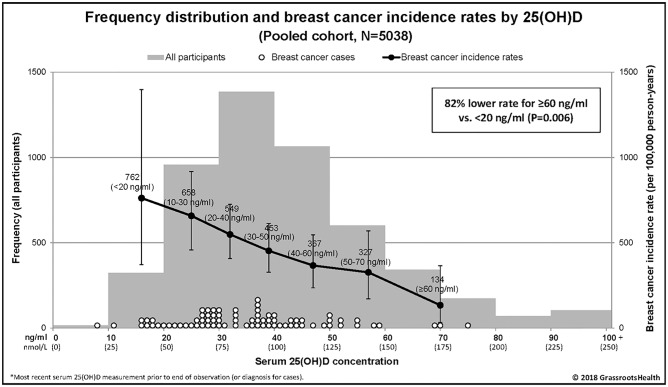
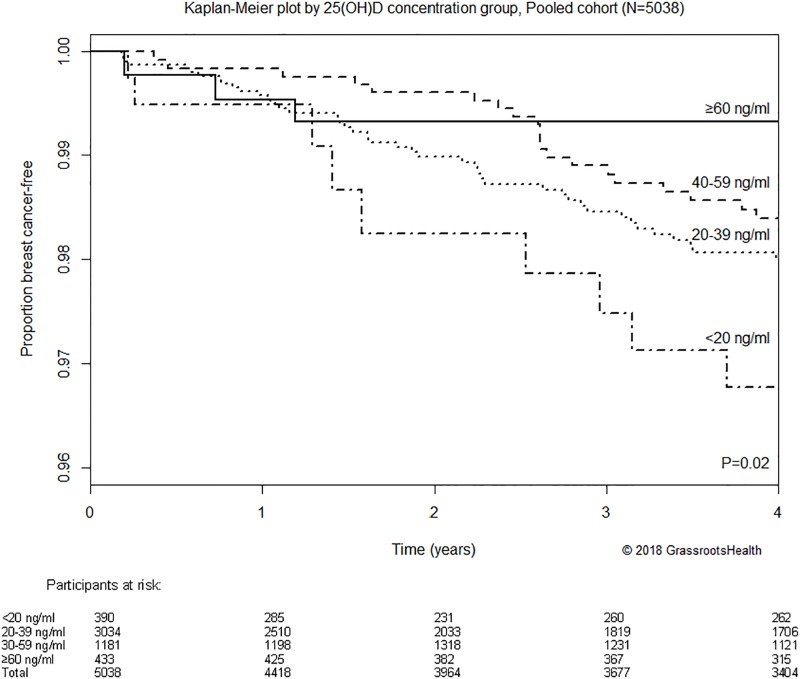
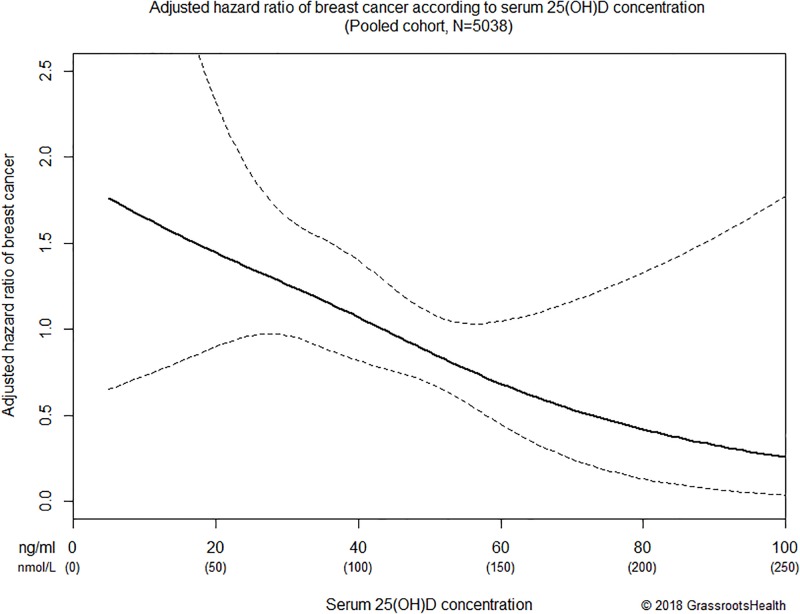
Results: Within the pooled cohort (N = 5038), 77 women were diagnosed with breast cancer (age-adjusted incidence: 512 cases per 100,000 person-years). Results were similar for the three analyses. First, comparing incidence rates, there was an 82% lower incidence rate of breast cancer for women with 25(OH)D concentrations ≥60 vs <20 ng/ml (Rate Ratio = 0.18, P = 0.006). Second, Kaplan-Meier curves for concentrations of <20, 20-39, 40-59 and ≥60 ng/ml were significantly different (P = 0.02), with the highest proportion breast cancer-free in the ≥60 ng/ml group (99.3%) and the lowest proportion breast cancer-free in the <20 ng/ml group (96.8%). The proportion with breast cancer was 78% lower for ≥60 vs <20 ng/ml (P = 0.02). Third, multivariate Cox regression revealed that women with 25(OH)D concentrations ≥60 ng/ml had an 80% lower risk of breast cancer than women with concentrations <20 ng/ml (HR = 0.20, P = 0.03), adjusting for age, BMI, smoking status, calcium supplement intake, and study of origin.
Conclusions: Higher 25(OH)D concentrations were associated with a dose-response decrease in breast cancer risk with concentrations ≥60 ng/ml being most protective.
Conflict of interest statement
Bio-Tech Pharmacal was a commercial source of funding. It did not have any relationship with GrassrootsHealth, UC San Diego, MUSC, Inova Schar, or Creighton University with regard to employment, patents, projects in development, or products marketed. Representatives of this source did not review the manuscript or play any role in design, analysis, or writing of the manuscript and had no control over any decision to publish it. This does not alter our adherence to PLOS ONE policies on sharing data and materials.
Figures
References
-
- National Cancer Institute (NCI). Cancer Statistics for Breast (Female). https://seer.cancer.gov/statfacts/html/breast.html. Accessed November 13, 2017.
-
- Siegel R. L., Miller K. D. and Jemal A. (2017), Cancer statistics, 2017. CA: A Cancer Journal for Clinicians, 67: 7–30. - PubMed
-
- Gorham ED, Garland CF, Garland FC. Acid haze air pollution and breast and colon cancer mortality in 20 Canadian cities. Can J Public Health. 1989. Mar-Apr;80(2):96–100. - PubMed
-
- Gorham ED, Garland FC, Garland CF. Sunlight and breast cancer incidence in the USSR. Int J Epidemiol. 1990. December;19(4):820–4. - PubMed
-
- Garland FC, Garland CF, Gorham ED, Young JF. Geographic variation in breast cancer mortality in the United States: a hypothesis involving exposure to solar radiation. Prev Med. 1990. November;19(6):614–22. - PubMed
Publication types
MeSH terms
Substances
LinkOut - more resources
Full Text Sources
Other Literature Sources
Medical
