


More than cholesterol catabolism: regulatory vulnerabilities in Mycobacterium tuberculosis
- PMID: 29906645
- PMCID: PMC6005656
- DOI: 10.1016/j.cbpa.2018.05.012
More than cholesterol catabolism: regulatory vulnerabilities in Mycobacterium tuberculosis
Abstract
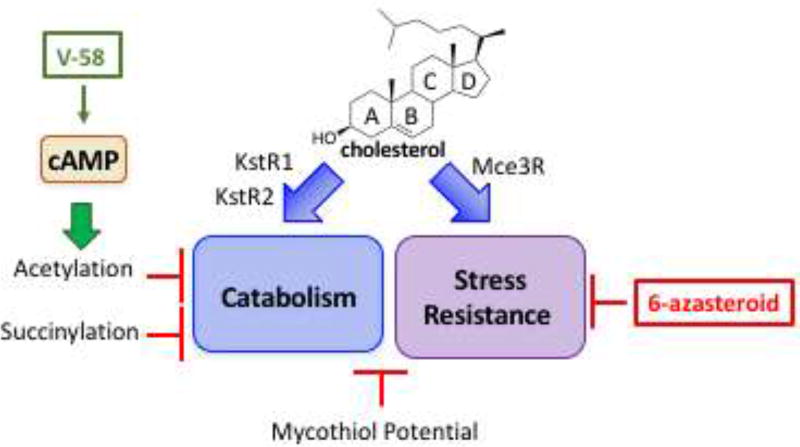
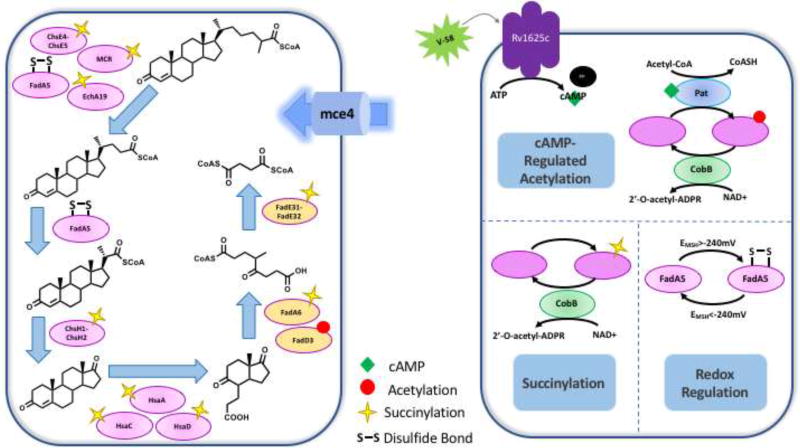
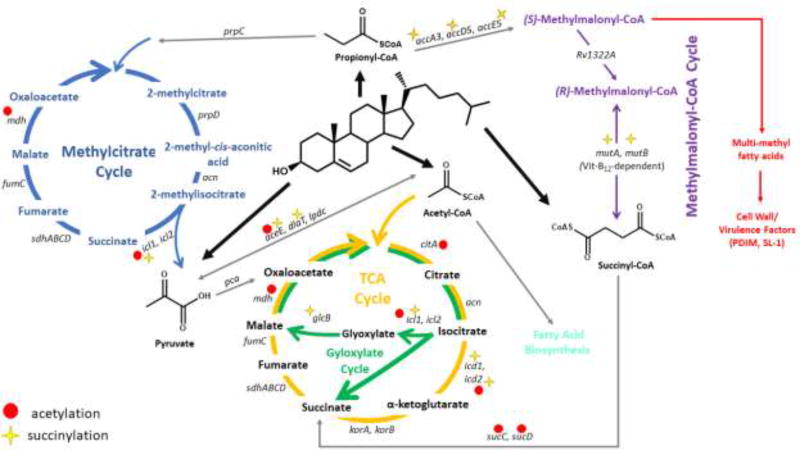
Mycobacterium tuberculosis (Mtb) is the epitome of persistent. Mtb is the pathogen that causes tuberculosis, the leading cause of death by infection worldwide. The success of this pathogen is due in part to its clever ability to adapt to its host environment and its effective manipulation of the host immune system. A major contributing factor to the survival and virulence of Mtb is its acquisition and metabolism of host derived lipids including cholesterol. Accumulating evidence suggests that the catabolism of cholesterol during infection is highly regulated by cholesterol catabolites. We review what is known about how regulation interconnects with cholesterol catabolism. This framework provides support for an indirect approach to drug development that targets Mtb cholesterol metabolism through dysregulation of nutrient utilization pathways.
Copyright © 2018 Elsevier Ltd. All rights reserved.
Figures
References
-
- Russell DG. Mycobacterium tuberculosis: here today, and here tomorrow. Nat Rev Mol Cell Biol. 2001;2(8):569–577. - PubMed
-
- Cambier CJ, Falkow S, Ramakrishnan L. Host evasion and exploitation schemes of Mycobacterium tuberculosis. Cell. 2014;159(7):1497–1509. - PubMed
-
- Peyron P, Vaubourgeix J, Poquet Y, Levillain F, Botanch C, Bardou F, Daffe M, Emile JF, Marchou B, Cardona PJ, de Chastellier C, et al. Foamy macrophages from tuberculous patients' granulomas constitute a nutrient-rich reservoir for M. tuberculosis persistence. PLoS Pathog. 2008;4(11):e1000204. - PMC - PubMed
Publication types
MeSH terms
Substances
Grants and funding
LinkOut - more resources
Full Text Sources
Other Literature Sources
Medical
