. 2018 Aug;9(4):1533-1547.
doi: 10.1007/s13300-018-0458-5. Epub 2018 Jun 15.

Semaglutide s.c. Once-Weekly in Type 2 Diabetes: A Population Pharmacokinetic Analysis

Affiliations

Semaglutide s.c. Once-Weekly in Type 2 Diabetes: A Population Pharmacokinetic Analysis

Kristin Cecilie Carlsson Petri et al. Diabetes Ther. 2018 Aug.

Abstract

Introduction: Semaglutide, a new treatment option approved for the treatment of patients with type 2 diabetes mellitus, is a glucagon-like peptide-1 receptor agonist to be injected subcutaneously once weekly. This analysis used a population pharmacokinetic model of semaglutide to identify clinically relevant covariates for exposure.

Methods: A total of 1612 patients with up to seven pharmacokinetic observations each were included in the analysis. All subjects had type 2 diabetes mellitus and were enrolled in one of five trials in the phase III development program for subcutaneous semaglutide once weekly (the SUSTAIN program). The treatment duration of the trials varied from 30 to 104 weeks.

Results: No clinically relevant effects on the exposure were seen for sex, age, race, ethnicity, renal function, or injection site used, and semaglutide exposure was stable over time. Of the covariates chosen, only body weight had a relevant effect on the exposure of semaglutide. Few subjects developed semaglutide antibodies, and the antibodies had no effect on exposure. Dose proportionality was shown for the 0.5 mg and 1.0 mg maintenance doses of semaglutide.

Conclusion: The population pharmacokinetic study showed that semaglutide exposure is not affected by covariates other than body weight at either a maintenance dose of 0.5 or 1.0 mg semaglutide. Therefore, we conclude that no semaglutide dose adjustments are needed in different populations. This finding is to be further explored in an exposure-response analysis.

Trial registration: The trials were registered at ClinicalTrials.gov (identifiers: NCT02054897, NCT01930188, NCT01885208, NCT01720446 and NCT02207374).

Funding: Novo Nordisk A/S, Bagsværd, Denmark.

Keywords: GLP-1 analog; GLP-1 receptor agonist; Population pharmacokinetics; Semaglutide.


Figures
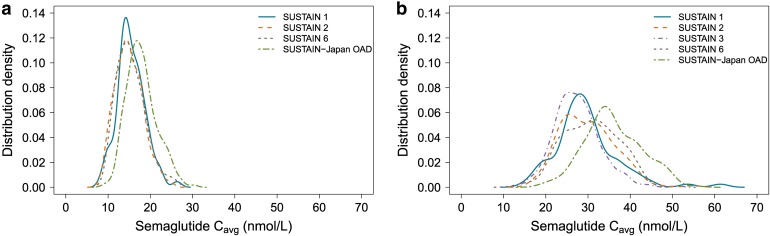
Fig. 1
Fig. 1
Distribution of exposure values from trials included in the population PK analysis. a Exposure for subjects treated with 0.5 mg semaglutide; b exposure for subjects treated with 1.0 mg semaglutide. PK pharmacokinetic, SUSTAIN Semaglutide Unabated Sustainability in Treatment of Type 2 Diabetes
Fig. 2
Fig. 2
Forest plot of covariate analysis for semaglutide exposure expressed as steady-state dose-normalized average semaglutide concentrations relative to a reference subject. The reference subject profile was non-Hispanic or Latino, white, female, below 65 years, with a body weight of 85 kg, with normal renal function, and who was dosed in the abdomen with semaglutide 1 mg. The column to the right shows means and 90% CI for the relative exposures. Two additional race groups (American Indian or Alaska native, n = 3 subjects, and unknown, n = 41) were included in the analysis without a separate race covariate, i.e., modeled as the reference race group (white) in the covariate analysis. Subjects without information on race were from France (n = 20), Mexico (n = 13), Canada and the USA (n = 2 each), Australia, Norway, South Africa, and the UK (n = 1 each). Body weight test categories (55 and 127 kg) represent the 5% and 95% percentiles, respectively, in the data set. Vertical dotted lines indicate the acceptance interval for bioequivalence (0.80; 1.25). Cavg average semaglutide concentrations at steady state; CI confidence interval
Fig. 3
Fig. 3
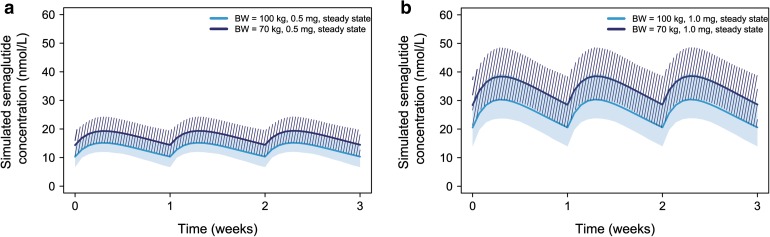
Simulated concentration profiles for semaglutide 0.5 mg (a) or 1.0 mg (b) at steady state over 3 weeks, with variability. The shaded area illustrates the simulated 95% concentration range predicted from the between-subject variability in the full population PK model (N = 1000 replications in each group). BW body weight
Fig. 4
Fig. 4
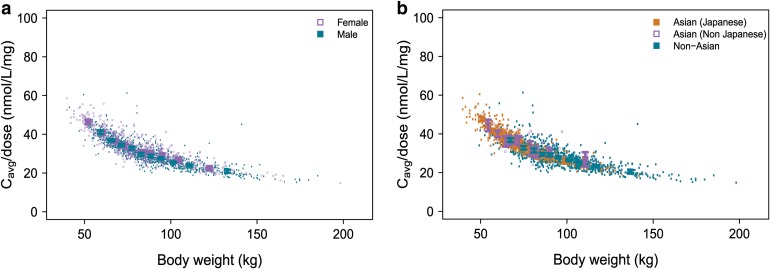
Semaglutide exposure versus body weight. Data are dose-normalized individual average semaglutide concentrations (Cavg) versus baseline body weight (small rectangles) and mean exposure estimates versus body weight presented in 10 quantiles by sex (a) or by ethnicity (b)
Fig. 5
Fig. 5
Simulated semaglutide concentration profiles following missed or delayed doses. Data are simulated concentrations during once-weekly dosing at steady-state concentrations with one missed dose at week 11 (a) and for a dose with a delay of 5 days at week 11 (b) compared with a steady-state profile for semaglutide dosed at weekly intervals. Simulations are for a reference subject profile (non-Hispanic or Latino, white female < 65 years, with a body weight of 85 kg, with normal renal function, and dosed in the abdomen with semaglutide 1.0 mg)

References

    1. Collaboration NCDRF. Worldwide trends in diabetes since 1980: a pooled analysis of 751 population-based studies with 4.4 million participants. Lancet. 2016;387:1513–30. - PMC - PubMed
    1. International Diabetes Federation . IDF diabetes atlas. 7. Brussels: International Diabetes Federation; 2015. - PubMed
    1. Giovannucci E, Harlan DM, Archer MC, Bergenstal RM, Gapstur SM, Habel LA, et al. Diabetes and cancer: a consensus report. Diabetes Care. 2010;33:1674–1685. doi: 10.2337/dc10-0666. - DOI - PMC - PubMed
    1. Laakso M. Cardiovascular disease in type 2 diabetes from population to man to mechanisms: the Kelly West Award Lecture 2008. Diabetes Care. 2010;33:442–449. doi: 10.2337/dc09-0749. - DOI - PMC - PubMed
    1. Noto H, Tsujimoto T, Sasazuki T, Noda M. Significantly increased risk of cancer in patients with diabetes mellitus: a systematic review and meta-analysis. EndocrPract. 2011;17:616–628. - PubMed

Associated data