


No neurodevelopmental benefit of cerebral oximetry in the first randomised trial (SafeBoosC II) in preterm infants during the first days of life
- PMID: 29908039
- PMCID: PMC6585779
- DOI: 10.1111/apa.14463
No neurodevelopmental benefit of cerebral oximetry in the first randomised trial (SafeBoosC II) in preterm infants during the first days of life
Abstract
Aim: Cerebral hypoxia has been associated with neurodevelopmental impairment. We studied whether reducing cerebral hypoxia in extremely preterm infants during the first 72 hours of life affected neurological outcomes at two years of corrected age.
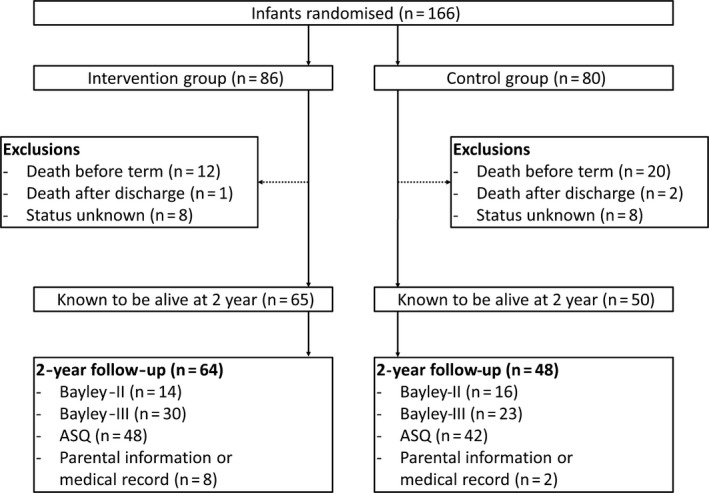
Methods: In 2012-2013, the phase II randomised Safeguarding the Brains of our smallest Children trial compared visible cerebral near-infrared spectroscopy (NIRS) monitoring in an intervention group and blinded NIRS monitoring in a control group. Cerebral hypoxia was significantly reduced in the intervention group. We followed up 115 survivors from eight European centres at two years of corrected age, by conducting a medical examination and assessing their neurodevelopment with the Bayley Scales of Infant and Toddler Development, Second or Third Edition, and the parental Ages and Stages Questionnaire (ASQ).
Results: There were no differences between the intervention (n = 65) and control (n = 50) groups with regard to the mean mental developmental index (89.6 ± 19.5 versus 88.4 ± 14.7, p = 0.77), ASQ score (215 ± 58 versus 213 ± 58, p = 0.88) and the number of children with moderate-to-severe neurodevelopmental impairment (10 versus six, p = 0.58).
Conclusion: Cerebral NIRS monitoring was not associated with long-term benefits or harm with regard to neurodevelopmental outcome at two years of corrected age.
Keywords: Ages and stages questionnaire; Bayley scales of infant and toddler development; Cerebral near-infrared spectroscopy; Extremely preterm infants; Neurodevelopment.
©2018 The Authors. Acta Paediatrica published by John Wiley & Sons Ltd on behalf of Foundation Acta Paediatrica.
Conflict of interest statement
The authors do not have any conflict of interests to declare.
Figures
References
-
- Volpe JJ. Brain injury in the premature infant. Neuropathology, clinical aspects, pathogenesis, and prevention. Clin Perinatol 1997; 24: 567–87. - PubMed
-
- Soul JS, Hammer PE, Tsuji M, Saul JP, Bassan H, Limperopoulos C, et al. Fluctuating pressure‐passivity is common in the cerebral circulation of sick premature infants. Pediatr Res 2007; 61: 467–73. - PubMed
-
- Boylan GB, Young K, Panerai RB, Rennie JM, Evans DH. Dynamic cerebral autoregulation in sick newborn infants. Pediatr Res 2000; 48: 12–7. - PubMed
-
- Riera J, Cabañas F, Serrano JJ, Madero R, Pellicer A. New developments in cerebral blood flow autoregulation analysis in preterm infants: a mechanistic approach. Pediatr Res 2016; 79: 460–5. - PubMed
-
- Andersen CC, Karayil SM, Hodyl NA, Stark MJ. Early red cell transfusion favourably alters cerebral oxygen extraction in very preterm newborns. Arch Dis Child Fetal Neonatal Ed 2015; 100: F433–5. - PubMed
Publication types
MeSH terms
Grants and funding
LinkOut - more resources
Full Text Sources
Other Literature Sources
