


Genome sequencing uncovers phenocopies in primary progressive multiple sclerosis
- PMID: 29908077
- PMCID: PMC6119489
- DOI: 10.1002/ana.25263
Genome sequencing uncovers phenocopies in primary progressive multiple sclerosis
Abstract
Objective: Primary progressive multiple sclerosis (PPMS) causes accumulation of neurological disability from disease onset without clinical attacks typical of relapsing multiple sclerosis (RMS). However, whether genetic variation influences the disease course remains unclear. We aimed to determine whether mutations causative of neurological disorders that share features with multiple sclerosis (MS) contribute to risk for developing PPMS.
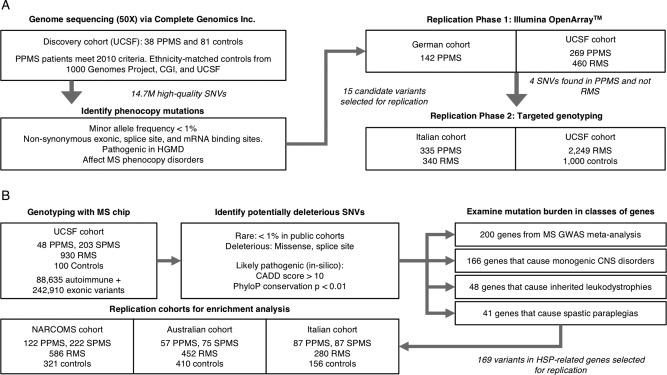
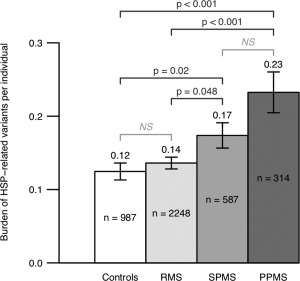
Methods: We examined whole-genome sequencing (WGS) data from 38 PPMS and 81 healthy subjects of European ancestry. We selected pathogenic variants exclusively found in PPMS patients that cause monogenic neurological disorders and performed two rounds of replication genotyping in 746 PPMS, 3,049 RMS, and 1,000 healthy subjects. To refine our findings, we examined the burden of rare, potentially pathogenic mutations in 41 genes that cause hereditary spastic paraplegias (HSPs) in PPMS (n = 314), secondary progressive multiple sclerosis (SPMS; n = 587), RMS (n = 2,248), and healthy subjects (n = 987) genotyped using the MS replication chip.
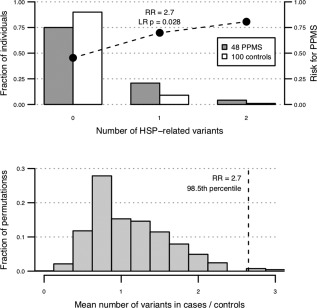
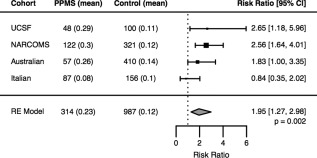
Results: WGS and replication studies identified three pathogenic variants in PPMS patients that cause neurological disorders sharing features with MS: KIF5A p.Ala361Val in spastic paraplegia 10; MLC1 p.Pro92Ser in megalencephalic leukodystrophy with subcortical cysts, and REEP1 c.606 + 43G>T in Spastic Paraplegia 31. Moreover, we detected a significant enrichment of HSP-related mutations in PPMS patients compared to controls (risk ratio [RR] = 1.95; 95% confidence interval [CI], 1.27-2.98; p = 0.002), as well as in SPMS patients compared to controls (RR = 1.57; 95% CI, 1.18-2.10; p = 0.002). Importantly, this enrichment was not detected in RMS.
Interpretation: This study provides evidence to support the hypothesis that rare Mendelian genetic variants contribute to the risk for developing progressive forms of MS. Ann Neurol 2018;83:51-63.
© 2018 American Neurological Association.
Conflict of interest statement
Nothing to report.
Figures
Comment in
-
New rare genetic variants in multiple sclerosis.J Neurol. 2019 Jan;266(1):278-280. doi: 10.1007/s00415-018-9128-9. J Neurol. 2019. PMID: 30460446 Free PMC article. No abstract available.
References
-
- Louapre C, Lubetzki C, Matute C, Seze J, Giovannoni G, Hemmer B. Neurodegeneration in multiple sclerosis is a process separate from inflammation: yes. Mult Scler J 2015;21:1626–1628. - PubMed
-
- Cree BA. Genetics of primary progressive multiple sclerosis. Handb Clin Neurol 2014;122:211–230. - PubMed
-
- Jenkins TM, Khaleeli Z, Thompson AJ. Diagnosis and management of primary progressive multiple sclerosis. Minerva Med 2008;99:141–155. - PubMed
Publication types
MeSH terms
Substances
Supplementary concepts
Grants and funding
LinkOut - more resources
Full Text Sources
Other Literature Sources
Molecular Biology Databases
