


Review
doi: 10.1016/j.ceb.2018.05.016.
Epub 2018 Jun 19.
Tissue aging: the integration of collective and variant responses of cells to entropic forces over time
Affiliations
- PMID: 29908481
- PMCID: PMC6258070
- DOI: 10.1016/j.ceb.2018.05.016
Item in Clipboard
Review
Tissue aging: the integration of collective and variant responses of cells to entropic forces over time
Curr Opin Cell Biol.
2018 Oct.
Abstract
Aging is driven by unavoidable entropic forces, physicochemical in nature, that damage the raw materials that constitute biological systems. Single cells experience and respond to stochastic physicochemical insults that occur either to the cells themselves or to their microenvironment, in a dynamic and reciprocal manner, leading to increased age-related cell-to-cell variation. We will discuss the biological mechanisms that integrate cell-to-cell variation across tissues resulting in stereotypical phenotypes of age.
Copyright © 2018 Elsevier Ltd. All rights reserved.
Figures
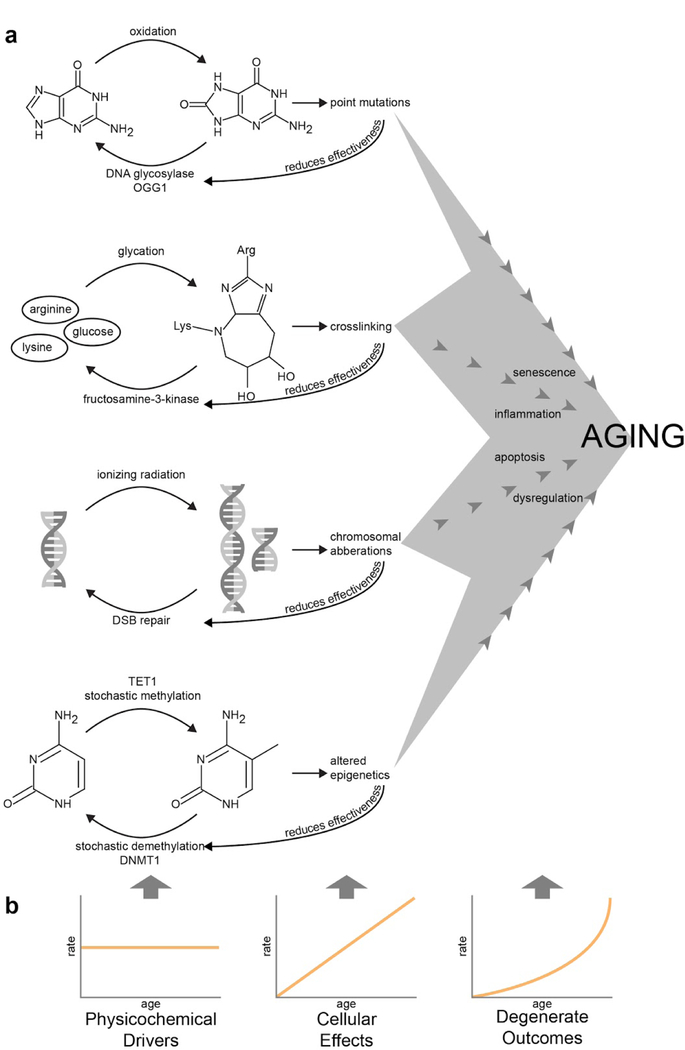
(a) A handful of distinct physicochemical drivers of aging, each antagonized by a biological repair mechanism, eventually leads to distinct cellular effects and shared degenerate outcomes. (b) Due to continually reduced effectiveness of the repair mechanisms, a constant level of physicochemical damage leads to an increasing quantity of cellular effects and an accelerating amount of degenerate outcomes.OGG1 repairs 8-oxoguanine[57], fructosamine 3-kinase deglycates proteins[17], double-strand break (DSB) repair involves various pathways[58], and TET1 and DNMT1 maintain methylation fidelity by acting on hemimethylated DNA[59].
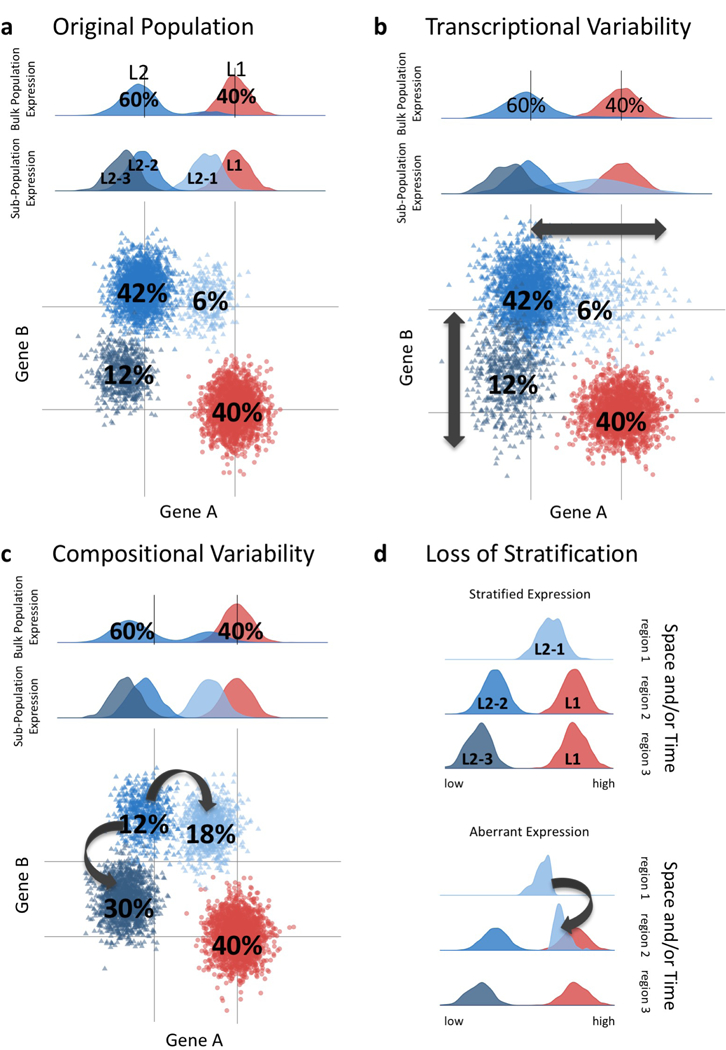
There are multiple routes to achieve age-associated variability among the cells that derive tissues. Hypothetical single-cell RNA sequencing shows heterogeneity of cell populations within a tissue. (a) Two hypothetical lineages each with a given frequency: L1=40% and L2=60% are depicted. At single cell resolution, one can observe multiple sub-populations of L2, e.g. L2–1 (6%), L2–2 (36%), and L2–3 (18%). Histograms of expression of Gene A of the bulk population and sub-populations shown in the top two panels. Dot-plot showing lineage-specific expression of Genes A and B are shown in the bottom panel. (b) Increased transcriptional variability with age has been reported. A hypothetical example in shown whereby expression of Genes A and B in the L2 sub-populations increases in variance, leading to an apparent loss of lineage-specific expression with age. (c) Changes with age in the composition of lineages that comprise a tissue has been reported. Change in sub-population frequency is shown with reduction of L2–2 (12%), and increases of L2–1 (18%) and L2–3 (30%) sub-populations with age. This could occur either via shift in lineage bias or by fate drift. (d) Loss of stratification with age is another hypothetical means of increasing transcriptional variability. Stratified expression of the original population in time and/or space is shown in the top panel. Loss of stratified expression with age is illustrated in bottom panel with half of L2–1 showing aberrant timing and/or spatial localization.
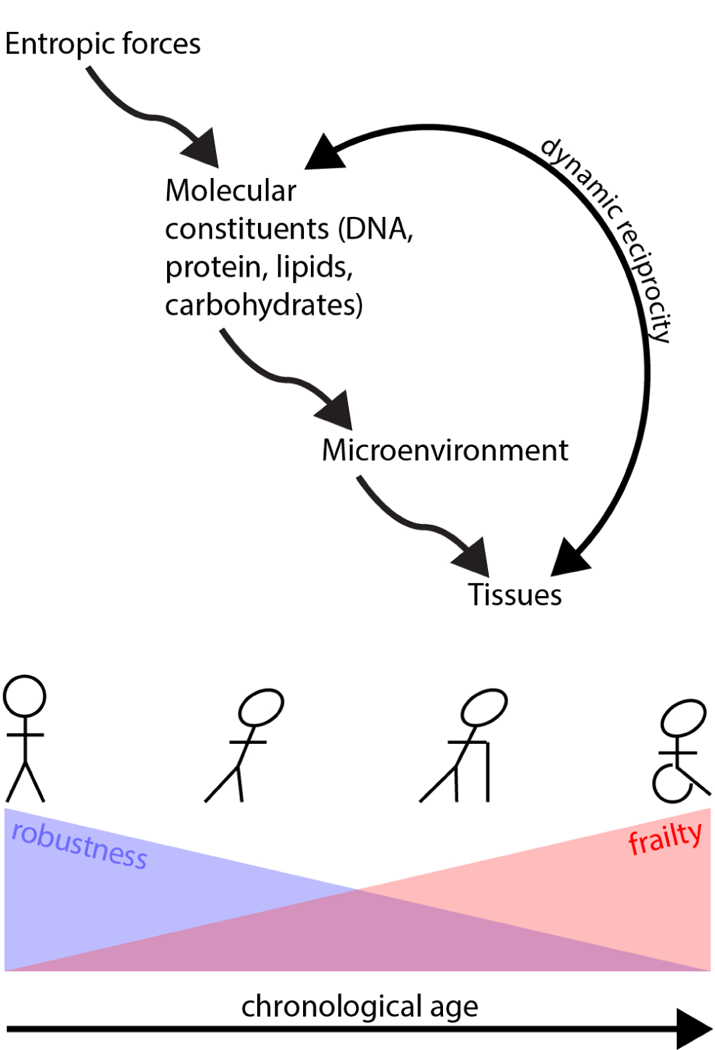
Over time, constant entropic forces act on molecular constituents, altering cells and extracellular matrix and ultimately evoking dynamic and reciprocal responses from the tissues. This, in turn, pushes cells through a series of metastable states of decreasing robustness and increasing frailty. This decreased robustness, combined with the stochastic nature of the entropic drivers, tends to increase cell-to-cell variability over time.
References
-
- Kishabongo AS, Katchunga P, Cikomola JC, De Somer FM, De Buyzere ML, Speeckaert MM, Delanghe JR: The presence of fructosamine in human aortic valves is associated with valve stiffness. J Clin Pathol 2016, 69:772–776. - PubMed
-
- Wielopolski L, Asselin PK, Ramirez LK, Bauman WA, Bikit I: THE UBIQUITY OF BACKGROUND RADIATION AND THE CLINICAL UTILITY OF NATURALLY OCCURRING POTASSIUM-40 IN HUMAN BODY. In Gamma Rays: Technology, Applications and Health Implications Nova Science Publishers, Incorporated; 2012:345–359.
Publication types
MeSH terms
Grants and funding
LinkOut - more resources
Full Text Sources
Other Literature Sources
Medical
