


Why don't segregated Roma do more for their health? An explanatory framework from an ethnographic study in Slovakia
- PMID: 29909522
- PMCID: PMC6245243
- DOI: 10.1007/s00038-018-1134-2
Why don't segregated Roma do more for their health? An explanatory framework from an ethnographic study in Slovakia
Abstract
Objectives: The health status of segregated Roma is poor. To understand why segregated Roma engage in health-endangering practices, we explored their nonadherence to clinical and public health recommendations.
Methods: We examined one segregated Roma settlement of 260 inhabitants in Slovakia. To obtain qualitative data on local-level mechanisms supporting Roma nonadherence, we combined ethnography and systematic interviewing over 10 years. We then performed a qualitative content analysis based on sociological and public health theories.
Results: Our explanatory framework summarizes how the nonadherence of local Roma was supported by an interlocked system of seven mechanisms, controlled by and operating through both local Roma and non-Roma. These regard the Roma situation of poverty, segregation and substandard infrastructure; the Roma socialization into their situation; the Roma-perceived value of Roma alternative practices; the exclusionary non-Roma and self-exclusionary Roma ideologies; the discrimination, racism and dysfunctional support towards Roma by non-Roma; and drawbacks in adherence.
Conclusions: Non-Roma ideologies, internalized by Roma into a racialized ethnic identity through socialization, and drawbacks in adherence might present powerful, yet neglected, mechanisms supporting segregated Roma nonadherence.
Keywords: Adherence; Ethnographic study; Health inequality; Roma health; Slovakia.
Conflict of interest statement
Conflict of interest
The authors declare that they have no conflict of interest.
Ethical approval
All procedures performed in studies involving human participants were in accordance with the ethical standards of the institutional and/or national research committee and with the 1964 Declaration of Helsinki and its later amendments or comparable ethical standards.
Informed consent
Informed consent was obtained from all individual participants included in the study.
Figures
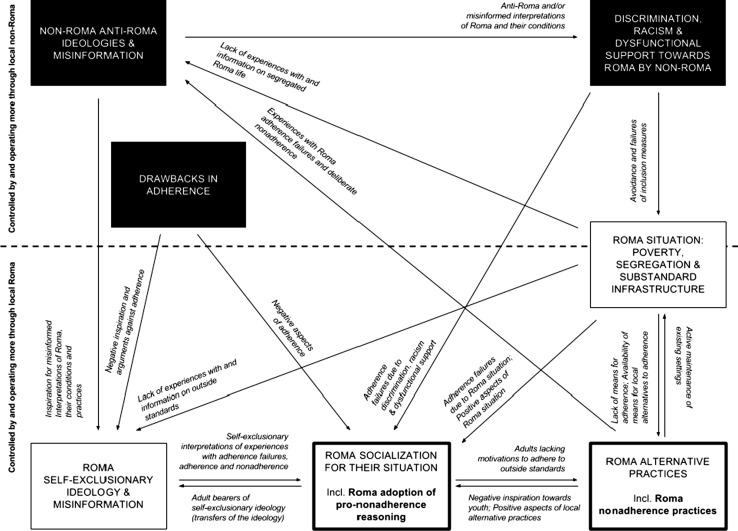
Comment in
-
Why don't segregated Roma do more for their health? A complex question.Int J Public Health. 2019 Jun;64(5):803-804. doi: 10.1007/s00038-019-01233-0. Epub 2019 May 30. Int J Public Health. 2019. PMID: 31143963 No abstract available.
-
What Roma nonadherence is likely and what drives it? Reply to Broz and Nunes.Int J Public Health. 2019 Jun;64(5):805-807. doi: 10.1007/s00038-019-01250-z. Epub 2019 May 30. Int J Public Health. 2019. PMID: 31143964 No abstract available.
References
-
- Andreassen T, Weiderpass E, Nicula F, Suteu O, Itu A, Bumbu M, Tincu A, Ursin G, Moen K. Controversies about cervical cancer screening: a qualitative study of Roma women’s (non) participation in cervical cancer screening in Romania. Soc Sci Med. 2017;183:48–55. doi: 10.1016/j.socscimed.2017.04.040. - DOI - PubMed
-
- Archer MS. Being human: the problem of agency. Cambridge: Cambridge University Press; 2000.
-
- Babinska I, Geckova AM, Jarcuska P, Pella D, Marekova M, Stefkova G, Veselska ZD. Does the population living in Roma settlements differ in physical activity, smoking and alcohol consumption from the majority population in Slovakia? Cent Eur J Public Health. 2014;22:S22–S27. doi: 10.21101/cejph.a3897. - DOI - PubMed
-
- Belak A. Health-system limitations of Roma health in Slovakia: a qualitative study. Bratislava: WHO Country Office in Slovakia; 2013.
MeSH terms
Grants and funding
LinkOut - more resources
Full Text Sources
Other Literature Sources
