


The Development of a Decision Tool for the Empiric Treatment of Suspected Urinary Tract Infection in Frail Older Adults: A Delphi Consensus Procedure
- PMID: 29910137
- PMCID: PMC8048094
- DOI: 10.1016/j.jamda.2018.05.001
The Development of a Decision Tool for the Empiric Treatment of Suspected Urinary Tract Infection in Frail Older Adults: A Delphi Consensus Procedure
Abstract
Objectives: Nonspecific signs and symptoms combined with positive urinalysis results frequently trigger antibiotic therapy in frail older adults. However, there is limited evidence about which signs and symptoms indicate urinary tract infection (UTI) in this population. We aimed to find consensus among an international expert panel on which signs and symptoms, commonly attributed to UTI, should and should not lead to antibiotic prescribing in frail older adults, and to integrate these findings into a decision tool for the empiric treatment of suspected UTI in this population.
Design: A Delphi consensus procedure.
Setting and participants: An international panel of practitioners recognized as experts in the field of UTI in frail older patients.
Measures: In 4 questionnaire rounds, the panel (1) evaluated the likelihood that individual signs and symptoms are caused by UTI, (2) indicated whether they would prescribe antibiotics empirically for combinations of signs and symptoms, and (3) provided feedback on a draft decision tool.
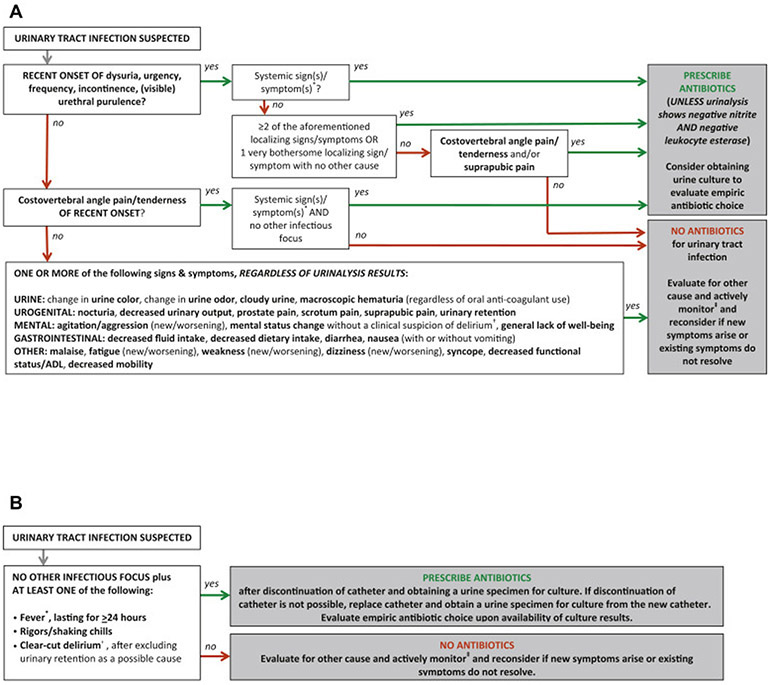
Results: Experts agreed that the majority of nonspecific signs and symptoms should be evaluated for other causes instead of being attributed to UTI and that urinalysis should not influence treatment decisions unless both nitrite and leukocyte esterase are negative. These and other findings were incorporated into a decision tool for the empiric treatment for suspected UTI in frail older adults with and without an indwelling urinary catheter.
Conclusions: A decision tool for suspected UTI in frail older adults was developed based on consensus among an international expert panel. Studies are needed to evaluate whether this decision tool is effective in reaching its aim: the improvement of diagnostic evaluation and treatment for suspected UTI in frail older adults.
Keywords: Urinary tract infection; antibiotic prescribing; frail older adults; nonspecific signs and symptoms; urinalysis.
Copyright © 2018 AMDA – The Society for Post-Acute and Long-Term Care Medicine. Published by Elsevier Inc. All rights reserved.
Conflict of interest statement
CONFLICTS OF INTEREST:
L.B. reports personal fees from the Dutch Association of Elderly Care Physicians, during the conduct of the study; H.V. reports grants from the Dutch Ministry of Health, Welfare and Sport, during the conduct of the study; S.G.s reports personal fees from InfectoPharm, outside the submitted work; D.N. reports grants from the Agency for Healthcare Research and Quality and grants from the National Institute of Aging, during the conduct of the study; P.U. reports personal fees from the Swedish Medical Products Agency, outside the submitted work; the other authors have no competing interests to disclose.
Figures
References
-
- Nicolle LE, Urinary tract infection in long-term-care facility residents. Clin Infect Dis, 31 (2000), pp. 757–761 - PubMed
-
- Schweizer AK, Hughes CM, Macauley DC, O'Neill C, Managing urinary tract infections in nursing homes: A qualitative assessment. Pharm World Sci, 27 (2005), pp. 159–165 - PubMed
-
- Nace DA, Drinka PJ, Crnich CJ, Clinical uncertainties in the approach to long-term care residents with possible urinary tract infection. J Am Med Dir Assoc, 15 (2014), pp. 133–139 - PubMed
Publication types
MeSH terms
Substances
Grants and funding
LinkOut - more resources
Full Text Sources
Other Literature Sources
Medical
