


Prevalence of Intestinal Parasites Among HIV Infected and HIV Uninfected Patients Treated at the 1° De Maio Health Centre in Maputo, Mozambique
- PMID: 29911204
- PMCID: PMC5999047
Prevalence of Intestinal Parasites Among HIV Infected and HIV Uninfected Patients Treated at the 1° De Maio Health Centre in Maputo, Mozambique
Abstract
Introduction: Increased evidence suggests intestinal parasite infections, one of the major causes of morbidity and mortality in sub-Saharan Africa, increase the acquisition and progression of AIDS.
Objective: The aim of this study was to determine the prevalence of HIV and intestinal parasite co-infections, the relationship to the degree of immunosuppression and the effect of antiretroviral treatment (ART) and trimethoprim-sulfamethoxazole (TS) on patients treated at 1° de Maio Health Centre in Maputo, Mozambique.
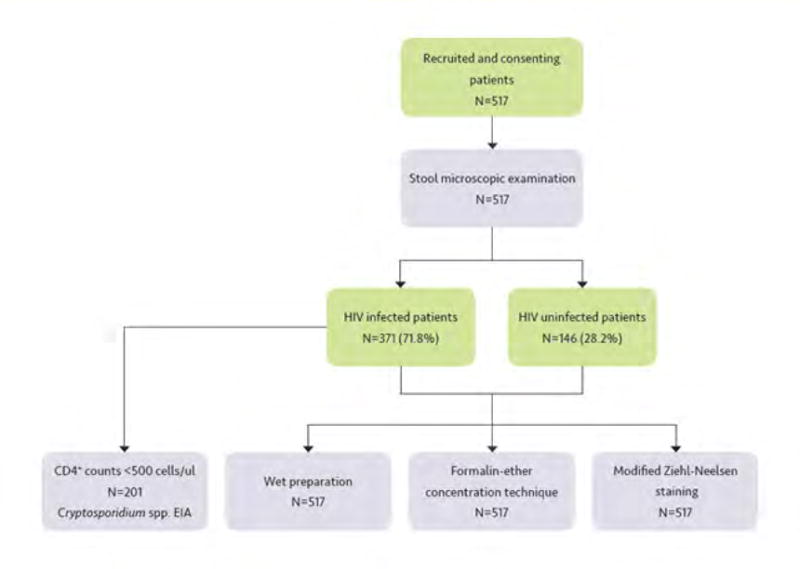
Methods: A cross sectional study was conducted from December 2015 to August 2016. A total of 517 stool samples from 371 (71.8%) HIV infected and 146 (28.2%) HIV uninfected patients were examined for the presence of parasites using direct wet mount, Ritchie and modified Ziehl Neelsen techniques. A subsample of 201 stools from HIV infected patients was processed for coproantigens for the detection of Cryptosporidium spp.
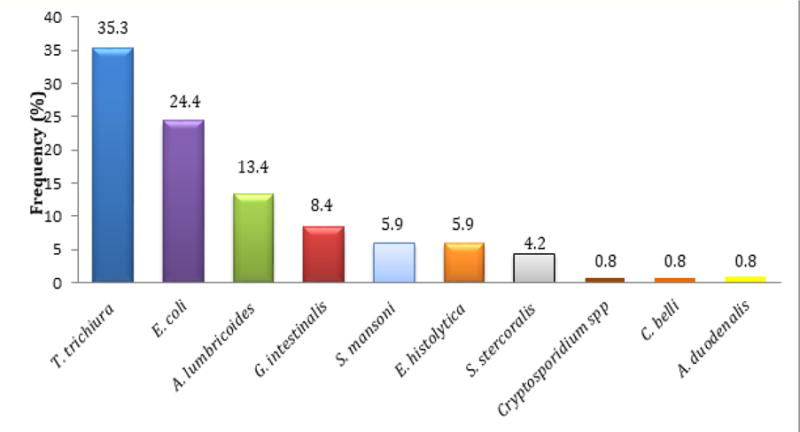
Results: Overall, 148 (28.6%) of the individuals were infected with at least one parasite. The prevalence of intestinal parasites was 98 (26.4%) and 50 (34.2%) in HIV infected and uninfected patients, respectively. This difference was not statistically significant. We identified 10 different parasites including (most frequently) Trichuris trichiura 67 (12.9%), Ascaris lumbricoides 27 (5.2%) and Entamoeba coli 40 (7.7%). Giardia intestinalis prevalence was significantly higher in HIV infected patients 12 (3.2%), p = 0.02. Parasitic intensity was higher in HIV infected patients than in HIV uninfected patients. Cryptosporidium spp. prevalence by coproantigen detection was 6% and was associated with degree of immune suppression. A CD4+ T-cell count of < 200 cells/μL was significantly associated with higher prevalence and intensity of parasitism, while ART and TS prophylaxis was associated with lower parasitic prevalence.
Conclusions: Our study revealed that the prevalence and intensity of intestinal parasites in HIV infected patients was related to the degree of immune suppression as assessed by CD4+ cell count, while ART and TS seemed to reduce the parasitic infection.
Keywords: Co-Infection HIV intestinal parasites; Coccidiae; Helminthes; Protozoan.
Conflict of interest statement
Conflict of Interest The authors declare no conflict of interests.
Figures
References
-
- Veas Francisco, Rey Jean-Loup. Infection à VIH et parasitoses en zone Tropicale. Cahiers Santé. 1991;1:189–201.
-
- Organization WH; World Health Organization. Soil Transmitted Helminth Infections: fact sheet. 2016
Grants and funding
LinkOut - more resources
Full Text Sources
Research Materials
Miscellaneous