


Behaviour change techniques associated with adherence to prescribed exercise in patients with persistent musculoskeletal pain: Systematic review
- PMID: 29911311
- PMCID: PMC6585717
- DOI: 10.1111/bjhp.12324
Behaviour change techniques associated with adherence to prescribed exercise in patients with persistent musculoskeletal pain: Systematic review
Abstract
Purpose: Exercise (planned, structured, repetitive movement) improves pain and function in people with persistent musculoskeletal pain (PMSK), but adherence is often poor. This systematic review evaluates the evidence from randomized controlled trials (RCTs) on the effectiveness of interventions to improve exercise adherence in people with PMSK and describes the content, context, and theoretical underpinning of behaviour change interventions designed to increase adherence.
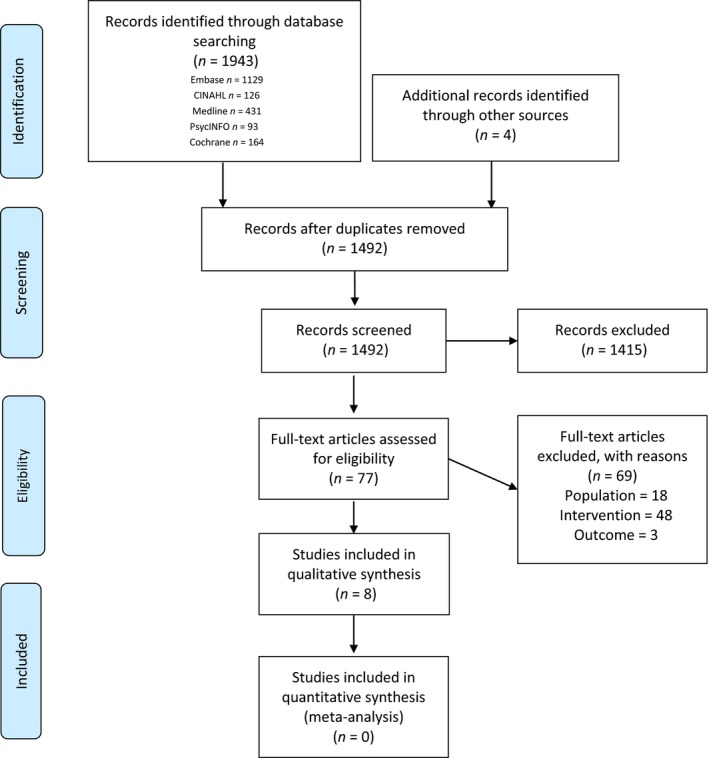
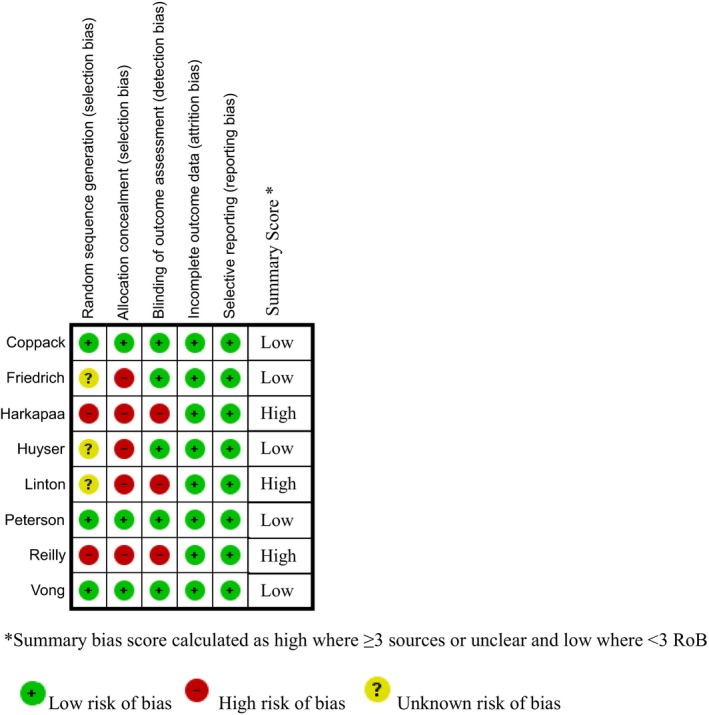
Methods: Nine electronic databases were searched from inception dates to August 2017. Studies were included if they were RCTs that included adults with PMSK ≥3 months; ≥one measure of exercise adherence, exercise prescribed to both groups, and employed ≥one behaviour change technique (BCT) in the treatment group. Independent data extraction, theory coding, BCT taxonomy coding, and quality assessment using Cochrane Risk of Bias (RoB) tool was conducted by two reviewers.
Results: Eight RCTs (five low, three high RoB) met inclusion criteria. Five trials reported between-group differences in exercise adherence, favouring the treatment group. Three trials reported theoretical underpinning. There was moderate evidence that five BCTs, social support, goal setting, instruction of behaviour, demonstration of behaviour, and practice/rehearsal, improved exercise adherence. Interventions employing ≤seven BCTs, unique to those included in the control group, were most effective at enhancing exercise adherence.
Conclusions: Limited moderate-quality evidence supports using a small number of BCTs to enhance exercise adherence in people with PMSK. Further research should explore the associations and synergies between BCTs and explicitly report how theory was utilized. This may inform recommendations for health care professionals working with this population. Statement of contribution What is already known on this subject? Exercise (i.e., planned, structured, repetitive movements) improves pain and function in people with persistent musculoskeletal pain (PMSK). Many people with PMSK do not adhere to exercises prescribed by a health care professional. Little research has explored how to enhance adherence to prescribed exercise in people with PMSK. What does this study add? Moderate-quality evidence from eight trials suggests behaviour change interventions enhance exercise adherence. Social support, goal setting, demonstration, instruction, and rehearsal were employed in effective interventions. Interventions with ≤7 behaviour change techniques were more effective at improving adherence than those employing >7.
Keywords: behaviour change; exercise adherence; persistent pain; systematic review.
© 2018 The Authors. British Journal of Health Psychology published by John Wiley & Sons Ltd on behalf of British Psychological Society.
Conflict of interest statement
All authors declare no conflict of interest.
Figures
Similar articles
-
Psychological interventions for improving adherence to inhaled therapies in people with cystic fibrosis.Cochrane Database Syst Rev. 2023 Mar 29;3(3):CD013766. doi: 10.1002/14651858.CD013766.pub2. Cochrane Database Syst Rev. 2023. PMID: 36989170 Free PMC article. Review.
-
Behaviour change techniques applied in interventions to enhance physical activity adherence in patients with chronic musculoskeletal conditions: A systematic review and meta-analysis.Patient Educ Couns. 2019 Jan;102(1):25-36. doi: 10.1016/j.pec.2018.09.018. Epub 2018 Sep 29. Patient Educ Couns. 2019. PMID: 30279029
-
Effectiveness of behaviour change techniques in physiotherapy interventions to promote physical activity adherence in lower limb osteoarthritis patients: A systematic review.PLoS One. 2019 Jul 10;14(7):e0219482. doi: 10.1371/journal.pone.0219482. eCollection 2019. PLoS One. 2019. PMID: 31291326 Free PMC article.
-
Identifying behaviour change techniques in 287 randomized controlled trials of audit and feedback interventions targeting practice change among healthcare professionals.Implement Sci. 2023 Nov 21;18(1):63. doi: 10.1186/s13012-023-01318-8. Implement Sci. 2023. PMID: 37990269 Free PMC article.
-
Use of behavior change techniques in physical activity programs and services for older adults: findings from a rapid review.Ann Behav Med. 2024 Feb 10;58(3):216-226. doi: 10.1093/abm/kaad074. Ann Behav Med. 2024. PMID: 38300788 Free PMC article. Review.
Cited by
-
The relationship between readiness to change pain-related exercise participation and perceived work ability: a cross-sectional study of factory workers.BMC Musculoskelet Disord. 2021 Sep 6;22(1):762. doi: 10.1186/s12891-021-04642-6. BMC Musculoskelet Disord. 2021. PMID: 34488707 Free PMC article.
-
Clinical effectiveness of an individually tailored strengthening programme, including progressive resistance exercises and advice, compared to usual care for ambulant adolescents with spastic cerebral palsy (ROBUST trial): a parallel group randomized controlled trial.Bone Jt Open. 2025 May 1;6(5):517-527. doi: 10.1302/2633-1462.65.BJO-2024-0268. Bone Jt Open. 2025. PMID: 40306695 Free PMC article.
-
Key Factors Associated with Adherence to Physical Exercise in Patients with Chronic Diseases and Older Adults: An Umbrella Review.Int J Environ Res Public Health. 2021 Feb 19;18(4):2023. doi: 10.3390/ijerph18042023. Int J Environ Res Public Health. 2021. PMID: 33669679 Free PMC article.
-
Experiences of physiotherapists considering virtual reality for shoulder rehabilitation: A focus group study.Digit Health. 2024 Feb 26;10:20552076241234738. doi: 10.1177/20552076241234738. eCollection 2024 Jan-Dec. Digit Health. 2024. PMID: 38414562 Free PMC article.
-
Patients' health outcomes after an implementation intervention targeting the physiotherapists' clinical behaviour.Arch Physiother. 2021 Oct 9;11(1):22. doi: 10.1186/s40945-021-00116-z. Arch Physiother. 2021. PMID: 34625120 Free PMC article.
References
-
- Arvinen‐Barrow, M. , Penny, G. , Hemmings, B. , & Corr, S. (2010). UK chartered physiotherapists' personal experiences in using psychological interventions with injured athletes: An interpretative phenomenological analysis. Psychology of Sport & Exercise, 11(1), 58–66. 10.1016/j.psychsport.2009.05.004 - DOI
-
- Bandura, A. (1986). Social foundations of thought and action: A social cognitive theory. Englewood Cliffs, NJ: Prentice‐Hall.
-
- Bartholomew, L. K. , Markham, C. M. , Ruiter, R. A. C. , Fernandez, M. E. , Kok, G. , & Parcel, G. S. (2016). Planning health promotion programs: An intervention mapping approach (4th ed.). San Francisco, CA: Jossey‐Bass.
Publication types
MeSH terms
LinkOut - more resources
Full Text Sources
Other Literature Sources
Medical
Miscellaneous
