. 2018 Jul;24(7):1239-1245.
doi: 10.3201/eid2407.172026.

Geographically Diverse Clusters of Nontoxigenic Corynebacterium diphtheriae Infection, Germany, 2016-2017

Geographically Diverse Clusters of Nontoxigenic Corynebacterium diphtheriae Infection, Germany, 2016-2017

Alexandra Dangel et al. Emerg Infect Dis. 2018 Jul.

Abstract

From 2016 through the middle of 2017, the German Consiliary Laboratory on Diphtheria noted an increase in nontoxigenic Corynebacterium diphtheriae isolates submitted from cities in northern Germany. Many patients for whom epidemiologic data were available were homeless, alcohol or drug abusers, or both. After performing routine diagnostics and multilocus sequence typing (MLST), we analyzed isolates of sequence type (ST) 8 and previously submitted isolates by whole-genome sequencing. Results were analyzed for phylogenetic relationship by core genome MLST (cg-MLST) and whole-genome single-nucleotide polymorphism profiles. Next-generation sequencing-based cg-MLST revealed several outbreak clusters caused by ST8; the geographic focus was in the metropolitan areas of Hamburg and Berlin. To achieve enhanced analytical depth, we used additional cg-MLST target genes and genome-wide single-nucleotide polymorphisms. We identified patient characteristics and detected transmission events, providing evidence that nontoxigenic C. diphtheriae infection is a potential public health threat in industrialized countries.

Keywords: DNA sequencing; Germany; bacteria; bacterial infections; diphtheria; disease outbreaks; drug users; epidemiology; homeless; molecular typing; public health.


Figures
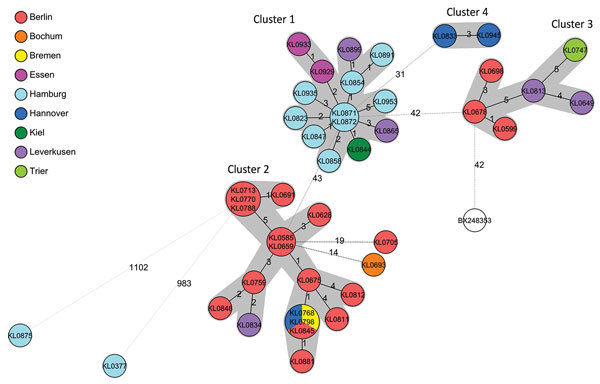
Figure 1
Figure 1
Minimum-spanning tree of core genome multilocus sequence typing with 1,553 targets of the nontoxigenic Corynebacterium diphtheriae sequence type 8 (ST8) isolate branch for isolates submitted from northern Germany, January 2015–June 2017. The branch of 41 ST8 typed isolates is shown, together with the 2 nearest isolates from other STs KL0875 (ST441) and KL0377 (ST123) and the reference genome used (GenBank accession no. BX248353). Allelic distances between isolates are indicated, clusters with allele difference <5 are shaded in gray, and the reference genome is shown in white.
Figure 2
Figure 2
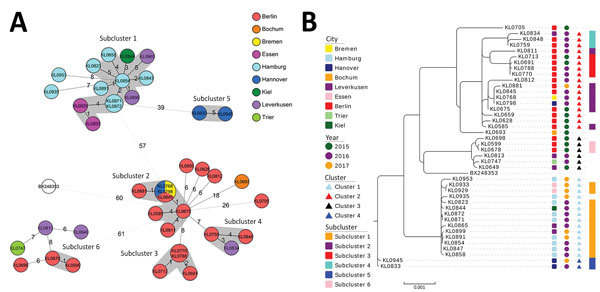
Enhancement of phylogenetic analysis depth of the 41 nontoxigenic sequence type 8 Corynebacterium diphtheriae isolates submitted from northern Germany, January 2015–June 2017, and reference genome. A) Phylogenetic minimum-spanning tree of isolates analyzed by extended core-genome multilocus sequence typing (cg-MLST), based on 2,154 target loci. Allele distances between isolates are indicated. Gray indicates subclusters with allele difference <5; white indicates the reference genome (BX248353). B) Phylogenetic maximum-likelihood tree based on genome-wide single-nucleotide polymorphism profiles. From left to right, the color-coded columns indicate isolate affiliations to submitting city, isolate submission year, cg-MLST cluster based on allelic difference of <5 alleles out of 1,553 cg-MLST target loci, and extended cg-MLST-subclusters based on allelic difference of <5 alleles out of 1,553 plus 601 extended cg-MLST target loci. Relative distances are based on 30 000 genomic positions. Scale bar indicates the portion of relative distances based on 14,920 distinct aligned positions.

Comment in

References

    1. Kantsone I, Lucenko I, Perevoscikovs J. More than 20 years after re-emerging in the 1990s, diphtheria remains a public health problem in Latvia. Euro Surveill. 2016;21:30414. 10.2807/1560-7917.ES.2016.21.48.30414 - DOI - PMC - PubMed
    1. World Health Organization. Diphtheria vaccine: WHO position paper, August 2017 - Recommendations. Vaccine. 2018;36:199–201. 10.1016/j.vaccine.2017.08.024 - DOI - PubMed
    1. Farfour E, Badell E, Zasada A, Hotzel H, Tomaso H, Guillot S, et al. Characterization and comparison of invasive Corynebacterium diphtheriae isolates from France and Poland. J Clin Microbiol. 2012;50:173–5. 10.1128/JCM.05811-11 - DOI - PMC - PubMed
    1. Fricchione MJ, Deyro HJ, Jensen CY, Hoffman JF, Singh K, Logan LK. Non-toxigenic penicillin and cephalosporin-resistant Corynebacterium diphtheriae endocarditis in a child: a case report and review of the literature. J Pediatric Infect Dis Soc. 2014;3:251–4. 10.1093/jpids/pit022 - DOI - PubMed
    1. Zasada AA. Nontoxigenic highly pathogenic clone of Corynebacterium diphtheriae, Poland, 2004-2012. Emerg Infect Dis. 2013;19:1870–2. 10.3201/eid1911.130297 - DOI - PMC - PubMed

Publication types

LinkOut - more resources