Effect of Tamsulosin on Passage of Symptomatic Ureteral Stones: A Randomized Clinical Trial
- PMID: 29913020
- PMCID: PMC6082698
- DOI: 10.1001/jamainternmed.2018.2259
Effect of Tamsulosin on Passage of Symptomatic Ureteral Stones: A Randomized Clinical Trial
Abstract
Importance: Urinary stone disease is a common presentation in the emergency department, and α-adrenergic receptor blockers, such as tamsulosin, are commonly used to facilitate stone passage.
Objective: To determine if tamsulosin promotes the passage of urinary stones within 28 days among emergency department patients.
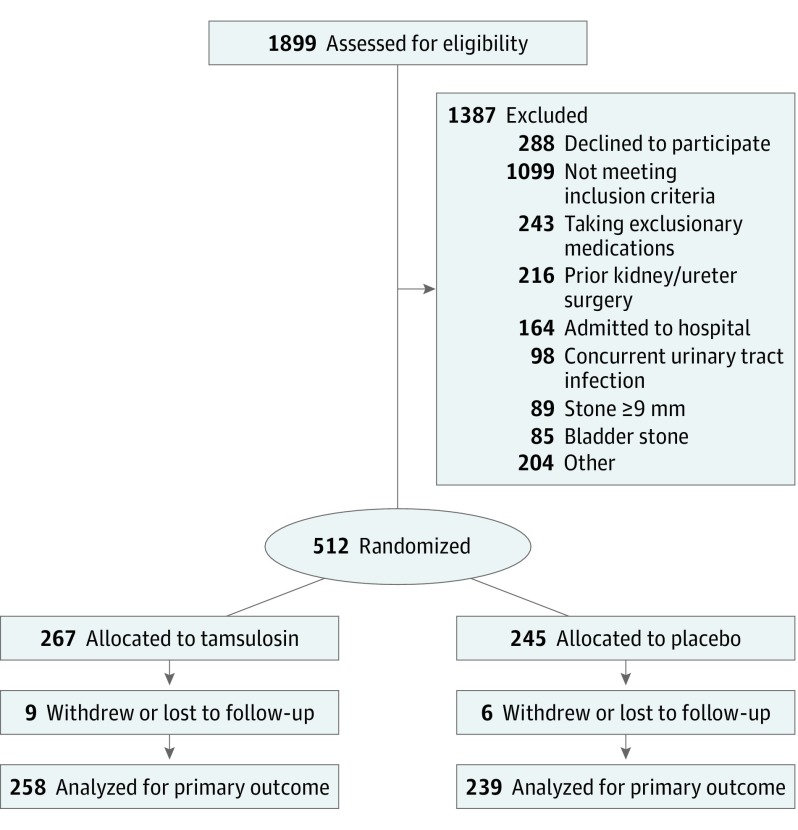
Design, setting, and participants: We conducted a double-blind, placebo-controlled clinical trial from 2008 to 2009 (first phase) and then from 2012 to 2016 (second phase). Participants were followed for 90 days. The first phase was conducted at a single US emergency department; the second phase was conducted at 6 US emergency departments. Adult patients were eligible to participate if they presented with a symptomatic urinary stone in the ureter less than 9 mm in diameter, as demonstrated on computed tomography.
Interventions: Participants were randomized to treatment with either tamsulosin, 0.4 mg, or matching placebo daily for 28 days.
Main outcomes and measures: The primary outcome was stone passage based on visualization or capture by the study participant by day 28. Secondary outcomes included crossover to open-label tamsulosin, time to stone passage, return to work, use of analgesic medication, hospitalization, surgical intervention, and repeated emergency department visit for urinary stones.
Results: The mean age of 512 participants randomized to tamsulosin or placebo was 40.6 years (range, 18-74 years), 139 (27.1%) were female, and 110 (22.8%) were nonwhite. The mean (SD) diameter of the urinary stones was 3.8 (1.4) mm. Four hundred ninety-seven patients were evaluated for the primary outcome. Stone passage rates were 50% in the tamsulosin group and 47% in the placebo group (relative risk, 1.05; 95.8% CI, 0.87-1.27; P = .60), a nonsignificant difference. None of the secondary outcomes were significantly different. All analyses were performed according to the intention-to-treat principle, although patients lost to follow-up before stone passage were excluded from the analysis of final outcome.
Conclusions and relevance: Tamsulosin did not significantly increase the stone passage rate compared with placebo. Our findings do not support the use of tamsulosin for symptomatic urinary stones smaller than 9 mm. Guidelines for medical expulsive therapy for urinary stones may need to be revised.
Trial registration: ClinicalTrials.gov Identifier: NCT00382265.
Conflict of interest statement
Comment in
-
Medical Expulsive Therapy for Ureteral Stones-Stone Age Medicine.JAMA Intern Med. 2018 Aug 1;178(8):1058-1059. doi: 10.1001/jamainternmed.2018.2265. JAMA Intern Med. 2018. PMID: 29913003 No abstract available.
-
Re: Effect of Tamsulosin on Passage of Symptomatic Ureteral Stones: A Randomized Clinical Trial.J Urol. 2018 Nov;200(5):938-941. doi: 10.1016/j.juro.2018.07.070. Epub 2018 Aug 7. J Urol. 2018. PMID: 30360332 No abstract available.
-
The status of medical expulsive therapy in the age of evidence-based medicine.Ann Transl Med. 2018 Nov;6(Suppl 1):S18. doi: 10.21037/atm.2018.09.09. Ann Transl Med. 2018. PMID: 30613593 Free PMC article. No abstract available.
References
-
- Litwin M, Saigal C. Urologic Diseases in America. Washington, DC: US Department of Health and Human Services, Public Health Service, National Institutes of Health, National Institute of Diabetes and Digestive and Kidney Diseases; 2012. NIH Pub 12-7865.
-
- Jeong IG, Kang T, Bang JK, et al. Association between metabolic syndrome and the presence of kidney stones in a screened population. Am J Kidney Dis. 2011;58(3):383-388. - PubMed
Publication types
MeSH terms
Substances
Associated data
Grants and funding
LinkOut - more resources
Full Text Sources
Other Literature Sources
Medical