Review
. 2018 Jun 17;19(6):1797.
doi: 10.3390/ijms19061797.

Role of MicroRNAs in Renal Parenchymal Diseases-A New Dimension

Affiliations
Review

Role of MicroRNAs in Renal Parenchymal Diseases-A New Dimension

Saeed Kamran Shaffi et al. Int J Mol Sci. .

Abstract

Since their discovery in 1993, numerous microRNAs (miRNAs) have been identified in humans and other eukaryotic organisms, and their role as key regulators of gene expression is still being elucidated. It is now known that miRNAs not only play a central role in the processes that ensure normal development and physiology, but they are often dysregulated in various diseases. In this review, we present an overview of the role of miRNAs in normal renal development and physiology, in maladaptive renal repair after injury, and in the pathogenesis of renal parenchymal diseases. In addition, we describe methods used for their detection and their potential as therapeutic targets. Continued research on renal miRNAs will undoubtedly improve our understanding of diseases affecting the kidneys and may also lead to new therapeutic agents.

Keywords: miRNA; miRNA detection; miRNA in renal parenchymal Diseases; miRNA-based therapeutics; micro RNA; renal parenchymal diseases.


Conflict of interest statement

The authors declare no conflict of interest.

Figures
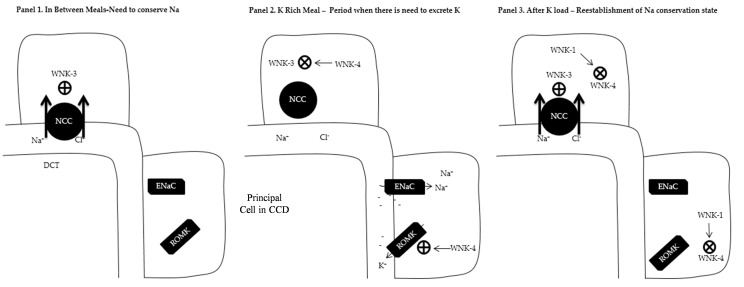
Figure 1
Figure 1
Overview of the with no Lysine Kinase (WNK) system. Abbreviations: NCC: Sodium/Chloride cotransporter; DCT: Distal Convoluted Tubule; CCD: Cortical Collecting Duct; ENaC; Epithelial Sodium Channel; ROMK: Renal Outer Medullary Potassium Channel; ⊕ Increase expression; ⨂ Decrease expression. (Panel 1) In between meals when the kidney retains Na+ and K+. This is mediated by the presence of WNK3 which increases the expression of NCC in the DCT as well as prevents ROMK expression in the CCD. (Panel 2) K+ rich meal period when there is need to excrete K+. Expression of WNK4 causes suppression of WNK3 which leads to diminished presence of NCC in the DCT and increased Na+ delivery to CCD. In the presence of aldosterone, ENaCs are expressed in the CCD with electrogenic Na absorption making the lumen negative. WNK4 increases the expression of ROMK in the CCD with the removal of K down the electrical gradient. (Panel 3) After K rich meal period. WNK1 antagonizes WNK4 with re-expression to WNK3 phenotype (Panel 1).
Figure 2
Figure 2
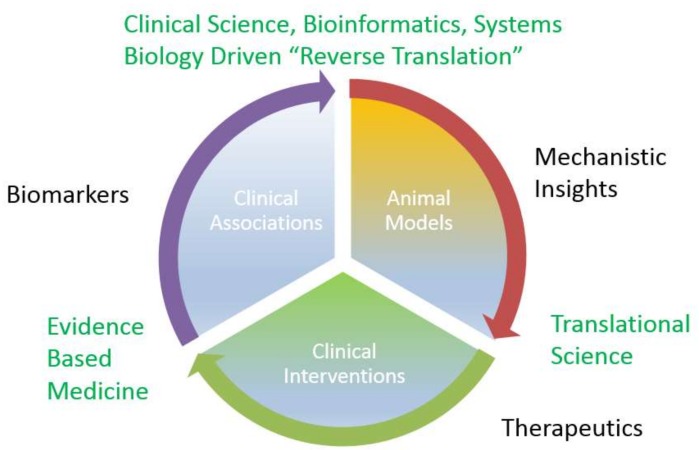
miRNA discovery cycle from biomarkers to therapeutics.
Figure 3
Figure 3
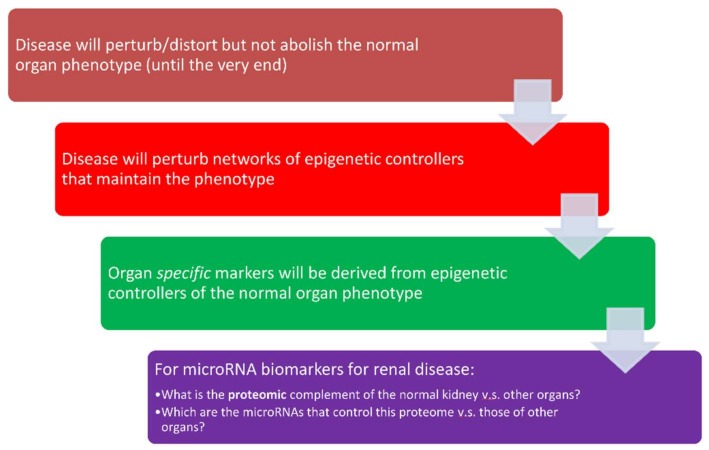
miRNAs as personalized diagnostics in kidney diseases.

References

    1. Ha M., Kim V.N. Regulation of microRNA biogenesis. Nat. Rev. Mol. Cell Biol. 2014;15:509–524. doi: 10.1038/nrm3838. - DOI - PubMed
    1. Creugny A., Fender A., Pfeffer S. Regulation of primary microRNA processing. FEBS Lett. 2018 doi: 10.1002/1873-3468.13067. - DOI - PubMed
    1. Shen J., Hung M.-C. Signaling-mediated regulation of MicroRNA processing. Cancer Res. 2015;75:783–791. doi: 10.1158/0008-5472.CAN-14-2568. - DOI - PMC - PubMed
    1. Achkar N.P., Cambiagno D.A., Manavella P.A. miRNA Biogenesis: A Dynamic Pathway. Trends Plant Sci. 2016;21:1034–1044. doi: 10.1016/j.tplants.2016.09.003. - DOI - PubMed
    1. miRBase. [(accessed on 20 November 2017)]; Available online: http://www.mirbase.org/