


Exploring patterns of response across the lifespan: the Cambridge Centre for Ageing and Neuroscience (Cam-CAN) study
- PMID: 29914423
- PMCID: PMC6006958
- DOI: 10.1186/s12889-018-5663-7
Exploring patterns of response across the lifespan: the Cambridge Centre for Ageing and Neuroscience (Cam-CAN) study
Abstract
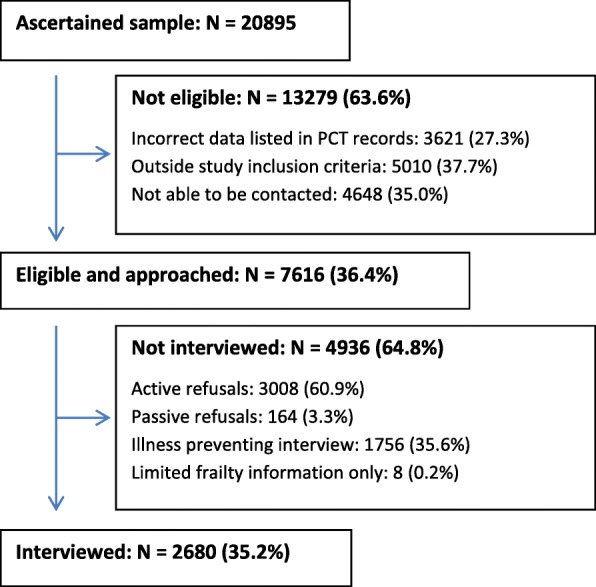
Background: With declining rates of participation in epidemiological studies there is an important need to attempt to understand what factors might affect response. This study examines the pattern of response at different adult ages within a contemporary cross-sectional population-based cohort, the Cambridge Centre for Ageing and Neuroscience (Cam-CAN).
Methods: Using logistic regression, we investigated associations between age, gender and Townsend deprivation level for both participants and non-participants. Weighted estimates of the odds ratios with confidence intervals for each demographic characteristic were calculated. Reasons given for refusal were grouped into three broad categories: 'active', 'passive' and illness preventing interview.
Results: An association of age and participation was found, with individuals in middle age groups more likely to participate (age group 48-57 OR: 1.8, 95% CI: 1.5-2.2 and age group 58-67 OR: 2.1, 95% CI: 1.7-2.4). Overall, there was no difference in participation between men and women. An association with deprivation was found, with those living in the most deprived areas being the least willing to participate (fifth quintile OR: 0.6, 95% CI: 0.5-0.7). An interaction between age and gender was found whereby younger women and older men were more likely to agree to participate (p = 0.01).
Conclusion: Our findings highlight some of the factors affecting recruitment into epidemiological studies in the UK and suggest that targeted age-specific recruitment strategies might be needed to increase participation rates in future cohort investigations.
Keywords: Ageing; Cognition; Epidemiological study; Lifespan; Neuroscience; Non-participation.
Conflict of interest statement
Ethics approval and consent to participate
Ethical approval for the study was obtained from the Cambridgeshire 2 (now East of England – Cambridge Central) Research Ethics Committee. All participants provided written informed consent.
Consent for publication
Not applicable.
Competing interests
The authors declare that they have no competing interests.
Publisher’s Note
Springer Nature remains neutral with regard to jurisdictional claims in published maps and institutional affiliations.
Figures
References
MeSH terms
Grants and funding
LinkOut - more resources
Full Text Sources
Other Literature Sources
