


Kinetic analysis of the multistep aggregation pathway of human transthyretin
- PMID: 29915031
- PMCID: PMC6142231
- DOI: 10.1073/pnas.1807024115
Kinetic analysis of the multistep aggregation pathway of human transthyretin
Abstract
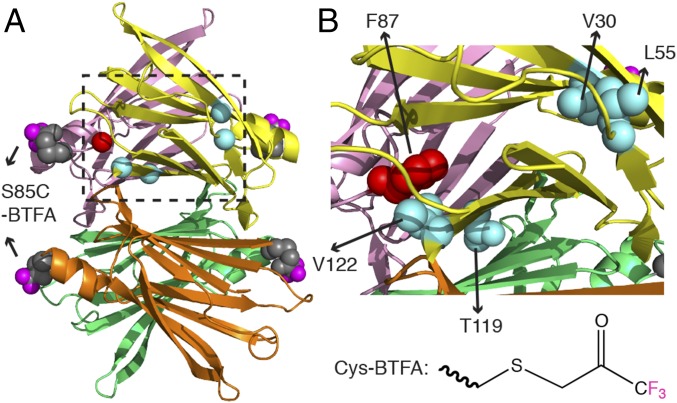
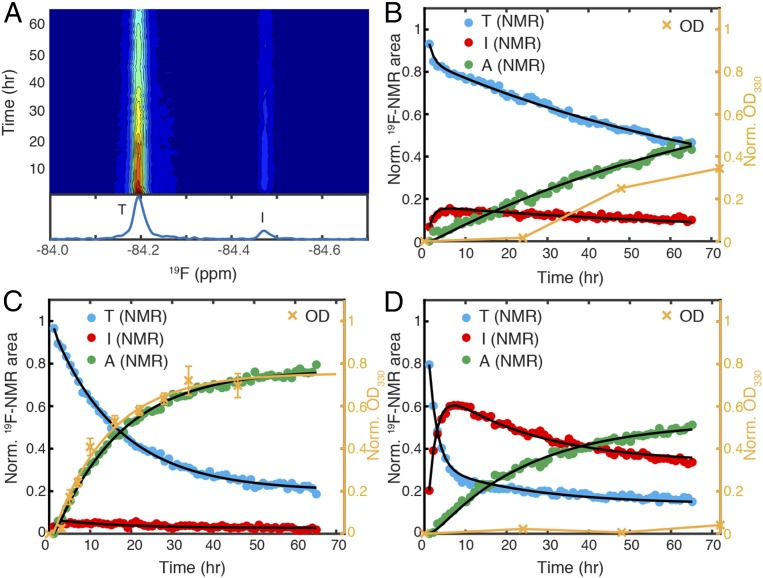
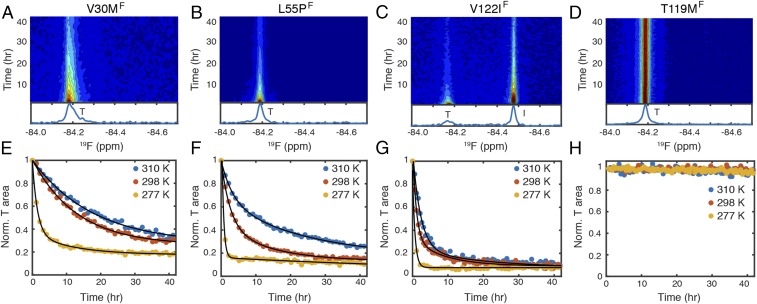
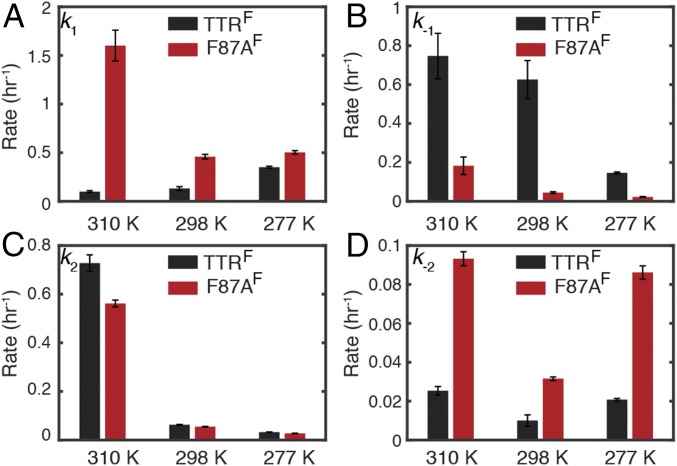
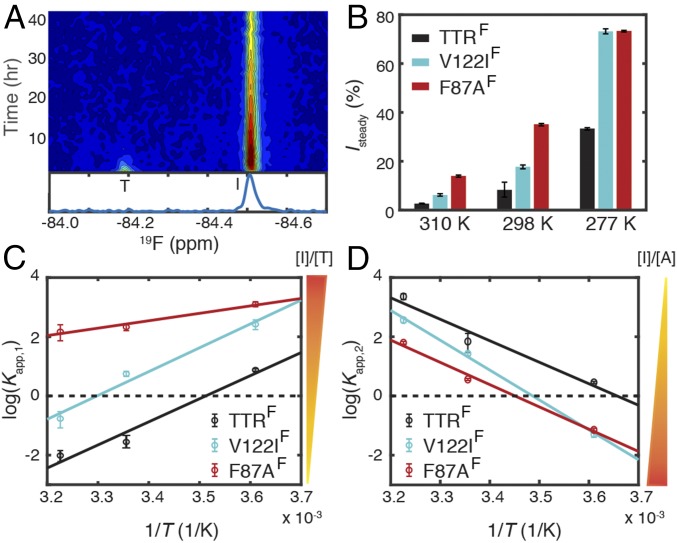
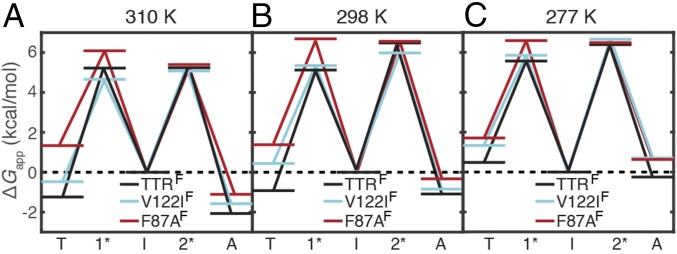
Aggregation of transthyretin (TTR) is the causative agent for TTR cardiomyopathy and polyneuropathy amyloidoses. Aggregation is initiated by dissociation of the TTR tetramer into a monomeric intermediate, which self-assembles into amyloid. The coupled multiple-step equilibria and low-concentration, aggregation-prone intermediates are challenging to probe using conventional assays. We report a 19F-NMR assay that leverages a highly sensitive trifluoroacetyl probe at a strategic site that gives distinct 19F chemical shifts for the TTR tetramer and monomeric intermediate and enables direct quantification of their populations during the aggregation process. Integration of real-time 19F-NMR and turbidity measurements as a function of temperature allows kinetic and mechanistic dissection of the aggregation pathway of both wild-type and mutant TTR. At physiological temperature, the monomeric intermediate formed by wild-type TTR under mildly acidic conditions rapidly aggregates into species that are invisible to NMR, leading to loss of the NMR signal at the same rate as the turbidity increase. Lower temperature accelerates tetramer dissociation and decelerates monomer tetramerization and oligomerization via reduced hydrophobic interactions associated with packing of a phenylalanine (F87) into a neighboring protomer. As a result, the intermediate accumulates to a higher level, and formation of higher-order aggregates is delayed. Application of this assay to pathogenic (V30M, L55P, and V122I) and protective (T119M) mutants revealed significant differences in behavior. A monomeric intermediate was observed only for V122I: aggregation of V30M and L55P proceeds without an observable monomeric intermediate, whereas the protective mutant T119M remains resistant to tetramer dissociation and aggregation.
Keywords: aggregation kinetics; amyloidogenic protein; hydrophobic interaction; low-population intermediate; real-time NMR.
Conflict of interest statement
The authors declare no conflict of interest.
Figures

References
-
- Knowles TP, Vendruscolo M, Dobson CM. The amyloid state and its association with protein misfolding diseases. Nat Rev Mol Cell Biol. 2014;15:384–396. - PubMed
-
- Bemporad F, Chiti F. Protein misfolded oligomers: Experimental approaches, mechanism of formation, and structure-toxicity relationships. Chem Biol. 2012;19:315–327. - PubMed
-
- Walsh DM, Selkoe DJ. Aβ oligomers–A decade of discovery. J Neurochem. 2007;101:1172–1184. - PubMed
-
- Colon W, Kelly JW. Partial denaturation of transthyretin is sufficient for amyloid fibril formation in vitro. Biochemistry. 1992;31:8654–8660. - PubMed
-
- Lai Z, Colón W, Kelly JW. The acid-mediated denaturation pathway of transthyretin yields a conformational intermediate that can self-assemble into amyloid. Biochemistry. 1996;35:6470–6482. - PubMed
Publication types
MeSH terms
Substances
Grants and funding
LinkOut - more resources
Full Text Sources
Other Literature Sources
Research Materials
Miscellaneous
