Ten-year Nationwide Population-based Survey on the Characteristics of Children with Henoch-Schӧnlein Purpura in Korea
- PMID: 29915525
- PMCID: PMC6000599
- DOI: 10.3346/jkms.2018.33.e174
Ten-year Nationwide Population-based Survey on the Characteristics of Children with Henoch-Schӧnlein Purpura in Korea
Abstract
Background: Henoch-Schӧnlein purpura (HSP) is a common vasculitis of childhood. Though HSP is usually self-limiting, severe complications can occur. The management for this condition has not been established yet. Thus, this nationwide study aimed at investigating epidemiological characteristics of children with HSP in Korea. The patterns of clinical practice with regard to the complications of the condition were also investigated.
Methods: This is a national population-based study that used the National Health Insurance Database. Children below 18 years who were diagnosed with HSP in Korea between 2006 and 2015 were enrolled. Data, such as age, sex, yearly and monthly distribution of HSP, hospitalization, re-hospitalization, comorbidities, and interventions were obtained. The use of steroids was also analyzed.
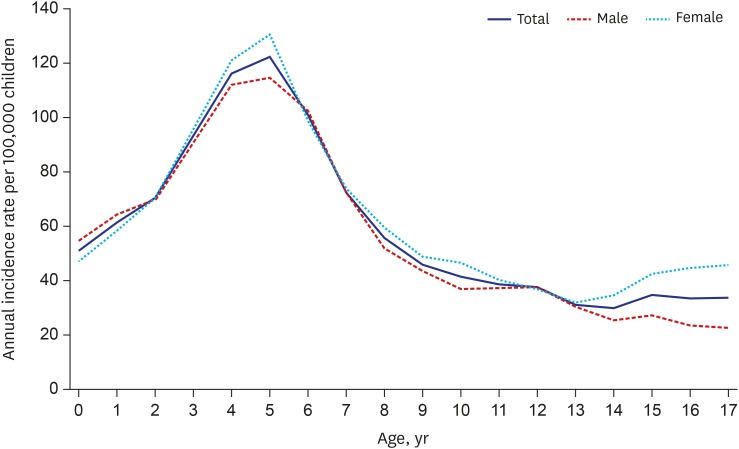
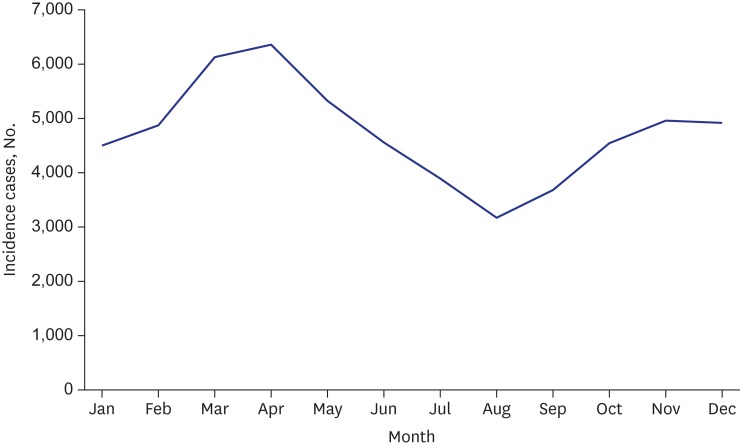
Results: A total of 56,841 children were enrolled. The annual incidence of HSP was 55.9 per 100,000 children. The peak age was 5 years. Spring was the most prevalent season. Sex (male) and young age (< 9 years) were risk factors of hospitalization. Younger children were more likely to be re-hospitalized and suspected with intussusception, arthritis, and nephritis. Only 4 children received laparotomy. In total, 57% were managed with steroids, and mean durations of medication were 4-5 days. Children who were hospitalized and those with comorbidities used steroids more frequently (P < 0.001).
Conclusion: The annual incidence of HSP is 55.9 per 100,000 children which is higher in Korea than that in other countries. Younger children can have a more severe clinical course. This nationwide survey provides valuable information to understand HSP in children and to inspire further research on HSP.
Keywords: Child; Epidemiology; Henoch-Schӧnlein Purpura; Korea; Steroids.
Conflict of interest statement
Disclosure: The authors have no potential conflicts of interest to disclose.
Figures
Comment in
-
What We Know about Henoch-Schönlein Purpura in Children up to Date?J Korean Med Sci. 2018 Jun 7;33(25):e199. doi: 10.3346/jkms.2018.33.e199. eCollection 2018 Jun 18. J Korean Med Sci. 2018. PMID: 29915528 Free PMC article. No abstract available.
References
-
- Jennette JC, Falk RJ, Bacon PA, Basu N, Cid MC, Ferrario F, et al. 2012 revised International Chapel Hill Consensus Conference Nomenclature of Vasculitides. Arthritis Rheum. 2013;65(1):1–11. - PubMed
-
- Mills JA, Michel BA, Bloch DA, Calabrese LH, Hunder GG, Arend WP, et al. The American College of Rheumatology 1990 criteria for the classification of Henoch-Schönlein purpura. Arthritis Rheum. 1990;33(8):1114–1121. - PubMed
-
- Ozen S, Pistorio A, Iusan SM, Bakkaloglu A, Herlin T, Brik R, et al. EULAR/PRINTO/PRES criteria for Henoch-Schönlein purpura, childhood polyarteritis nodosa, childhood Wegener granulomatosis and childhood Takayasu arteritis: Ankara 2008. Part II: final classification criteria. Ann Rheum Dis. 2010;69(5):798–806. - PubMed
-
- Rosenblum ND, Winter HS. Steroid effects on the course of abdominal pain in children with Henoch-Schӧnlein purpura. Pediatrics. 1987;79(6):1018–1021. - PubMed
MeSH terms
Substances
LinkOut - more resources
Full Text Sources
Other Literature Sources