. 2018 Jun 4:9:1172.
doi: 10.3389/fimmu.2018.01172. eCollection 2018.

Virulence Associated Gene 8 of Bordetella pertussis Enhances Contact System Activity by Inhibiting the Regulatory Function of Complement Regulator C1 Inhibitor

Affiliations

Virulence Associated Gene 8 of Bordetella pertussis Enhances Contact System Activity by Inhibiting the Regulatory Function of Complement Regulator C1 Inhibitor

Elise S Hovingh et al. Front Immunol. .

Abstract

Bordetella pertussis is a Gram-negative bacterium and the causative agent of whooping cough. Whooping cough is currently re-emerging worldwide and, therefore, still poses a continuous global health threat. B. pertussis expresses several virulence factors that play a role in evading the human immune response. One of these virulence factors is virulence associated gene 8 (Vag8). Vag8 is a complement evasion molecule that mediates its effects by binding to the complement regulator C1 inhibitor (C1-INH). This regulatory protein is a fluid phase serine protease that controls proenzyme activation and enzyme activity of not only the complement system but also the contact system. Activation of the contact system results in the generation of bradykinin, a pro-inflammatory peptide. Here, the activation of the contact system by B. pertussis was explored. We demonstrate that recombinant as well as endogenous Vag8 enhanced contact system activity by binding C1-INH and attenuating its inhibitory function. Moreover, we show that B. pertussis itself is able to activate the contact system. This activation was dependent on Vag8 production as a Vag8 knockout B. pertussis strain was unable to activate the contact system. These findings show a previously overlooked interaction between the contact system and the respiratory pathogen B. pertussis. Activation of the contact system by B. pertussis may contribute to its pathogenicity and virulence.

Keywords: Bordetella pertussis; C1 inhibitor; contact system; virulence associated gene 8; whooping cough.


Figures
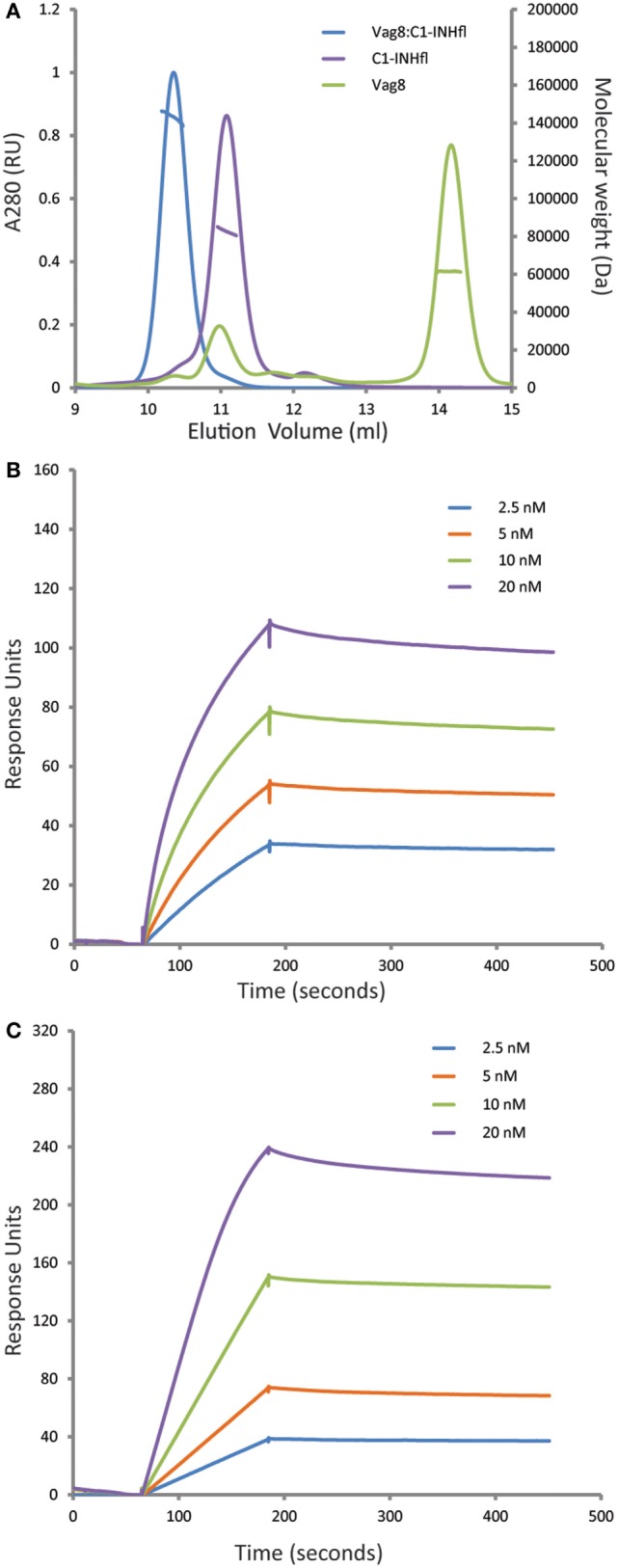
Figure 1
Figure 1
Virulence associated gene 8 (Vag8) and complement regulator C1 inhibitor (C1-INH) interact to form a tight 1:1 complex. (A) Size exclusion chromatography with multi-angle light scattering analysis (SEC-MALS) of Vag8 (green), C1-INH (purple), and Vag8_C1-INH complex (blue). The masses calculated from the scattering are shown as lines across the peaks. Protein conjugate analysis demonstrates that the mass of complex (146 kDa) corresponds to 118 kDa of protein and 28 kDa of sugar. This is consistent with a 1:1 complex of Vag8 (60 kDa) and glycosylated C1-INH (58 kDa protein/28 kDa sugar). (B,C) SPR analyses of the binding between Vag8 on the chip surface and increasing concentrations of C1-INHFL (B) and C1-INHNT98 (C) in solution.
Figure 2
Figure 2
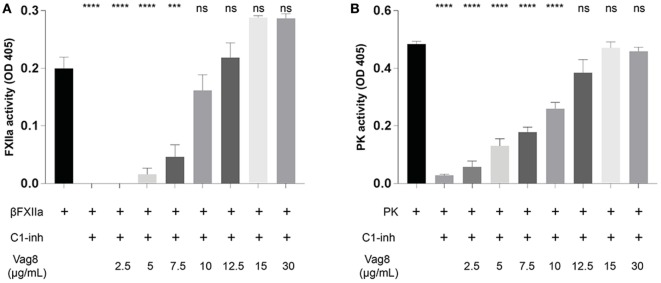
Virulence associated gene 8 (Vag8) interferes with the inhibition of βFXIIa and plasma kallikrein (PK) by complement regulator C1 inhibitor (C1-INH). (A) Vag8 (2.5, 5, 7.5, 10, 12.5, 15, and 30 µg/mL) dose-dependently enhances the activity of 1 µg/mL βFXIIa in the presence of 10 µg/mL C1-INH reaching similar activity as βFXIIa alone upon using 10 µg/mL of Vag8. (B) Vag8 (2.5, 5, 7.5, 10, 12.5, 15, and 30 µg/mL) dose-dependently enhances the activity of 0.5 µg/mL PK in the presence of 10 µg/mL C1-INH reaching similar activity as PK alone upon using 12.5 µg/mL of Vag8. Data represent the mean ± SEM of three separate experiments. ***p ≤ 0.001, ****p ≤ 0.0001, ns = non-significant compared to the black bar.
Figure 3
Figure 3
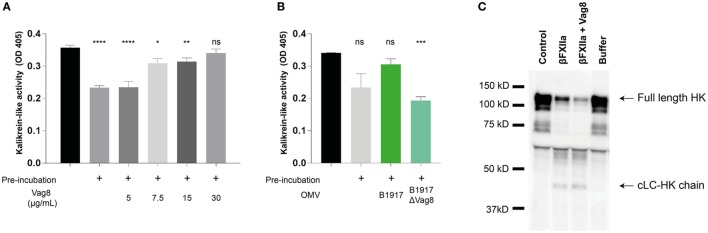
Virulence associated gene 8 (Vag8) induces enhanced activation of the contact system in plasma. (A) 60% plasma was incubated with Vag8 (5, 7.5, 15, and 30 µg/mL) following 10 min pre-incubation with 0.5 µg/mL βFXIIa. Vag8 dose-dependently enhances the induced kallikrein-like activity reaching similar levels upon using 7.5 µg/mL of Vag8 as the maximum kallikrein-like activity observed by βFXIIa alone without pre-incubation. (B) Moreover, the kallikrein-like activity in 60% plasma was also enhanced in the presence of endogenous Vag8 on outer membrane vesicles (OMVs) (60 µg/mL) derived from the wild type Bordetella pertussis strain B1917 but not when using OMVs of the knockout strain B1917ΔVag8. (C) Enhanced contact system activation was also shown by immunoblot. 90% plasma was incubated with 0.5 µg/mL βFXIIa either in the presence of 60 µg/mL Vag8 or buffer for 10 min and analyzed using anti-high-molecular-weight-kininogen (HK). The presence of Vag8 results in increased cleavage of the ~120 kDa full length HK compared to βFXIIa alone and the detection of the ~46 kDa cLC-HK chain (note the second and third lane). Plasma alone at t = 0 (control) and without βFXIIa at t = 10 (buffer) showed no cleavage of HK. Data shown in panel (A) represent the mean ± SEM of three separate experiments, while panels B and C are representative of three separate experiments. *p ≤ 0.05, **p ≤ 0.01, ***p ≤ 0.001, ****p ≤ 0.0001, ns, non-significant compared to the black bar.
Figure 4
Figure 4
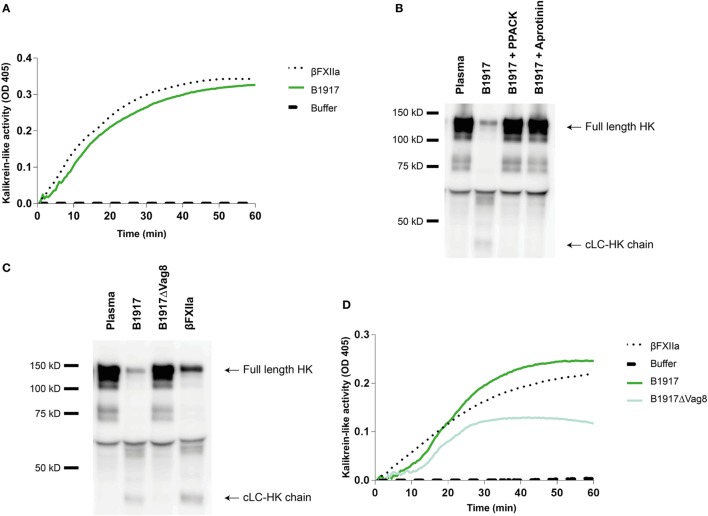
Bordetella pertussis activates the contact system mainly by Virulence associated gene 8 (Vag8) production. (A) B. pertussis wild type strain B1917 (3 × 107 CFU) induces similar kallikrein-like activity in 60% plasma compared to addition of 0.5 µg/mL βFXIIa. (B) Contact system activation by B. pertussis wild type strain B1917 was also shown by immunoblot. 50% plasma was incubated for 60 min with B. pertussis wild type strain B1917 (2 × 109 CFU) alone or in combination with the contact system inhibitors d-phenylalanyl-prolyl-arginyl chloromethyl ketone (PPACK) or aprotinin and analyzed using anti-high-molecular-weight-kininogen (HK). Incubation with B. pertussis wild type strain B1917 resulted in almost complete cleavage of the ~120 kDa full length HK as indicated by the appearance of the ~46 kDa cLC-HK chain. This feature was not observed in the presence of the inhibitors. (C) To determine whether Vag8 production was involved in contact system activation by this pathogen, 50% plasma was incubated either with B. pertussis wild type strain B1917 or with the knockout strain B1917ΔVag8 (2 × 109 CFU) and analyzed using anti-HK. The B. pertussis knockout strain B1917ΔVag8 was unable to activate the contact system as no cleavage of the ~120 kDa full length HK was detected. (D) This was also shown by the decreased kallikrein-like activity in 60% plasma upon incubation with the knockout strain B1917ΔVag8 (3 × 107 CFU) compared to the B. pertussis wild type strain B1917. Panels A–D are representative of three separate experiments.
Figure 5
Figure 5
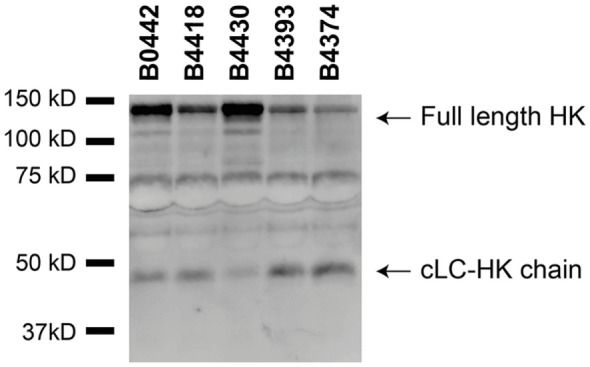
Various Bordetella pertussis strains activate the contact system. Contact system activation by B. pertussis strains B0442, B4418, B4430, B4393, and B4374 was shown by immunoblot. 50% plasma was incubated for 60 min with the B. pertussis strains (2 × 109 CFU) and analyzed using anti-high-molecular-weight-kininogen (HK). Incubation with all the B. pertussis strains resulted in cleavage of the ~120 kDa full length HK as indicated by the appearance of the ~46 kDa cLC-HK chain.
Figure 6
Figure 6
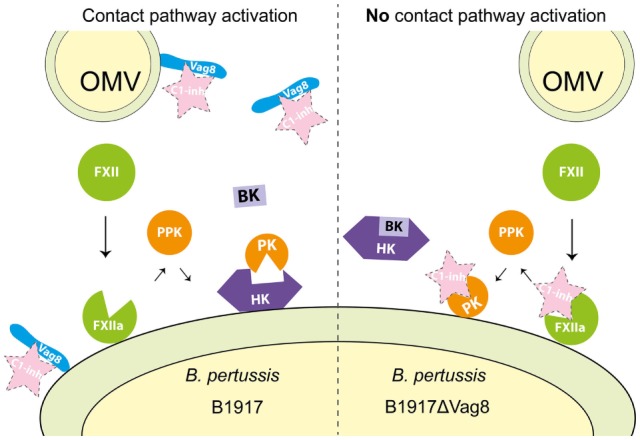
Proposed mechanism for Virulence associated gene 8 (Vag8) mediated activation of the contact system. Vag8, either on the bacterial surface as part of an outer membrane vesicles (OMVs) or as the secreted passenger, binds to complement regulator C1 inhibitor (C1-INH) (left panel). This results in the lack of inhibition of the contact system proteases FXIIa and plasma kallikrein (PK) by C1-INH. The lipooligosaccharide and polyphosphates present on the outer membrane of Bordetella pertussis are most likely responsible for FXII activation on the bacterial membrane as has been shown for other bacteria (, –42). This activation, which cannot be inhibited by C1-INH as it is bound to Vag8, will result in the release of bradykinin (BK). In the absence of Vag8, C1-INH will inhibit FXIIa and PK when formed and high-molecular-weight-kininogen (HK) will remain intact away from the bacterial surface (right panel).

References

    1. Crowcroft NS, Stein C, Duclos P, Birmingham M. How best to estimate the global burden of pertussis? Lancet Infect Dis (2003) 3(7):413–8. 10.1016/S1473-3099(03)00669-8 - DOI - PubMed
    1. Wendelboe AM, Van Rie A, Salmaso S, Englund JA. Duration of immunity against pertussis after natural infection or vaccination. Pediatr Infect Dis J (2005) 24(5 Suppl):S58–61. 10.1097/01.inf.0000160914.59160.41 - DOI - PubMed
    1. Klein NP, Bartlett J, Rowhani-Rahbar A, Fireman B, Baxter R. Waning protection after fifth dose of acellular pertussis vaccine in children. N Engl J Med (2012) 367(11):1012–9. 10.1056/NEJMoa1200850 - DOI - PubMed
    1. Warfel JM, Zimmerman LI, Merkel TJ. Acellular pertussis vaccines protect against disease but fail to prevent infection and transmission in a nonhuman primate model. Proc Natl Acad Sci U S A (2014) 111(2):787–92. 10.1073/pnas.1314688110 - DOI - PMC - PubMed
    1. Locht C. Pertussis: acellular, whole-cell, new vaccines, what to choose? Expert Rev Vaccines (2016) 15(6):671–3. 10.1586/14760584.2016.1161511 - DOI - PubMed

Publication types

MeSH terms