Prevalence of metabolic syndrome crossing 40% in Northern India: Time to act fast before it runs out of proportions
- PMID: 29915744
- PMCID: PMC5958552
- DOI: 10.4103/jfmpc.jfmpc_10_17
Prevalence of metabolic syndrome crossing 40% in Northern India: Time to act fast before it runs out of proportions
Abstract
Background: Metabolic syndrome (MetS) is a constellation of high blood pressure, hyperglycemia, obesity, and dyslipidemia. Its presence makes the patient more prone for cardiovascular events. Its prevalence has been documented as 11%-41%. The present study was undertaken to find out the demographic profile of the MetS in Kanpur region of northern India.
Materials and methods: This is a hospital based, cross-sectional study with adequate sample size.
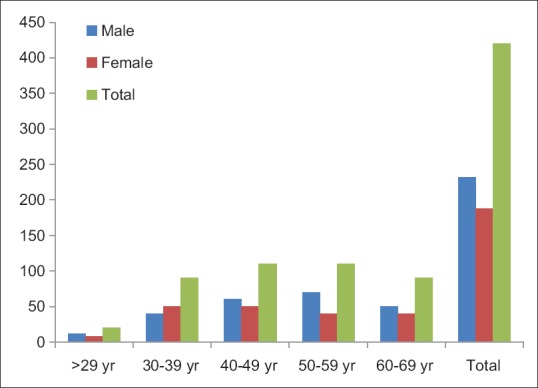
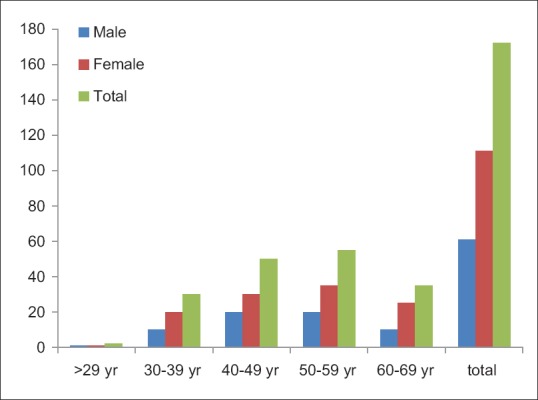
Results: Out of the randomly selected 420 patients (232 males and 188 females), 172 cases (61 males and 111 females) were found to have MeTS adopting the National Cholesterol Education Program Adult Treatment Panel III criteria. The overall prevalence of MeTS was found to be 40.9% (26.2% of total males and 59% of total females). Among the 172 cases of MeTS, females were more than males (64.5% vs. 35.4%). Maximum numbers of MeTS cases were in the age range of 50-59 years (55/172 = 31.9%) followed by 40-49 years (50/172 = 29%), >60 years (35/172 = 20.3%), 30-39 years (30/172 = 17.4%), and <30 years (2/172 = 1.1%). In the total study population of 420 cases, hyperglycemia was the most common (29.2%) and hyperglycemia, obesity, and high triglyceride were significantly higher prevalence in females. Among the participants of 111 cases of MeTS, hyperglycemia was the most common (71.5%) and high blood pressure, and low high density lipoprotein was significantly higher among males.
Conclusion: The prevalence of MetS was more than 40% and its prevalence in <40 years age group is rapidly increasing. Its high time to be more active physically, before fatal cardiovascular events.
Keywords: Dyslipidemia; hypertension; metabolic syndrome; obesity.
Conflict of interest statement
There are no conflicts of interest.
Figures
References
-
- Shaw JE, Chisholm DJ. Epidemiology and prevention of type 2 diabetes and the metabolic syndrome. Med J Aust. 2003;179:379–83. - PubMed
-
- Alberti KG, Eckel RH, Grundy SM, Zimmet PZ, Cleeman JI, Donato KA, et al. Harmonizing the metabolic syndrome: A joint interim statement of the International Diabetes Federation Task Force on Epidemiology and Prevention; National Heart, Lung, and Blood Institute; American Heart Association; World Heart Federation; International Atherosclerosis Society; and International Association for the Study of Obesity. Circulation. 2009;120:1640–5. - PubMed
-
- Alberti KG, Zimmet P, Shaw J IDF Epidemiology Task Force Consensus Group. The metabolic syndrome – A new worldwide definition. Lancet. 2005;366:1059–62. - PubMed
-
- Olijhoek JK, van der Graaf Y, Banga JD, Algra A, Rabelink TJ, Visseren FL, et al. The metabolic syndrome is associated with advanced vascular damage in patients with coronary heart disease, stroke, peripheral arterial disease or abdominal aortic aneurysm. Eur Heart J. 2004;25:342–8. - PubMed
-
- Grundy SM, Cleeman JI, Daniels SR, Donato KA, Eckel RH, Franklin BA, et al. Diagnosis and management of the metabolic syndrome: An American Heart Association/National Heart, Lung, and Blood Institute Scientific Statement. Circulation. 2005;112:2735–52. - PubMed
LinkOut - more resources
Full Text Sources
Other Literature Sources