


Clinical phenotypes and outcomes of pulmonary hypertension due to left heart disease: Role of the pre-capillary component
- PMID: 29920539
- PMCID: PMC6007912
- DOI: 10.1371/journal.pone.0199164
Clinical phenotypes and outcomes of pulmonary hypertension due to left heart disease: Role of the pre-capillary component
Abstract
Background: In pulmonary hypertension (PH), both wedge pressure elevation (PAWP) and a precapillary component may affect right ventricular (RV) afterload. These changes may contribute to RV failure and prognosis. We aimed at describing the different haemodynamic phenotypes of patients with PH due to left heart disease (LHD) and at characterizing the impact of pulmonary haemodynamics on RV function and outcome PH-LHD.
Methods: Patients with PH-LHD were compared with treatment-naïve idiopathic/heritable pulmonary arterial hypertension (PAH, n = 35). PH-LHD patients were subdivided in Isolated post-capillary PH (IpcPH: diastolic pressure gradient, DPG<7 mmHg and pulmonary vascular resistance, PVR≤3 WU, n = 37), Combined post- and pre-capillary PH (CpcPH: DPG≥7 mmHg and PVR>3 WU, n = 27), and "intermediate" PH-LHD (either DPG <7 mmHg or PVR ≤3 WU, n = 29).
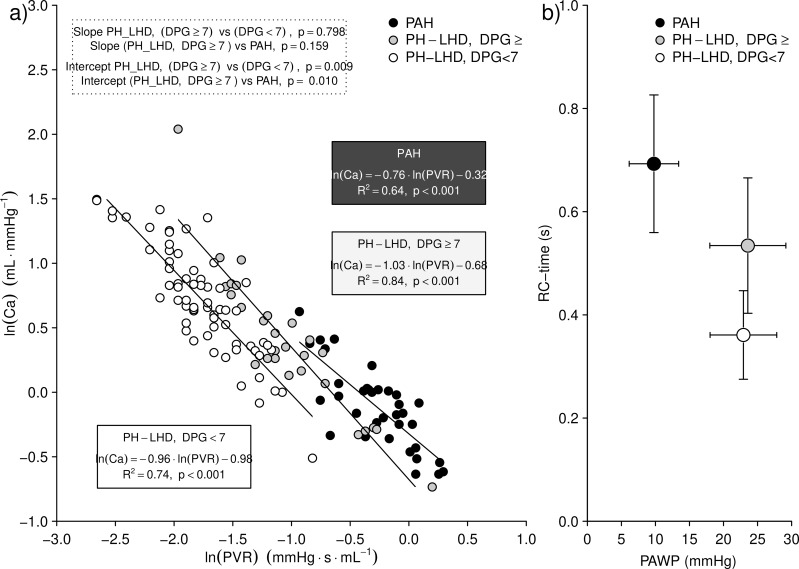
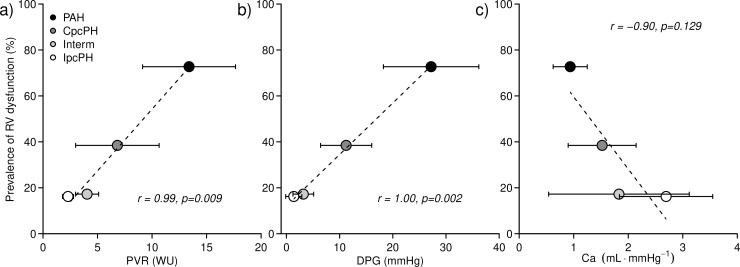
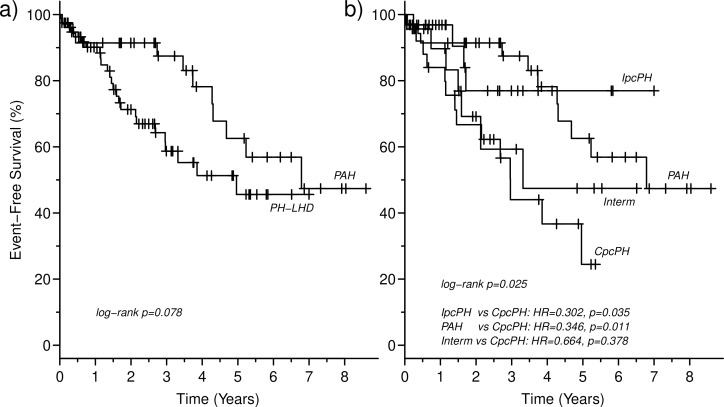
Results: Despite similar PAWP and cardiac index, haemodynamic severity and prevalence of RV dysfunction increased from IpcPH, to "intermediate" and CpcPH. PVR and DPG (but not compliance, Ca) were linearly correlated with RV dysfunction. CpcPH had worse prognosis (p<0.05) than IpcPH and PAH, but similar to "intermediate" patients. Only NTproBNP and Ca independently predicted survival in PH-LHD.
Conclusions: In PH-LHD, haemodynamic characterization according to DPG and PVR provides important information on disease severity, predisposition to RV failure and prognosis. Patients presenting the CpcPH phenotype appear to have haemodynamic profile closer to PAH but with worse prognosis. In PH-LHD, Ca and NTproBNP were independent predictors of survival.
Conflict of interest statement
JLV is the holder of the Actelion Research Chair on Pulmonary Hypertension in his department. SC is the recipient of a ERS PAH Short-Term Research Training Fellowship (STRTF 2014-5264) supported by an unrestricted grant by GSK, and of the international grant “Cesare Bartorelli” for the year 2014 funded by the Italian Society of Hypertension. This does not alter our adherence to PLOS ONE policies on sharing data and materials. None of the other authors has a financial relationship with a commercial entity that has an interest in the subject of the present manuscript or other conflicts of interest to disclose.
Figures
References
-
- Galiè N, Humbert M, Vachiery JL, Gibbs S, Lang I, Torbicki A, et al. 2015 ESC/ERS Guidelines for the diagnosis and treatment of pulmonary hypertension: The Joint Task Force for the Diagnosis and Treatment of Pulmonary Hypertension of the European Society of Cardiology (ESC) and the European Respiratory Society (ERS): Endorsed by: Association for European Paediatric and Congenital Cardiology (AEPC), International Society for Heart and Lung Transplantation (ISHLT). Eur Respir J 2015; 46:903–75 doi: 10.1183/13993003.01032-2015 - DOI - PubMed
-
- Vachiéry JL, Adir Y, Barberà JA, Champion H, Coghlan JG, Cottin V, et al. Pulmonary hypertension due to left heart diseases. J Am Coll Cardiol 2013;62:D100–8 doi: 10.1016/j.jacc.2013.10.033 - DOI - PubMed
-
- Naeije R, Vachiery JL, Yerly P, Vanderpool R. The transpulmonary pressure gradient for the diagnosis of pulmonary vascular disease. Eur Respir J 2013;41:217–23 doi: 10.1183/09031936.00074312 - DOI - PubMed
-
- Gerges C, Gerges M, Lang MB, Zhang Y, Jakowitsch J, Probst P, et al. Diastolic pulmonary vascular pressure gradient: a predictor of prognosis in "out-of-proportion" pulmonary hypertension. Chest 2013;143:758–66. doi: 10.1378/chest.12-1653 - DOI - PubMed
-
- Gerges M, Gerges C, Lang IM. How to define pulmonary hypertension due to left heart disease. Eur Respir J 2016; 48(2):553–5 doi: 10.1183/13993003.00432-2016 - DOI - PubMed
Publication types
MeSH terms
Substances
LinkOut - more resources
Full Text Sources
Other Literature Sources
Medical
Research Materials
