


Mothers' and fathers' mind-mindedness influences physiological emotion regulation of infants across the first year of life
- PMID: 29920863
- PMCID: PMC6220880
- DOI: 10.1111/desc.12689
Mothers' and fathers' mind-mindedness influences physiological emotion regulation of infants across the first year of life
Abstract
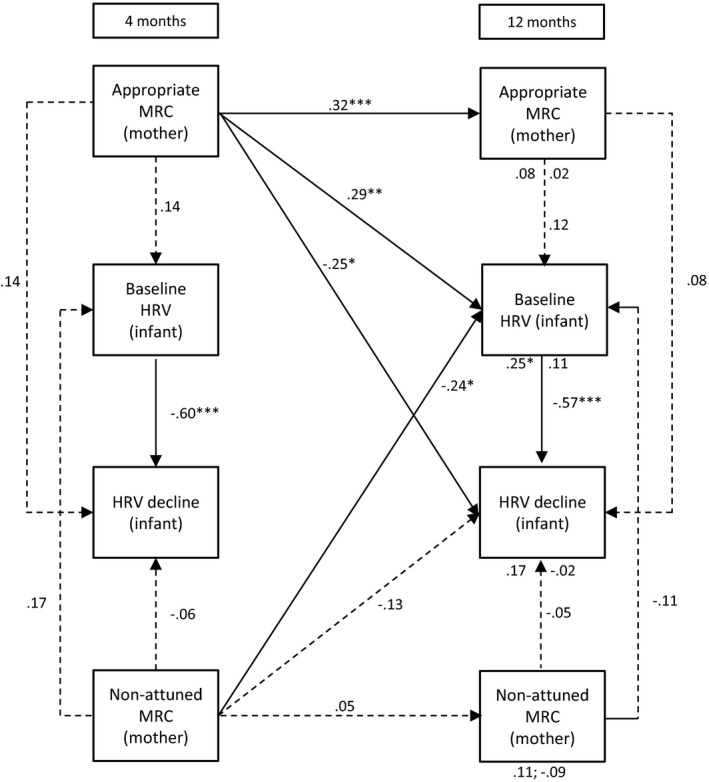
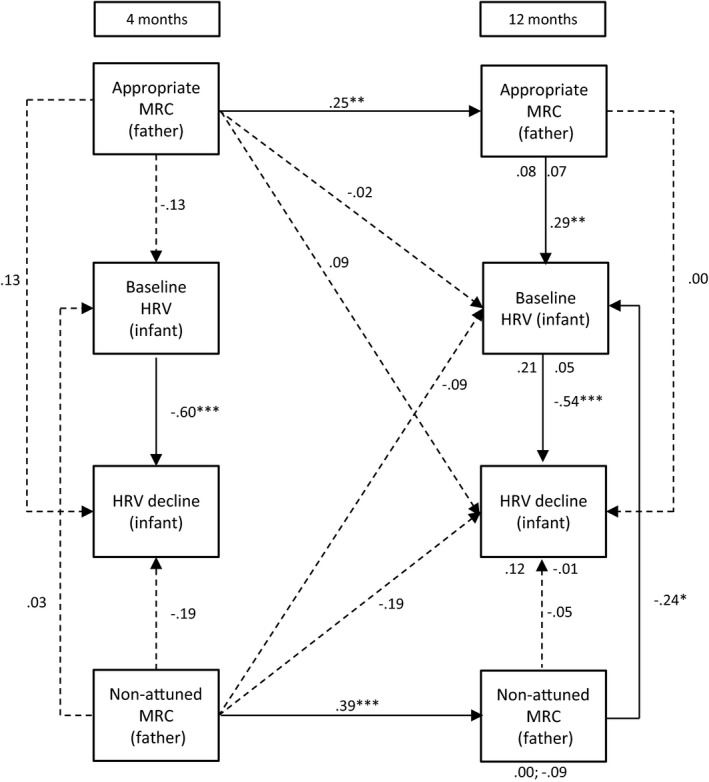
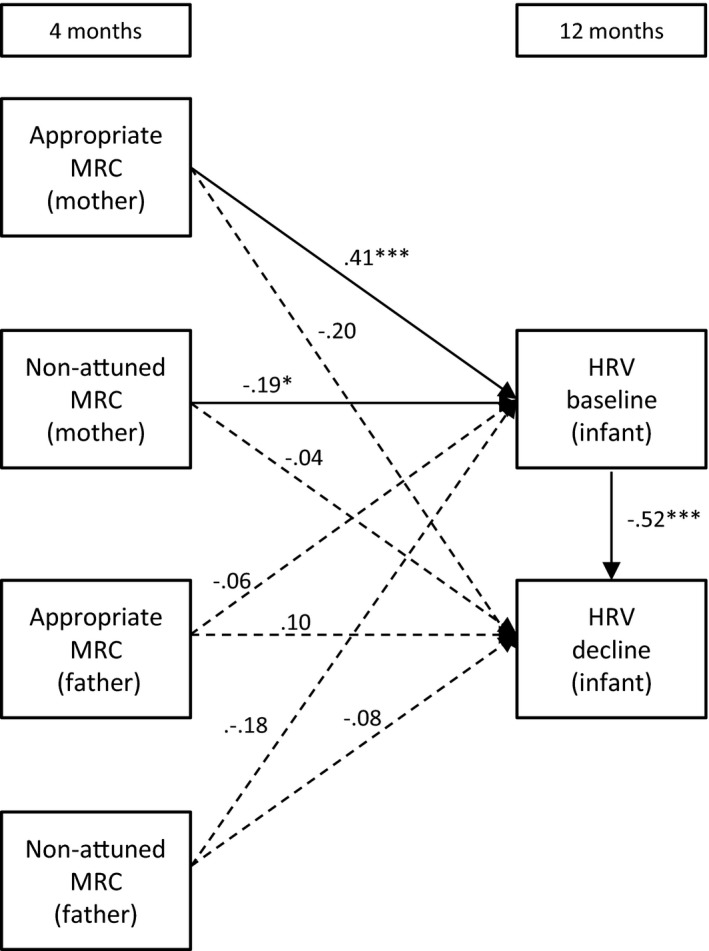
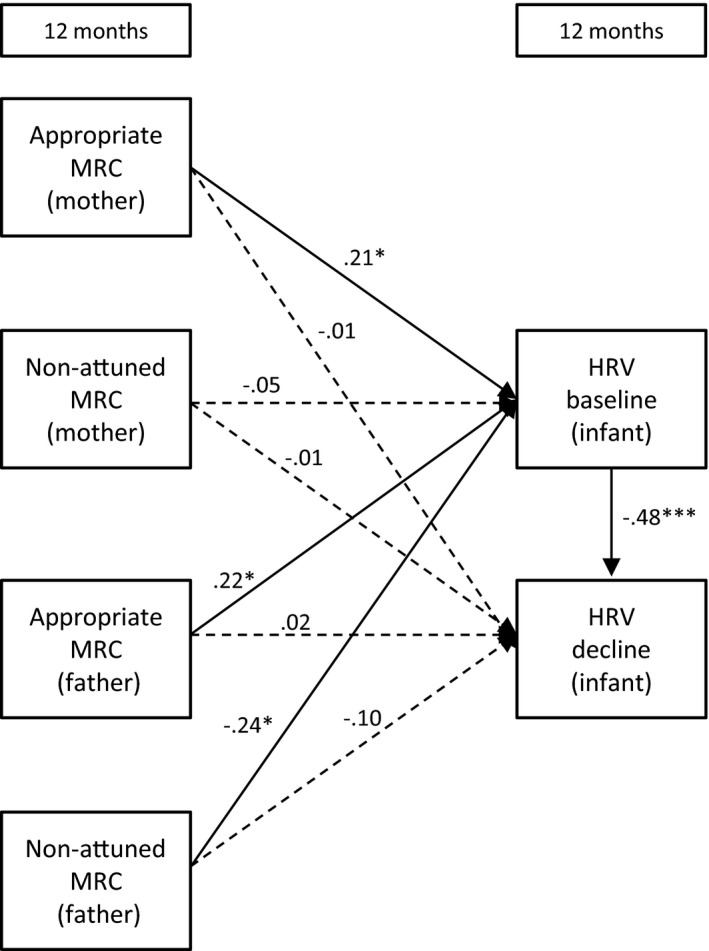
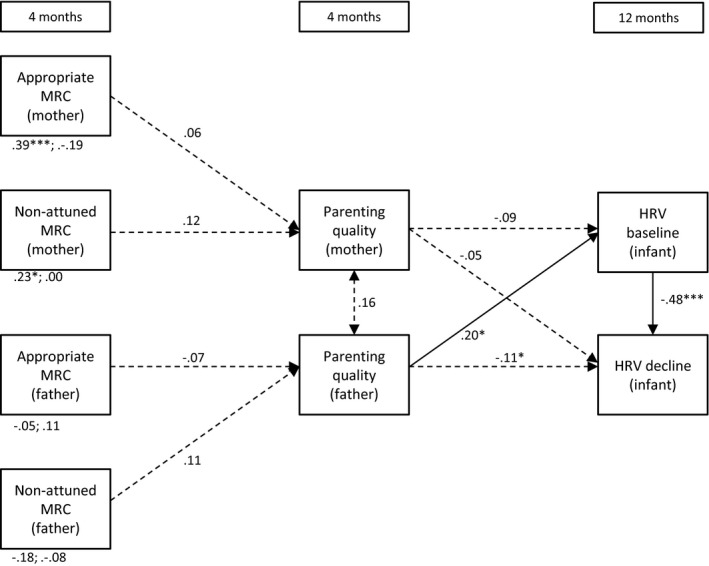
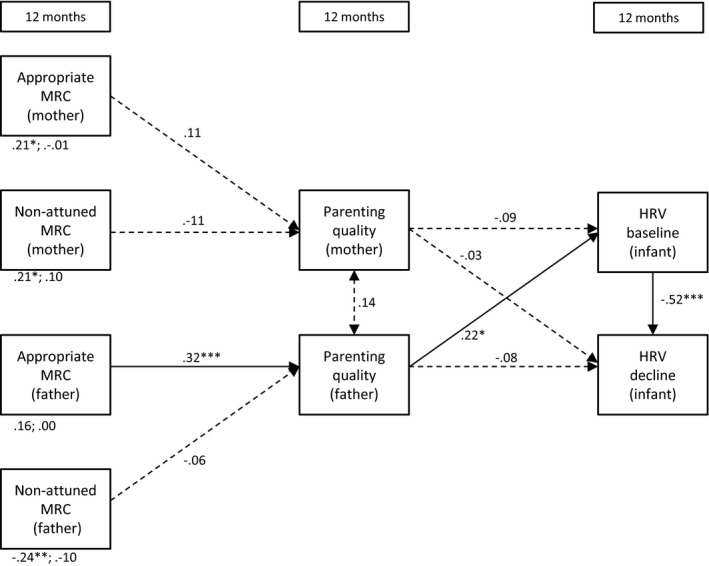
The main aim of this study was to test whether mothers' (n = 116) and fathers' (n = 116) mind-mindedness predicts infants' physiological emotion regulation (heart rate variability; HRV) across the first year of life. Three hypotheses were examined: (a) parents' mind-mindedness at 4 and 12 months predicts infants' HRV at 12 months over and above infants' initial HRV levels at 4 months, (b) mothers' and fathers' mind-mindedness independently predict infant HRV, and (c) the effects of mind-mindedness on infant HRV (partially) operate via parenting behaviour. Infants' HRV was assessed during rest and a stranger approach. Mind-mindedness was assessed by calculating the proportions of appropriate and non-attuned mind-related comments during free-play interactions, and parenting quality was observed at 4 and 12 months in the same interactions. Path analyses showed that mothers' appropriate mind-related comments at 4 and 12 months predicted higher baseline HRV at 12 months, whereas mothers' non-attuned comments predicted lower baseline HRV at 12 months. Similar, but concurrent, relations were found for fathers' appropriate and non-attuned mind-related comments and infant baseline HRV at 12 months. In addition, fathers' appropriate mind-related comments showed an indirect association with infant baseline HRV at 12 months via fathers' parenting quality. With regard to infant HRV reactivity during the stranger approach, mothers' appropriate mind-related comments at 4 months and fathers' non-attuned mind-related comments at 12 months predicted a larger HRV decline during the stranger approach at 12 months. Infants' HRV at 4 months did not predict parents' later mind-mindedness. The results indicate that mothers' and fathers' appropriate and non-attuned mind-related speech uniquely impacts the development of infants' physiological emotion regulation.
© 2018 The Authors. Developmental Science Published by John Wiley & Sons Ltd.
Figures
References
-
- Ainsworth, M.D.S. , Bell, S.M. , & Stayton, D.J. (1974). Infant–mother attachment and social development: Socialisation as a product of reciprocal responsiveness to signals In Richards M.P.M. (Ed.), The introduction of the child into a social world (pp. 99–135). Cambridge: Cambridge University Press.
-
- Appelhans, B.M. , & Luecken, L.J. (2006). Heart rate variability as an index of regulated emotional responding. Review of General Psychology, 10, 229–240.
-
- Arnott, B. , & Meins, E. (2007). Links among antenatal attachment representations, postnatal mind‐mindedness, and infant attachment security: A preliminary study of mothers and fathers. Bulletin of the Menninger Clinic, 71, 132–149. - PubMed
-
- Bar‐Haim, Y. , Marshall, P.J. , & Fox, N.A. (2000). Developmental changes in heart period and high‐frequency heart period variability from 4 months to 4 years of age. Developmental Psychobiology, 37, 44–56. - PubMed
-
- Bates, E. (2014). The emergence of symbols: Cognition and communication in infancy. New York: Academic Press.
MeSH terms
LinkOut - more resources
Full Text Sources
Other Literature Sources
