. 2019 Feb;19(2):488-500.
doi: 10.1111/ajt.14974. Epub 2018 Jul 21.

Gut microbiota dysbiosis and diarrhea in kidney transplant recipients

Affiliations

Gut microbiota dysbiosis and diarrhea in kidney transplant recipients

John Richard Lee et al. Am J Transplant. 2019 Feb.

Abstract

Posttransplant diarrhea is associated with kidney allograft failure and death, but its etiology remains unknown in the majority of cases. Because altered gut microbial ecology is a potential basis for diarrhea, we investigated whether posttransplant diarrhea is associated with gut dysbiosis. We enrolled 71 kidney allograft recipients for serial fecal specimen collections in the first 3 months of transplantation and profiled the gut microbiota using 16S ribosomal RNA (rRNA) gene V4-V5 deep sequencing. The Shannon diversity index was significantly lower in 28 diarrheal fecal specimens from 25 recipients with posttransplant diarrhea than in 112 fecal specimens from 46 recipients without posttransplant diarrhea. We found a lower relative abundance of 13 commensal genera (Benjamini-Hochberg adjusted P ≤ .15) in the diarrheal fecal specimens including the same 4 genera identified in our prior study. The 28 diarrheal fecal specimens were also evaluated by a multiplexed polymerase chain reaction (PCR) assay for 22 bacterial, viral, and protozoan gastrointestinal pathogens, and 26 specimens were negative for infectious etiologies. Using PICRUSt (Phylogenetic Investigation of Communities by Reconstruction of Unobserved States) to predict metagenomic functions, we found that diarrheal fecal specimens had a lower abundance of metabolic genes. Our findings suggest that posttransplant diarrhea is not associated with common infectious diarrheal pathogens but with a gut dysbiosis.

Keywords: complication: medical/metabolic; diarrhea; gut microbiota; kidney disease; kidney transplantation/nephrology; microbiomics; translational research/science.


Conflict of interest statement

DISCLOSURE

The authors of this manuscript have conflicts of interest to disclose as described by the American Journal of Transplantation. Carl Crawford receives support from MERCK, Rebiotix, and Seres. Lars Westblade receives research support from Accelerate Diagnostics, Inc. The other authors have no conflicts of interest to disclose.

Figures
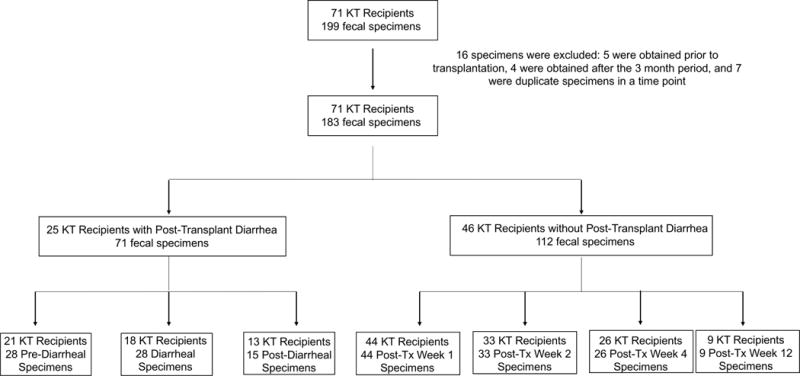
Figure 1
Figure 1. Flow Chart of the Profiled Fecal Specimens from the Diarrhea Group and the No Diarrhea Group
Seventy-one kidney transplant recipients provided 199 fecal specimens and 183 fecal specimens were analyzed. 25 kidney transplant recipients developed post-transplant diarrhea (Diarrhea Group) in the first 3 months following kidney transplantation and provided 71 fecal specimens which were classified as pre-diarrheal specimens, diarrheal specimens (collected at the time of a diarrheal episode), or post-diarrheal specimens. Forty-six kidney transplant recipients did not develop post-transplant diarrhea within the first 3 months of transplantation (No Diarrhea Group) and provided 112 fecal specimens which were collected during post-transplant week 1, post-transplant week 2, post-transplant week 4, or post-transplant week 12. KT: Kidney Transplant.
Figure 2
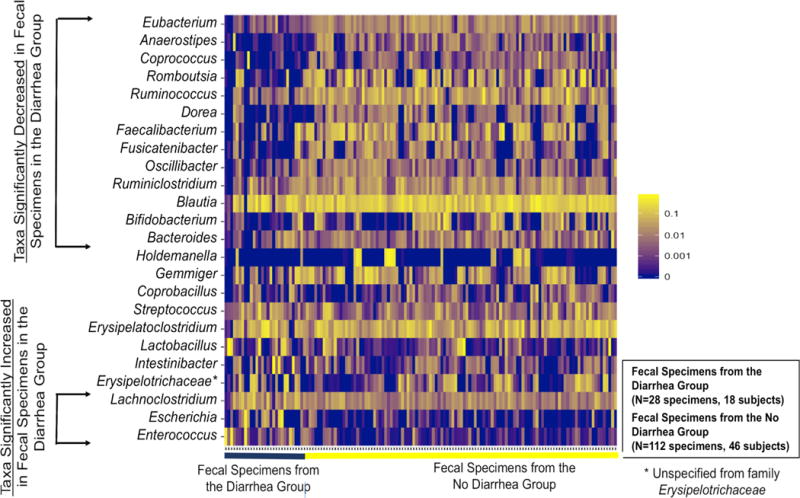
Figure 2. Heatmap of the Most Abundant Bacterial Genera by Diarrhea Group Status
On the x-axis are the 140 fecal specimens ordered by the 28 diarrheal fecal specimens from the 18 subjects in the Diarrhea Group (black line) and the 112 fecal specimens from the 46 subjects in the No Diarrhea Group (yellow line). On the y-axis are the top 24 genera with a >1% mean relative microbial abundance. The 13 genera significantly lower in the diarrheal fecal specimens compared to fecal specimens from the No Diarrhea Group are represented at the top portion of the y-axis (in order of significance) and the 3 genera significantly higher in the diarrheal fecal specimens compared to fecal specimens from the No Diarrhea Group are represented at the bottom portion of the y-axis (in order of significance). The intensity of the yellow color represents the relative abundance and is log-scaled.
Figure 3
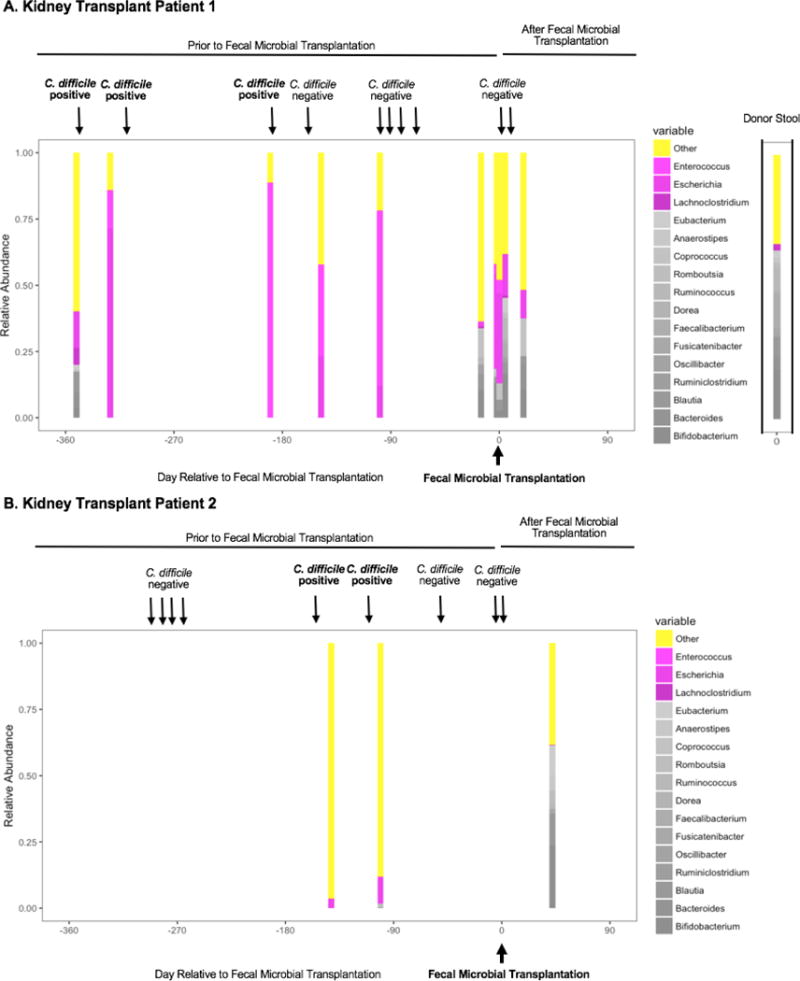
Figure 3. Serial Microbiome Profiles Before and After Fecal Microbial Transplantation in 2 Kidney Transplant Recipients with Recurrent Episodes of Diarrhea
Each panel represents a unique patient with each bar within the panel representing the microbiome profile in a single stool specimen. On the x axis, day 0 is the day the patient underwent fecal microbial transplantation (FMT); the relative abundances (y axis) of the 13 taxa that are decreased in diarrheal fecal specimens (Gray), the relative abundances of the 3 taxa that are increased in the diarrheal fecal specimens (Magenta), and the relative abundance of all other taxa (Yellow) are shown. The donor microbiome profile is shown to the right of Patient 1. Testing for C. difficile toxin B by PCR assay (Xpert® C. difficile/Epi, Cepheid, Sunnyvale, CA) is indicated by arrows above the graph. Following FMT from an allogeneic donor, the relative abundance of the 13 taxa that are significantly lower in the diarrheal fecal specimens together increased after FMT whereas the relative abundance of the 3 taxa that are significantly higher in the diarrheal fecal specimens together decreased after FMT.
Figure 4
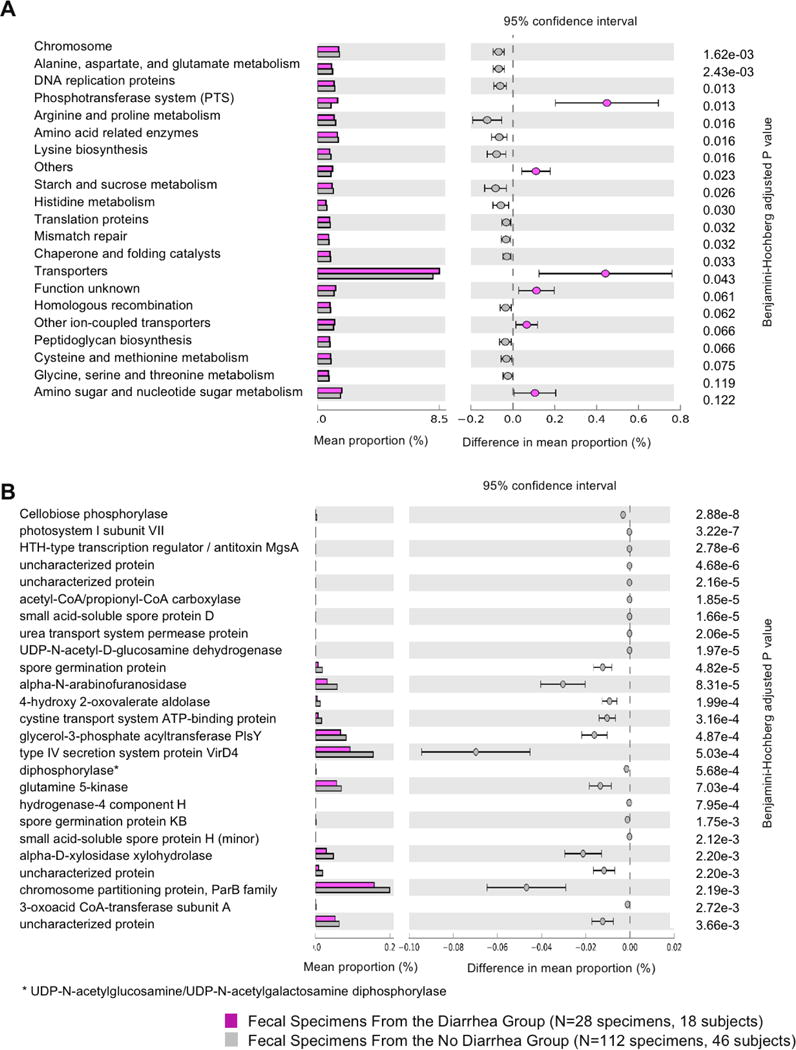
Figure 4. Metabolic Pathways and Bacterial Genes Distinguishing the Diarrheal Fecal Specimens from the Fecal Specimens in the No Diarrhea Group
PICRUSt analysis was performed on the 28 diarrheal fecal specimens from the 18 subjects in the Diarrhea Group and the 112 fecal specimens from the 46 subjects in the No Diarrhea Group. Panel A. The top 21 metabolic KEGG 3 pathways significantly different between the diarrheal fecal specimens and the fecal specimens from the No Diarrhea Group are shown. On the left are the relative mean abundances of the different KEGG pathways with the diarrheal fecal specimens in magenta and the fecal specimens in the No Diarrhea Group in gray. On the right are the mean differences between the diarrheal fecal specimens and the fecal specimens in the No Diarrhea Group, by KEGG pathways, with the magenta point representing a significantly higher abundance in the diarrheal fecal specimens and the gray point representing a significantly higher abundance in the fecal specimens in the No Diarrhea Group. Each point is accompanied by a 95% confidence interval indicated by the error bars. The metabolic pathways are sorted by BH adjusted p value. Panel B. The top 25 genes significantly different between the diarrheal fecal specimens and the fecal specimens from the No Diarrhea Group are shown. On the left are the relative mean abundances of the different genes with the diarrheal fecal specimens in magenta and the fecal specimens in the No Diarrhea Group in gray. On the right are the mean differences between the diarrheal fecal specimens and the fecal specimens in the No Diarrhea Group, by bacterial genes, with the gray points representing a significantly higher abundance in the fecal specimens in the No Diarrhea Group. Each point is accompanied by a 95% confidence interval indicated by the error bars. The genes are sorted by BH adjusted p value.

References

    1. Mycophenolate mofetil in renal transplantation: 3-year results from the placebo-controlled trial. European Mycophenolate Mofetil Cooperative Study Group. Transplantation. 1999;68(3):391–396. - PubMed
    1. Ekberg H, Kyllonen L, Madsen S, Grave G, Solbu D, Holdaas H. Increased prevalence of gastrointestinal symptoms associated with impaired quality of life in renal transplant recipients. Transplantation. 2007;83(3):282–289. - PubMed
    1. Bunnapradist S, Neri L, Wong W, Lentine KL, Burroughs TE, Pinsky BW, et al. Incidence and risk factors for diarrhea following kidney transplantation and association with graft loss and mortality. American journal of kidney diseases: the official journal of the National Kidney Foundation. 2008;51(3):478–486. - PubMed
    1. Aulagnon F, Scemla A, DeWolf S, Legendre C, Zuber J. Diarrhea after kidney transplantation: a new look at a frequent symptom. Transplantation. 2014;98(8):806–816. - PubMed
    1. Bunnapradist S, Lentine KL, Burroughs TE, Pinsky BW, Hardinger KL, Brennan DC, et al. Mycophenolate mofetil dose reductions and discontinuations after gastrointestinal complications are associated with renal transplant graft failure. Transplantation. 2006;82(1):102–107. - PubMed

Publication types

MeSH terms

Substances