


Depression and the relationship between sleep disturbances, nightmares, and suicidal ideation in treatment-seeking Canadian Armed Forces members and veterans
- PMID: 29921268
- PMCID: PMC6011186
- DOI: 10.1186/s12888-018-1782-z
Depression and the relationship between sleep disturbances, nightmares, and suicidal ideation in treatment-seeking Canadian Armed Forces members and veterans
Abstract
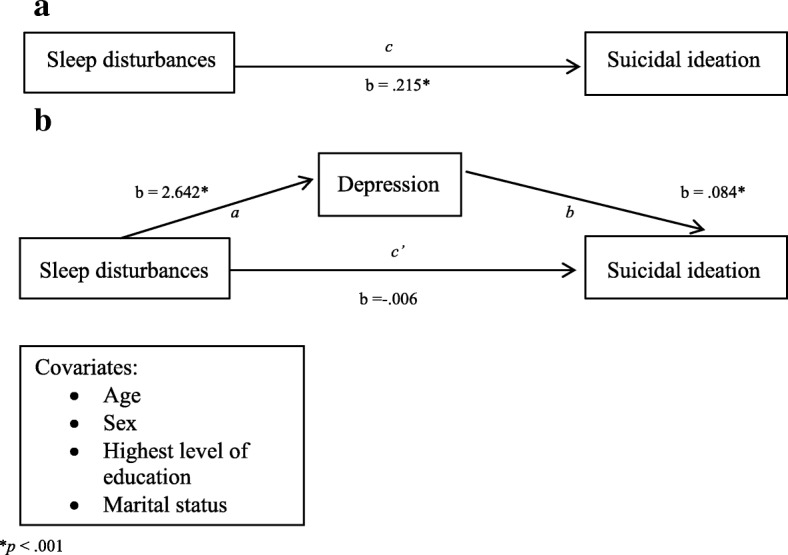
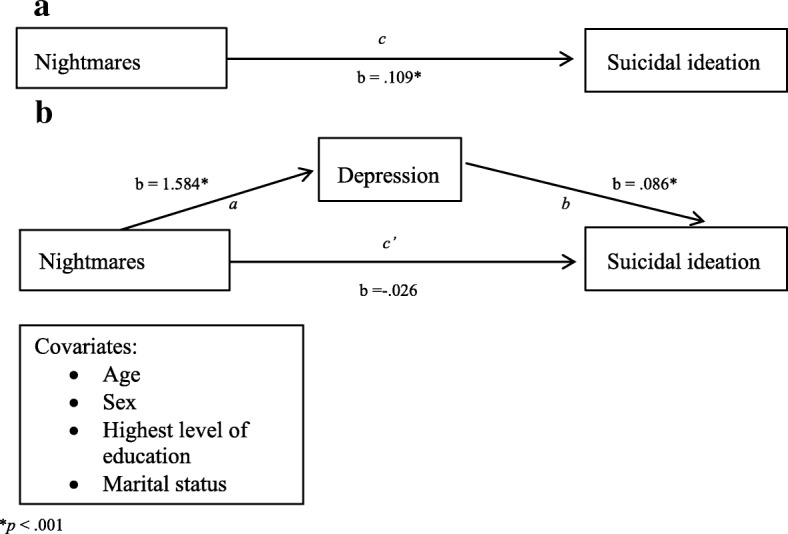
Background: Research on the relationship between insomnia and nightmares, and suicidal ideation (SI) has produced variable findings, especially with regard to military samples. This study investigates whether depression mediated the relationship between: 1) sleep disturbances and SI, and 2) trauma-related nightmares and SI, in a sample of treatment-seeking Canadian Armed Forces (CAF) personnel and veterans (N = 663).
Method: Regression analyses were used to investigate associations between sleep disturbances or trauma-related nightmares and SI while controlling for depressive symptom severity, posttraumatic stress disorder (PTSD) symptom severity, anxiety symptom severity, and alcohol use severity. Bootstrapped resampling analyses were used to investigate the mediating effect of depression.
Results: Approximately two-thirds of the sample (68%; N = 400) endorsed sleep disturbances and 88% (N = 516) reported experiencing trauma-related nightmares. Although sleep disturbances and trauma-related nightmares were both significantly associated with SI on their own, these relationships were no longer significant when other psychiatric conditions were included in the models. Instead, depressive symptom severity emerged as the only variable significantly associated with SI in both equations. Bootstrap resampling analyses confirmed a significant mediating role of depression for sleep disturbances.
Conclusions: The findings suggest that sleep disturbances and trauma-related nightmares are associated with SI as a function of depressive symptoms in treatment-seeking CAF personnel and veterans. Treating depression in patients who present with sleep difficulties may subsequently help mitigate suicide risk.
Keywords: Canadian armed forces; Insomnia; Major depressive disorder; Nightmares; Posttraumatic stress disorder; Suicide.
Conflict of interest statement
Ethics approval and consent to participate
This research was approved by the Health Sciences Research Ethics Board at Western University, as well as the Lawson Health Research Institute. All participants provided written informed consent for their data to be included in the study.
Consent for publication
N/A
Competing interests
The authors declare that they have no competing interests.
Publisher’s Note
Springer Nature remains neutral with regard to jurisdictional claims in published maps and institutional affiliations.
Figures
References
-
- Tanielian T, Karney BR, Chandra A, Meadows SO. The deployment life study: methodological overview and baseline sample description. Santa Monica, CA: RAND Corporation; 2014.
MeSH terms
LinkOut - more resources
Full Text Sources
Other Literature Sources
Medical
