


Contribution of physician assistants/associates to secondary care: a systematic review
- PMID: 29921680
- PMCID: PMC6020983
- DOI: 10.1136/bmjopen-2017-019573
Contribution of physician assistants/associates to secondary care: a systematic review
Abstract
Objective: To appraise and synthesise research on the impact of physician assistants/associates (PA) in secondary care, specifically acute internal medicine, care of the elderly, emergency medicine, trauma and orthopaedics, and mental health.
Design: Systematic review.
Setting: Electronic databases (Medline, Embase, ASSIA, CINAHL, SCOPUS, PsycINFO, Social Policy and Practice, EconLit and Cochrane), reference lists and related articles.
Included articles: Peer-reviewed articles of any study design, published in English, 1995-2017.
Interventions: Blinded parallel processes were used to screen abstracts and full text, data extractions and quality assessments against published guidelines. A narrative synthesis was undertaken.
Outcome measures: Impact on: patients' experiences and outcomes, service organisation, working practices, other professional groups and costs.
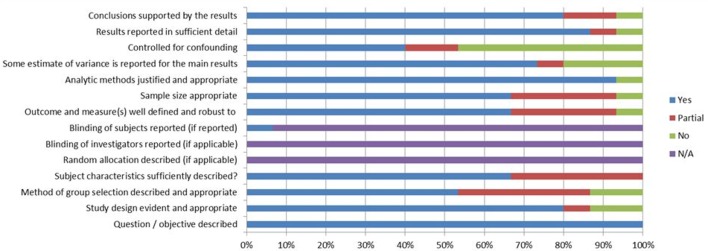
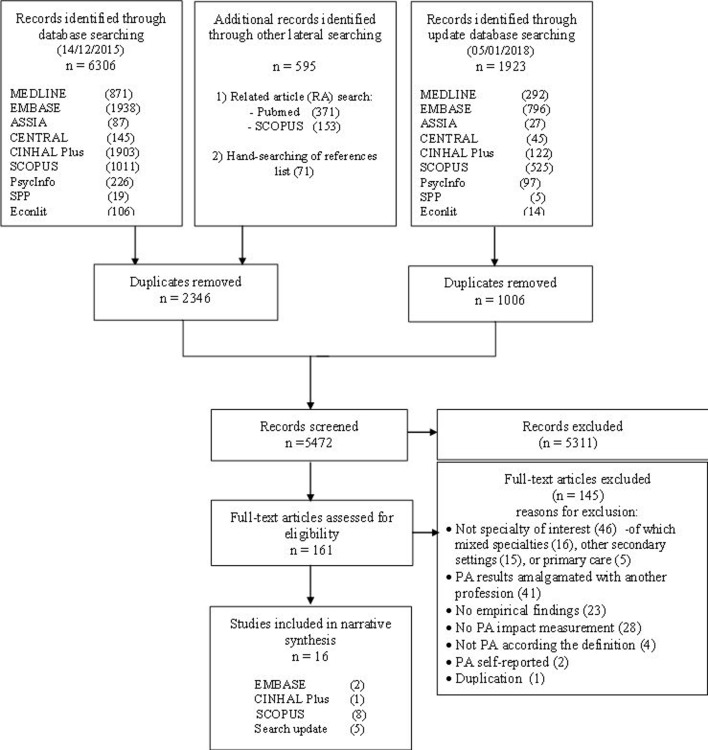
Results: 5472 references were identified and 161 read in full; 16 were included-emergency medicine (7), trauma and orthopaedics (6), acute internal medicine (2), mental health (1) and care of the elderly (0). All studies were observational, with variable methodological quality. In emergency medicine and in trauma and orthopaedics, when PAs are added to teams, reduced waiting and process times, lower charges, equivalent readmission rate and good acceptability to staff and patients are reported. Analgesia prescribing, operative complications and mortality outcomes were variable. In internal medicine outcomes of care provided by PAs and doctors were equivalent.
Conclusions: PAs have been deployed to increase the capacity of a team, enabling gains in waiting time, throughput, continuity and medical cover. When PAs were compared with medical staff, reassuringly there was little or no negative effect on health outcomes or cost. The difficulty of attributing cause and effect in complex systems where work is organised in teams is highlighted. Further rigorous evaluation is required to address the complexity of the PA role, reporting on more than one setting, and including comparison between PAs and roles for which they are substituting.
Prospero registration number: CRD42016032895.
Keywords: general medicine (see internal medicine); physician assistant; quality in health care.
© Article author(s) (or their employer(s) unless otherwise stated in the text of the article) 2018. All rights reserved. No commercial use is permitted unless otherwise expressly granted.
Conflict of interest statement
Competing interests: SL: University of Surrey runs a Physician Associate course. JP: chairs the UK and Ireland Board for Physician Associate Education and is the director of the Physician Associate programme at the University of Birmingham.
Figures
References
-
- World Health Organisation Global strategy on human resources for health: Workforce 2030. Draft (2015) 2016. (accessed 12 Nov 2016) http://www.who.int/hrh/resources/pub_globstrathrh-2030/en/
-
- World Health Organisation. Task shifting: rational redistribution of tasks among health workforce teams - global recommendations and guidelines. Geneva: World Health Organisation, 2008.
-
- NCCPA. 2016 Statistical profile of certified physician assistants an annual report of the national commission on certification of physician assistants: NCCPA, 2017. https://prodcmsstoragesa.blob.core.windows.net/uploads/files/2016Statist... (accessed 25 Jun 2018).
-
- AAPA. What is a PA? https://www.aapa.org/what-is-a-pa/ (accessed 22 Mar 2017).
Publication types
MeSH terms
Grants and funding
LinkOut - more resources
Full Text Sources
Other Literature Sources
